Arena District in Columbus in Franklin County, Ohio — The American Midwest (Great Lakes)
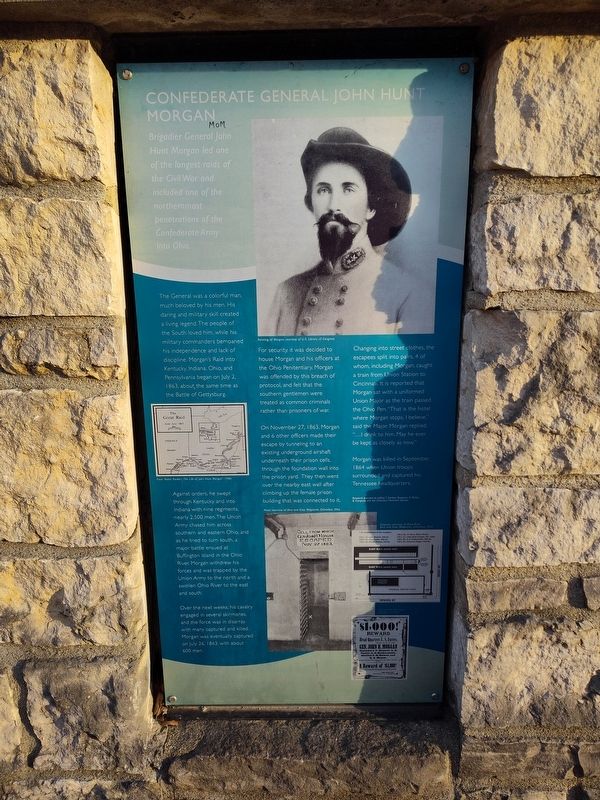
Confederate General John Hunt
Photographed by Craig Doda, April 11, 2026
1. Confederate General John Hunt Marker
Brigadier General John Hunt Morgan led one of the longest raids of the Civil War and included one of the northernmost penetrations of the Confederate Army into Ohio.
The General was a colorful man, much beloved by his men. His daring and military skill created a living legend. The people of the South loved him, while his military commanders bemoaned his independence and lack of discipline. Morgan's Raid into Kentucky, Indiana, Ohio, and Pennsylvania began on July 2, 1863, about the same time as the Battle of Gettysburg.
Against orders, he swept through Kentucky and into Indiana with nine regiments, nearly 2,500 men. The Union Army chased him across southern and eastern Ohio, and as he tried to turn south, a major battle ensued at Buffington Island in the Ohio River. Morgan withdrew his forces and was trapped by the Union Army to the north and a swollen Ohio River to the east and south.
Over the next weeks, his cavalry engaged in several skirmishes, and the force was in disarray with many captured and killed. Morgan was eventually captured on July 26, 1863, with about 600 men.
For security, it was decided to house
this page online
On November 27, 1863, Morgan and 6 other officers made their escape by tunneling to an existing underground airshaft underneath their prison cells, through the foundation wall into the prison yard. They then went over the nearby east wall after climbing up the female prison building that was connected to it.
Changing into street clothes, the escapees split into pairs, 4 of whom, including Morgan, caught a train from Union Station to Cincinnati. It is reported that Morgan sat with a uniformed Union Major as the train passed the Ohio Pen. "That is the hotel where Morgan stops, I believe," said the Major. Morgan replied, "...I drink to him. May he ever be kept as closely as now."
Morgan was killed in September 1864 when Union troops surrounded and captured his Tennessee headquarters.
Topics. This historical marker is listed in this topic list: War, US Civil. A significant historical date for this entry is July 2, 1863.
Location. 39° 57.938′ N, 83° 0.452′ W.
Photographed by Craig Doda, April 11, 2026
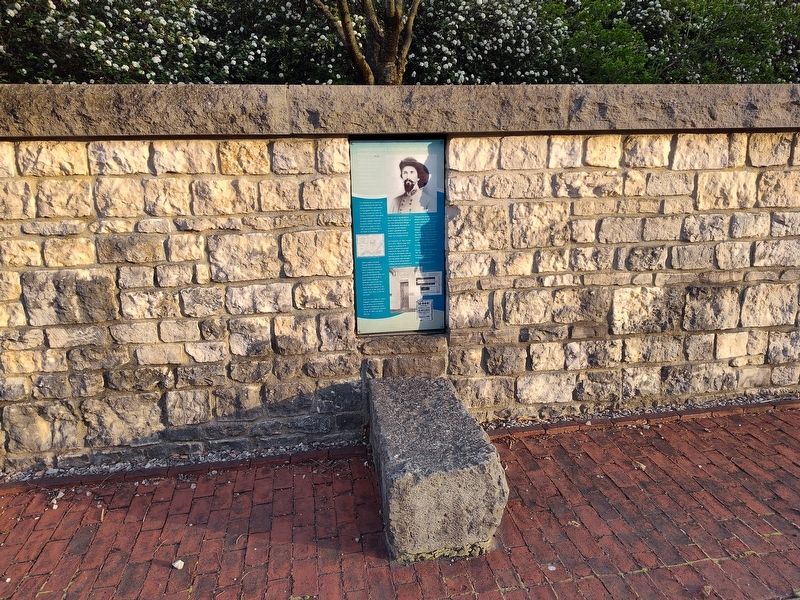
2. Confederate General John Hunt Marker

Regionally, this marker is in Ohio’s Scioto Valley. It is also in the American Midwest and in the Corn Belt. Globally, it is in North America, the Western Hemisphere, the Western World, and the Anglosphere. Historically, it finds itself in what was once the Haudenosaunee (Iroquois) Confederacy, the territory of the Mississippian Culture, and the Northwest Territory.
Other nearby markers. At least 8 other markers are within walking distance of this marker: The Ohio Penitentiary (here, next to this marker); Tragedy and the Demise of the Ohio Penitentiary (a few steps from this marker); The Irish in Columbus (within shouting distance of this marker); General John Hunt Morgan, CSA / Morgan's Escape (within shouting distance of this marker); Working Class Neighborhoods (about 300 feet away, measured in a direct line); The Urban Face of the Scioto River (about 400 feet away); William and Hannah Neil (about 600 feet away); John Brickell (about 700 feet away). Touch for a list and map of all markers in Columbus.
Credits. This page was last revised on April 30, 2026. It was originally submitted on April 29, 2026, by Craig Doda of Napoleon, Ohio. This page has been viewed 16 times since then. Photos: 1, 2. submitted on April 29, 2026, by Craig Doda of Napoleon, Ohio. • Devry Becker Jones was the editor who published this page.
