Cortez in Manatee County, Florida — The American South (South Atlantic)
Pillsbury Boatshop/Pillsbury Tienda de Barcos
Photographed by McGhiever, April 3, 2026
1. Pillsbury Boatshop/Pillsbury Tienda de Barcos Marker

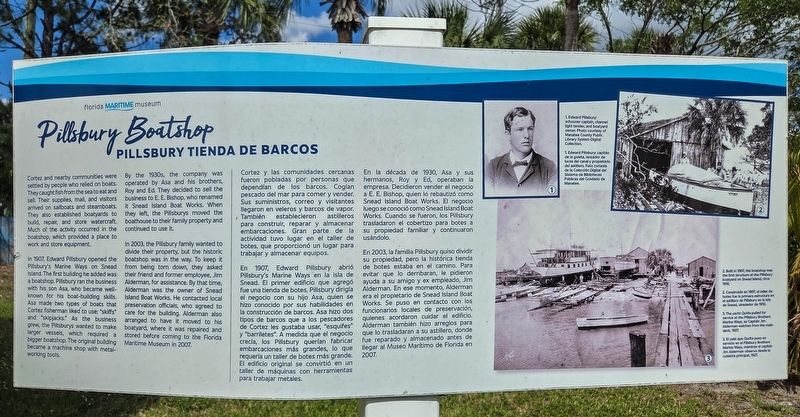
Cortez and nearby communities were settled by people who relied on boats. They caught fish from the sea to eat and sell. Their supplies, mail, and visitors arrived on sailboats and steamboats. They also established boatyards to build, repair, and store watercraft. Much of the activity occurred in the boatshop, which provided a place to work and store equipment.
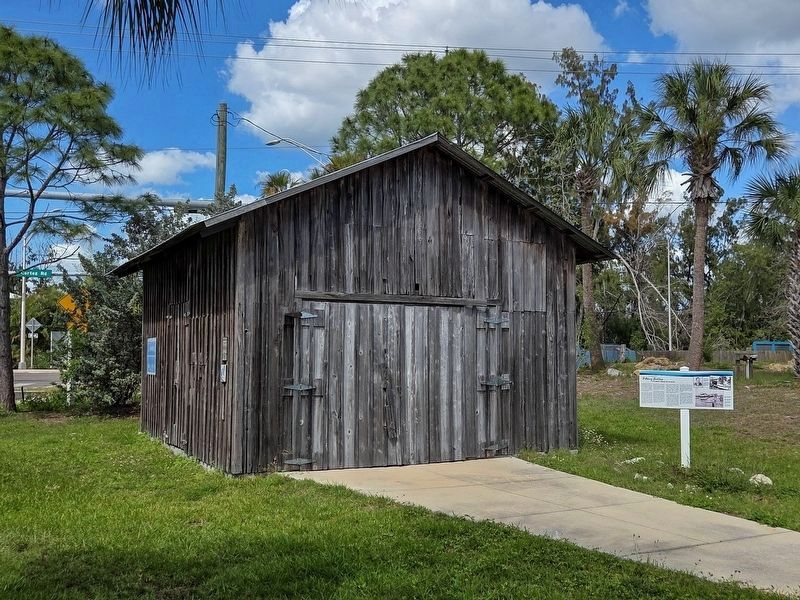
In 1907, Edward Pillsbury opened the Pillsbury's Marine Ways on Snead Island. The first building he added was a boatshop. Pillsbury ran the business with his son Asa, who became well-known for his boat-building skills. Asa made two types of boats that Cortez fisherman [sic] liked to use: "skiffs" and "skipjacks." As the business grew, the Pillsburys wanted to make larger vessels, which required a bigger boatshop. The original building became a machine shop with metalworking tools.
By the 1930s, the company was operated by Asa and his brothers, Roy and Ed. They decided to sell the business to E. E. Bishop, who renamed it Snead Island Boat Works. When they left, the Pillsburys moved to boathouse to their family property and continued to use it.
In
this page online
En 1907, Edward Pillsbury abrió Pillsbury's Marine Ways en la isla de Snead. El primer edificio que agregó fue una tienda de botes. Pillsbury dirigía el negocio con su hijo Asa, quien se hizo conocido por sus habilidades en la construcción
Photographed by McGhiever, April 3, 2026
2. Pillsbury Boatshop with marker at corner at right
En la década de 1930, Asa y sus hermanos, Roy y Ed, operaban la empresa. Decidieron vender el negocio a E. E. Bishop. quien lo rebautizó como Snead Island Boat Works. El negocio luego se conoció como Snead Island Boat Works. Cuando se fueron, los Pillsbury trasladaron el cobertizo para botes a su propiedad familiar y continuaron usándolo.
En 2003, la familia Pillsbury quiso dividir su propiedad, pero la histórico tienda de botes estaba en el camino. Para evitar que lo derribaran, le pidieron ayuda a su amigo y ex empleado, Jim Alderman. En ese momento, Alderman era el propietario de Snead Island Boat Works. Se puso en contacto con los funcionarios locales de preservación, quienes acordaron cuidar el edificio. Alderman también hizo arreglos para que lo trasladaran a su astillero, donde fue reparado y almacenado antes de llegar al Museo Marítimo de Florida en 2007.
Erected by the Florida Maritime Museum.
Topics. This historical marker is listed in these topic lists: Industry & Commerce • Waterways & Vessels. A significant historical year for this entry is 1907.
Location. 27° 28.081′ N, 82° 40.84′ W. Marker is in Cortez, Florida, in Manatee County. It can be reached from the intersection of 119th Street W. and Cortez Road W. (Florida Highway 684), on the left when traveling south. The marker is on the grounds of the Florida Maritime Museum, by the southeast corner of the boathouse standing due north of the museum. Touch for map. Marker is at or near this postal address: 4415 119th Street W, Cortez FL 34215, United States of America. Touch for directions.

Regionally, this marker is on the Gulf Coast and on Tampa Bay. It is also in the American South and on the Gulf Coast. Globally, it is in the North Atlantic Region, North America, a Gulf of Mexico state, the Western Hemisphere, the Western World, and the Anglosphere. Historically, it finds itself in what was once New Spain, the territory of the Mississippian Culture, one of the Confederate States of America, and the Antebellum South.
Other nearby markers. At least 8 other markers are within walking distance of this marker: Pillsbury Boatshop (here, next to this marker); Propeller from the 1892 Steamboat 'Mistletoe' (a few steps from this marker); A Century of Community/Un siglo de comunidad (within shouting distance of this marker); Robert Sailors Artistic Haven/Refugio artístico de Robert Sailors (within shouting distance of this marker); The 1890 Bratton Store / The 1912 Cortez Rural Graded Schoolhouse (within shouting distance of this marker); Welcome to Cortez/Bienvenido a Cortez (within shouting distance of this marker); The Burton/Bratton Store / La Tienda de Burton/Bratton (within shouting distance of this marker); Seminole Chickee (about 400 feet away, measured in a direct line). Touch for a list and map of all markers in Cortez.
Credits. This page was last revised on April 29, 2026. It was originally submitted on April 29, 2026, by McGhiever of Minneapolis, Minnesota. This page has been viewed 22 times since then. Photos: 1. submitted on April 29, 2026, by McGhiever of Minneapolis, Minnesota. 2. submitted on April 27, 2026, by McGhiever of Minneapolis, Minnesota.
