Burbank in Walla Walla County, Washington — The American West (Northwest)
Before This Was a Park
Frank And Laura Hood Start A Farm
Photographed by Clayton Pickett, April 28, 2026
1. Before This Was a Park Marker
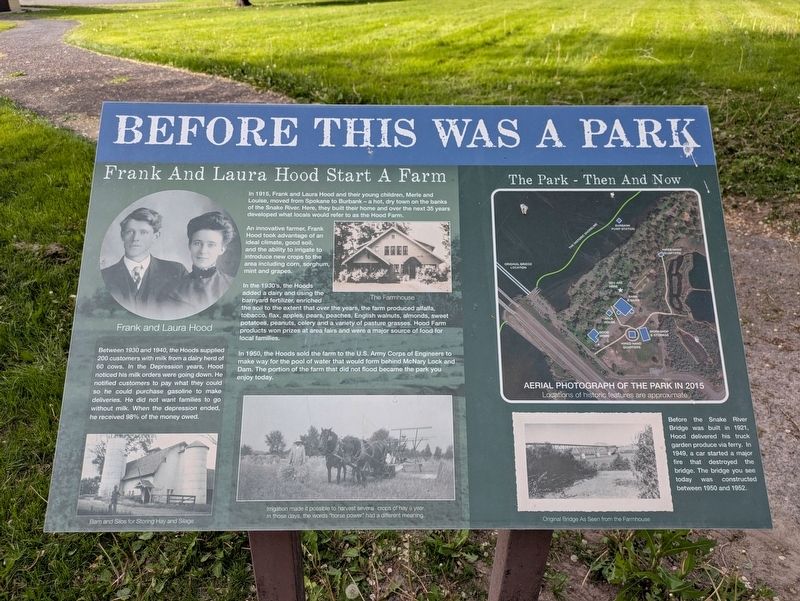
In 1915, Frank and Laura Hood and their young children, Merle and Louise, moved from Spokane to Burbank - a hot, dry town on the banks of the Snake River. Here, they built their home and over the next 35 years developed what locals would refer to as the Hood Farm.
An innovative farmer, Frank Hood took advantage of an ideal climate, good soil, and the ability to irrigate to introduce new crops to the area including corn, sorghum, mint and grapes.
In the 1930's, the Hoods added a dairy and using the barnyard fertilizer, enriched the soil to the extent that over the years, the farm produced alfalfa, potatoes, peanuts, celery and a variety of pasture grasses. Hood Farm products won prizes at area fairs and were a major source of food for local families.
In 1950, the Hoods sold the farm to the U.S. Army Corps of Engineers to make way for the pool of water that would form behind McNary Lock and Dam. The portion of the farm that did not flood became the park you enjoy today.
Between 1930 and 1940, the Hoods supplied 200 customers with milk from a dairy herd of 60 cows. In the Depression years, Hood noticed his milk orders were going
this page online
Before the Snake River Bridge was built in 1921, Hood delivered his truck garden produce via ferry. In 1949, a car started a major fire that destroyed the bridge. The bridge you see today was constructed between 1950 and 1952.
(Photo Captions)
Frank and Laura Hood
Barn and Silos for Storing Hay and Silage
The Farmhouse
Irrigation made it possible to harvest several crops of hay a year. In those days, the words "horse power" had a different meaning.
The Park - Then And Now
Aerial photograph of the park in 2015
Locations of historic features are approximate
Original Bridge As Seen from the Farmhouse
Topics. This historical marker is listed in these topic lists: Agriculture • Bridges & Viaducts • Settlements & Settlers. A significant historical year for this entry is 1915.
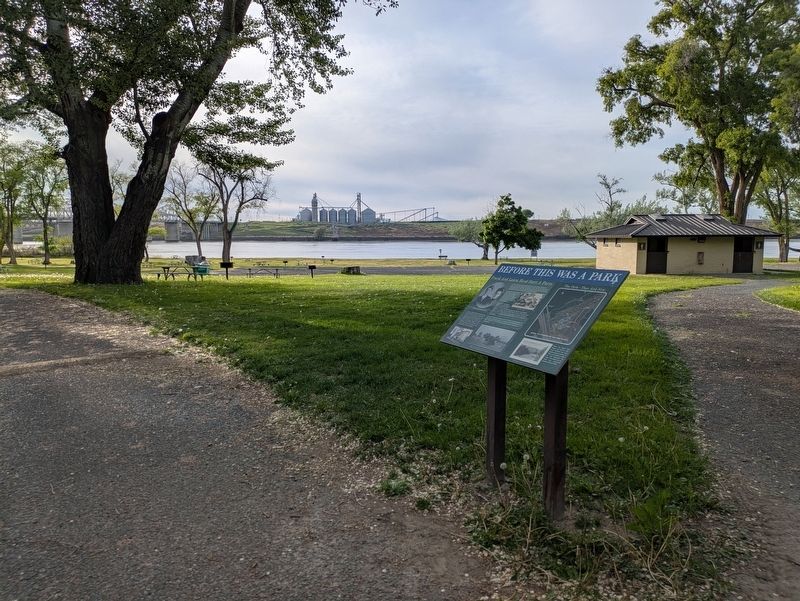
Location. 46° 12.879′ N, 119° 0.898′ W. Marker is in Burbank, Washington, in Walla Walla County. It is on Hood Park Road 0.4 miles west of Ice Harbor Drive (Washington
Photographed by Clayton Pickett, April 28, 2026
2. Before This Was a Park Marker

Regionally, this marker is in the Columbia Basin. It is also in the American Mountain West and in the Lewis & Clark Corridor. Globally, it is in North America, on the Pacific Rim, in the Western Hemisphere, in the Western World, and in the Anglosphere.
Other nearby markers. At least 8 other markers are within 2 miles of this marker, measured as the crow flies: Lewis and Clark Trail (a few steps from this marker); Mayor A. P. Gray (approx. 1½ miles away); "Sah-cah-ga-weah" (approx. 1.6 miles away); "great Columbia river" (approx. 1.6 miles away); Lewis and Clark National Historic Trail (approx. 1.6 miles away); Snake River Passage & Columbia Plains Crossing (approx. 1.6 miles away); Columbia River (approx. 1.6 miles away); At the Confluence (approx. 1.6 miles away).
Other markers no longer nearby. Ainsworth (was approx. 0.6 miles away but has been confirmed missing); Sacagawea (was approx. 0.6 miles away but has been confirmed missing).
Credits. This page was last revised on April 30, 2026. It was originally submitted on April 29, 2026, by Clayton Pickett of Richland, Washington. This page has been viewed 28 times since then. Photos: 1, 2. submitted on April 29, 2026, by Clayton Pickett of Richland, Washington. • James Hulse was the editor who published this page.
