Mill Mountain Park in Roanoke, Virginia — The American South (Mid-Atlantic)
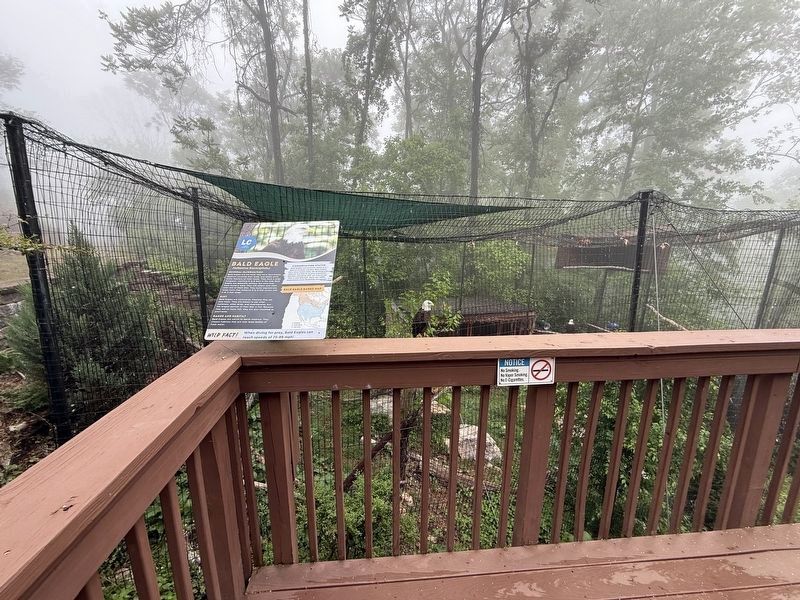
Bald Eagle
Haliaeetus leucocephalus

General Information
Bald Eagles are not bald, they have dark brown feathers covering their body, and adults grow white feathers on their heads. They have a large wingspan, reaching 6 to 8 feet! In the wild Bald Eagles are generally solitary, but once they have found a mate, they will remain with them until one of them dies. They build impressively large nests that measure 5 to 6 feet across and 2 to 4 feet deep!
Diet
Bald Eagles are carnivores, meaning they eat only meat. They are known to eat small mammals, other birds, and invertebrates, but the largest portion of their diet is fish. Because they eat so many fish, they are also classified as piscivores.
Range and Habitat
Bald Eagles are native to North America. They choose habitats that are near large bodies of fresh water.
Conservation Status
Least Concern
Bald Eagles are currently listed as a species of least concern. Bald Eagles were once listed under the Endangered Species Act due to serious population declines caused by DDT (an insecticide that is now banned). Since the 1980s, populations have thankfully increased!
Wild Fact!
When diving for prey,
this page online
Erected by Mill Mountain Zoo.
Topics. This historical marker is listed in these topic lists: Animals • Environment • Industry & Commerce.
Location. 37° 14.826′ N, 79° 56.206′ W. Marker is in Roanoke, Virginia. It is in Mill Mountain Park. It can be reached from Mill Mountain Spur Southeast south of Ridgeline Trail, on the right when traveling south. Touch for map. Marker is at or near this postal address: 2404 Prospect Rd SE, Roanoke VA 24014, United States of America. Touch for directions.

Regionally, this marker is in the Mountain Region and in Southwest Virginia. It is also in the American South and specifically in the Upper South. Globally, it is in North America, the Western Hemisphere, the Western World, and the Anglosphere. Historically, it finds itself in what was once the territory of the Mississippian Culture, one of the original Thirteen Colonies, one of the Confederate States of America, and the Antebellum South.
Other nearby markers. At least 8 other markers are within walking distance of this
Credits. This page was last revised on April 30, 2026. It was originally submitted on April 30, 2026, by Devry Becker Jones of Washington, District of Columbia. This page has been viewed 14 times since then. Photos: 1, 2. submitted on April 30, 2026, by Devry Becker Jones of Washington, District of Columbia.
