Staunton, Virginia — The American South (Mid-Atlantic)
West Africa, 1700s
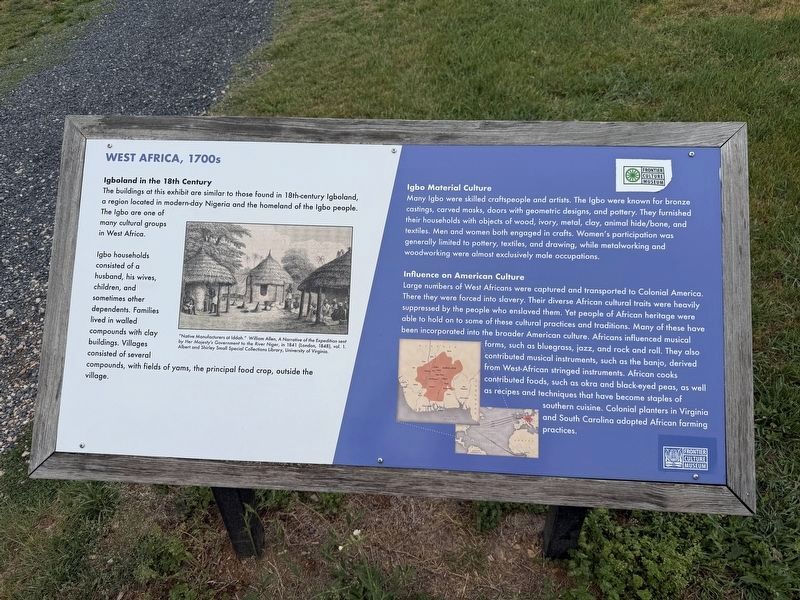
Igboland in the 18th Century
The buildings in this exhibit are similar to those found in 18th-century Igboland, a region located in modern-day Nigeria and the homeland of the Igbo people. The Igbo are one of many cultural groups in West Africa.
Igbo households consisted of a husband, his wives, children, and sometimes other dependents. Families lived in walled compounds with clay buildings. Villages consisted of several compounds, with fields of yams, the principal food crop, outside the village.
Igbo Material Culture
Many Igbo were skilled craftspeople and artists. The Igbo were known for bronze castings, carved masks, door with geometric designs, and pottery. They furnished their households with objects of wood, ivory, metal, clay, animal hide/bone, and textiles. Men and women both engaged in crafts. Women's participation was generally limited to pottery, textiles, and drawing, while metalworking and woodworking were almost exclusively male occupations.
Influence on American Culture
Large numbers of West Africans were captured and transported to Colonial America. There they were forced into slavery. Their
this page online
Erected by Frontier Culture Museum.
Topics. This historical marker is listed in these topic lists: African Americans • Anthropology & Archaeology • Arts, Letters, Music • Settlements & Settlers.
Location. 38° 7.467′ N, 79° 3.098′ W. Marker is in Staunton, Virginia. It can be reached from Frontier Drive north of Barterbrook Road, on the right when traveling north. Touch for map. Marker is
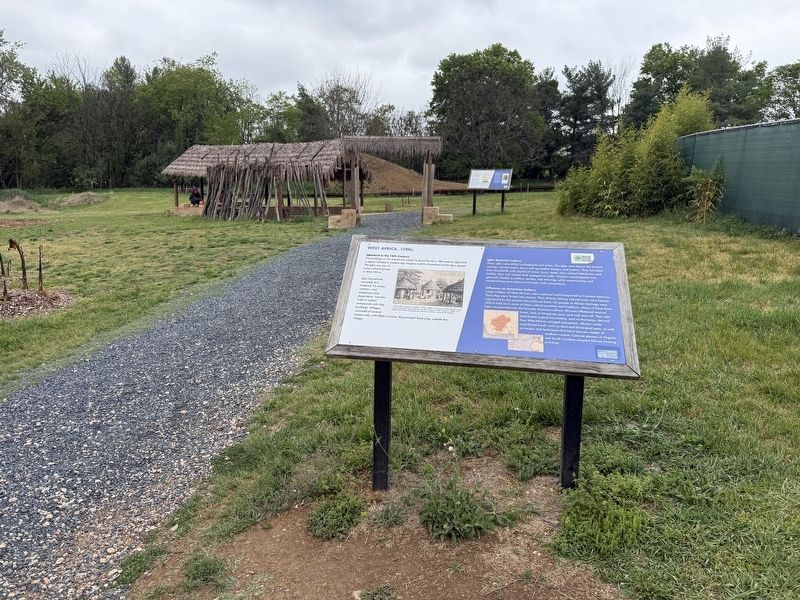

Regionally, this marker is in Virginia’s Shenandoah Valley. It is also in the American South and specifically in the Upper South. Globally, it is in North America, the Western Hemisphere, the Western World, and the Anglosphere. Historically, it finds itself in what was once the territory of the Mississippian Culture, one of the original Thirteen Colonies, one of the Confederate States of America, and the Antebellum South.
Other nearby markers. At least 8 other markers are within walking distance of this marker: A different marker also named West Africa, 1700s (a few steps from this marker); England, 1650s (about 300 feet away, measured in a direct line); The Great Road (about 400 feet away); Frontier Culture Museum (about 400 feet away); Welcome to the Frontier Culture Museum (about 500 feet away); Great Indian Warrior Trading Path (about 500 feet away); Ireland, 1750s (about 600 feet away); a different marker also named Ireland, 1750s (about 700 feet away). Touch for a list and map of all markers in Staunton.
Credits. This page was last revised on May 1, 2026. It was originally submitted on May 1, 2026, by Devry Becker Jones of Washington, District of Columbia. This page has been viewed 10 times since then. Photos: 1, 2. submitted on May 1, 2026, by Devry Becker Jones of Washington, District of Columbia.
