
St. John's Coalition in Pensacola in Escambia County, Florida — The American South (South Atlantic)
More to Discover... A Secret Language
| — | St. John's Cemetery | — |
Photographed by Cosmos Mariner, June 19, 2025
1. More to Discover... A Secret Language Marker
As viewed from the left edge of the interpretive panel.
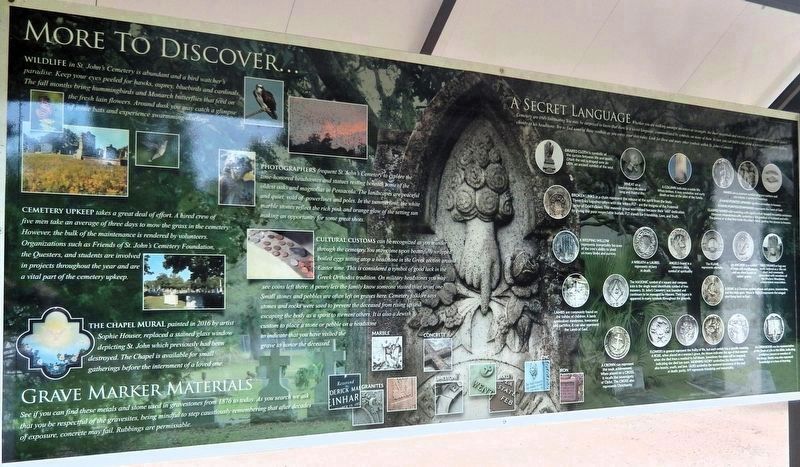
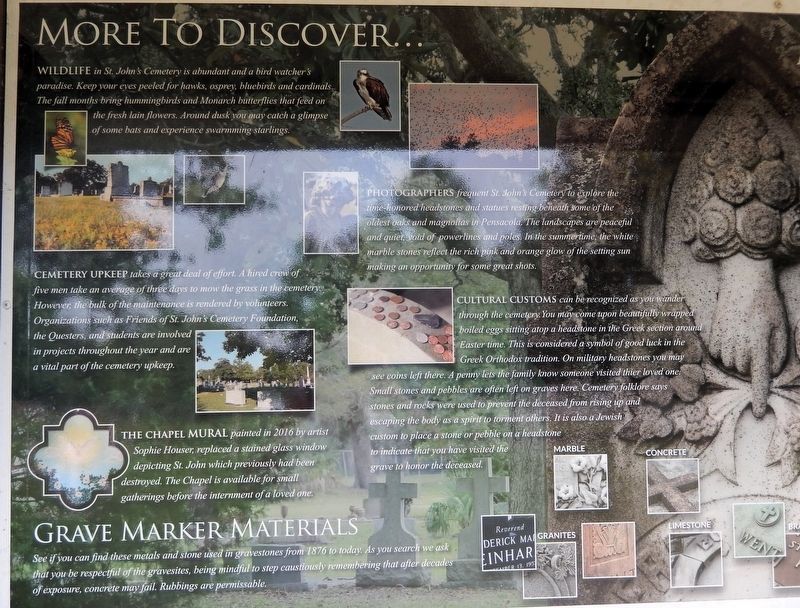
Wildlife in St. John’s Cemetery is abundant and a bird watcher’s paradise. Keep your eyes peeled for hawks. osprey, bluebirds and cardinals. The fall months bring hummingbirds and Monarch butterflies that feed on the fresh lain flowers. Around dusk you may catch a glimpse of some bats and experience swarming starlings.
Photographers frequent St. John’s Cemetery to explore the time-honored headstones and statues resting beneath some of the oldest oaks and magnolias in Pensacola. The landscapes are peaceful and quiet, void of powerlines and poles. In the summertime, the white marble stones reflect the rich pink and orange glow of the setting sun making an opportunity for some great shots.
Cemetery upkeep takes a great deal of effort. A hired crew of five men take an average of three days to mow the grass in the cemetery. However, the bulk of the maintenance is rendered by volunteers. Organizations such as Friends of St. John’s Cemetery Foundation, the Questers, and students are involved in projects throughout the year and are a vital part of the cemetery upkeep.
Cultural customs can be recognized as you wander through the
this page online
The Chapel Mural painted in 2016 by artist Sophie Houser, replaced a stained glass window depicting St. John which previously had been destroyed. The Chapel is available for small gatherings before the interment of a loved one.
Grave Marker Materials
See if you can find these metals and stone used in gravestones from 1876 to today. As you search we ask that you be respectful of the gravesites, being mindful to step cautiously remembering that after decades of exposure, concrete may fail. Rubbings
Photographed by Cosmos Mariner, June 19, 2025
2. More to Discover...
The left side of the interpretive panel.
A Secret Language
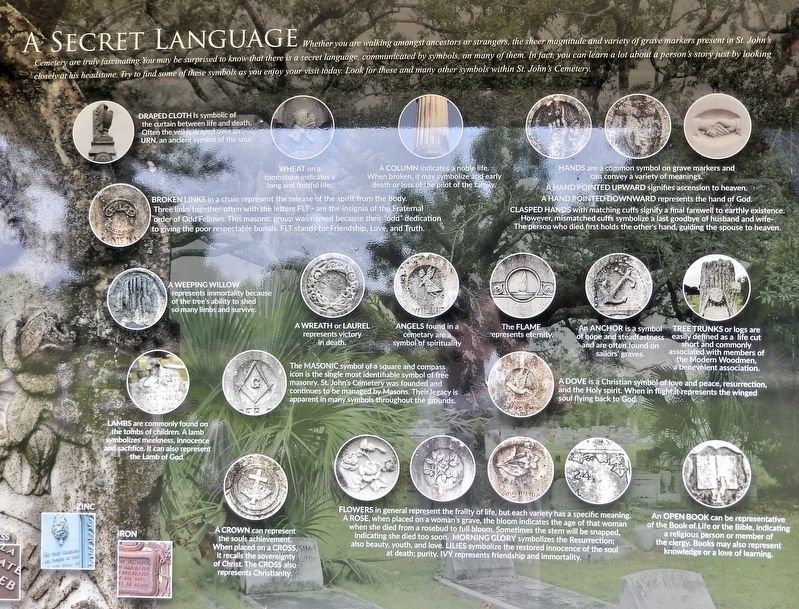
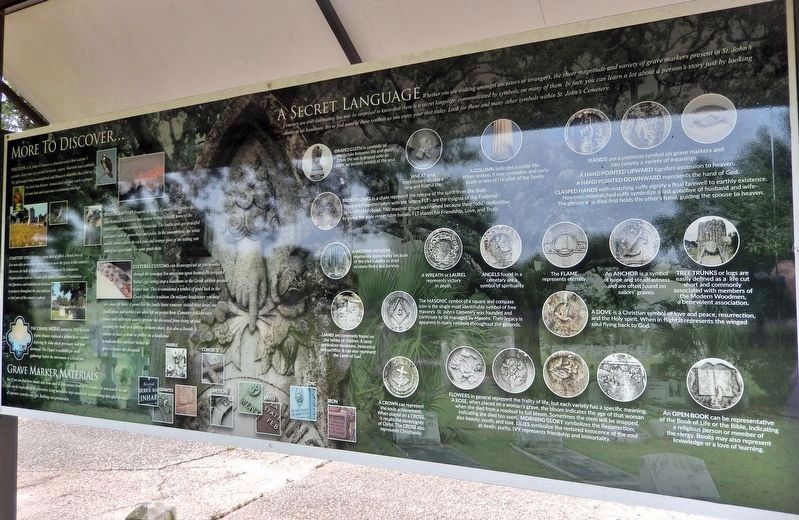
Whether you are walking amongst ancestors or strangers, the sheer magnitude and variety of grave markers present in St. John's Cemetery are truly fascinating. You may be surprised to know that there is a secret language, communicated by symbols, on many of them. In fact, you can learn a lot about a person's story just by looking closely at his headstone. Try to find some of these symbols as you enjoy your visit today. Look for these and many other symbols within St. John's Cemetery.
Draped cloth is symbolic of the curtain between life and death. Often the veil is draped over an urn, an ancient symbol of the soul.
Wheat on a tombstone indicates a long and fruitful life.
A column indicates a noble life. When broken, it may symbolize an early death or loss of the pilot of the family.
Hands are a common symbol on grave markers and can convey a variety of meanings. A hand pointed upward signifies ascension to heaven. A hand pointed downward represents the hand of God. Clasped hands with matching cuffs signify a final farewell to earthly existence.
Photographed by Cosmos Mariner, June 19, 2025
3. A Secret Language
The right side of the interpretive panel.
Broken links in a chain represent the release of the spirit from the body. Three links together — often with the letters FLT — are the insignia of the Fraternal Order of Odd Fellows. This masonic group was named because of their “odd” dedication to giving the poor respectable burials. FLT stands for Friendship, Love, and Truth.
A weeping willow represents immortality because of the tree's ability to shed so many limbs and survive.
A wreath or laurel represents victory in death.
Angels found in a cemetery are a symbol of spirituality.
The flame represents eternity.
An anchor is a symbol of hope and steadfastness and are often found on sailors’ graves.
Tree trunks or logs are easily defined as a life cut short and commonly associated with members of the Modern Woodmen, a benevolent association.
The Masonic symbol of a square and compass icon is the single most identifiable symbol of free masonry. St. John’s Cemetery was founded and continues to be managed by Masons. Their legacy is apparent
Photographed by Cosmos Mariner, June 19, 2025
4. More to Discover... A Secret Language Marker
As viewed from the right edge of the panel.
A dove is a Christian symbol of love and peace, resurrection, and the Holy spirit. When in flight, it represents the winged soul flying back to God.
Lambs are commonly found on the tombs of children. A lamb symbolizes meekness, innocence and sacrifice. It can also represent the Lamb of God.
A crown can represent the soul’s achievement. When placed on a cross, it recalls the sovereignty of Christ. The cross also represents Christianity.
Flowers in general represent the frailty of life, but each variety has a specific meaning. A rose, when placed on a woman’s grave, the bloom indicates the age of that woman when she died from a rosebud to full bloom. Sometimes the stem will be snapped, indicating she died too soon. Morning glory symbolizes the Resurrection; also beauty, youth, and love. Lilies symbolize the restored innocence of the soul at death; purity. Ivy represents friendship and immortality.
An open book can be representative of the Book of Life or the Bible, indicating a religious person or member of the clergy. Books may also represent knowledge or a love of learning.
Erected 2018 by
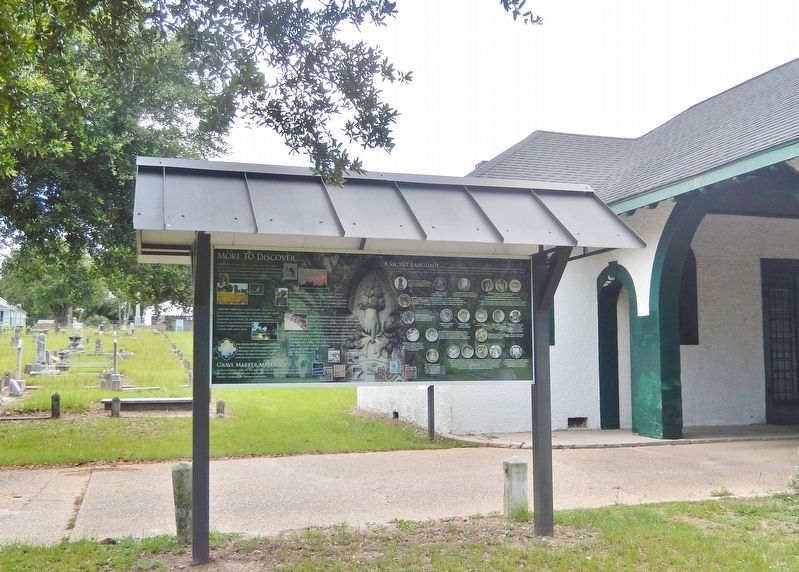
Photographed by Cosmos Mariner, June 19, 2025
5. More to Discover... A Secret Language Marker
The marker is on the south side of this interpretive kiosk, just inside the St. John's Cemetery gatehouse. The gatehouse is in the right background.
Topics. This historical marker is listed in this topic list: Cemeteries & Burial Sites. A significant historical year for this entry is 1876.
Location. 30° 24.979′ N, 87° 13.972′ W. Marker is in Pensacola, Florida, in Escambia County. It is in St. John's Coalition. It can be reached from the intersection of North G Street and West Belmont Street, on the left when traveling north. The marker is just inside the St. John's Cemetery gatehouse, on the left side as you pass through the gate. Touch for map. Marker is at or near this postal address: 301 North G Street, Pensacola FL 32501, United States of America. Touch for directions.

Regionally, this marker is on the Florida Panhandle. It is also in the American South, specifically in the Deep South, and on the Gulf Coast. Globally, it is in the North Atlantic Region, North America, a Gulf of Mexico state, the Western Hemisphere, the Western World, and the Anglosphere. Historically, it finds itself in what was once New Spain, the territory of the Mississippian Culture, one of the Confederate States of America, and the Antebellum South.
Other nearby markers. At least 8 other markers are within walking distance of this marker: Welcome to St. John's Cemetery (here, next to this marker); Gatehouse Chapel (here, next to this marker); St. Johns Historic Cemetery (a few steps from this marker); Historic North Side (a few steps from this marker); First Interment (within shouting distance of this marker); Baby Section (within shouting distance of this marker); William F. Miller (about 300 feet away, measured in a direct line); Inventor of FSU Tomahawk Chop (about 300 feet away). Touch for a list and map of all markers in Pensacola.
Related markers. Click here for a list of markers that are related to this marker. St. John's Cemetery
Credits. This page was last revised on May 4, 2026. It was originally submitted on May 1, 2026, by Cosmos Mariner of Cape Canaveral, Florida. This page has been viewed 19 times since then. Photos: 1, 2, 3, 4, 5. submitted on May 3, 2026, by Cosmos Mariner of Cape Canaveral, Florida.
