Staunton, Virginia — The American South (Mid-Atlantic)
Valley of Virginia, 1850s
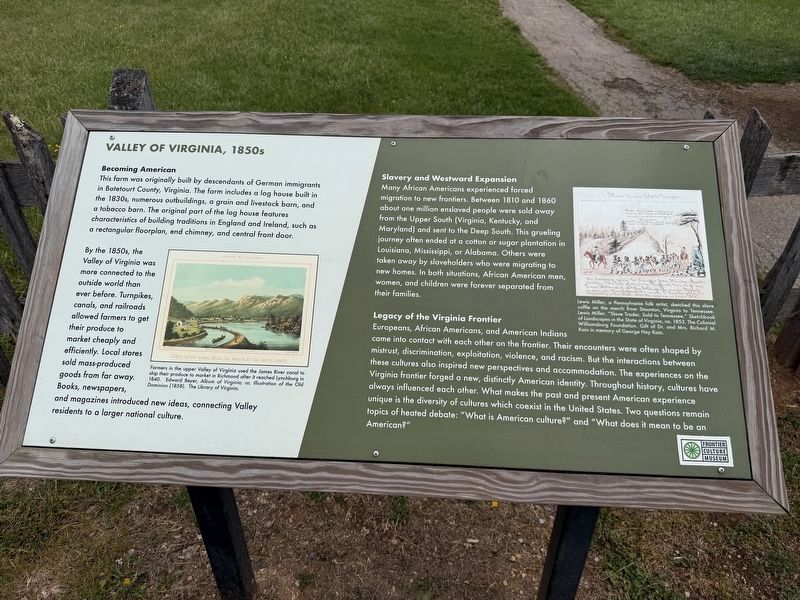
Becoming American
This form was originally built by descendants of German immigrants in Botetourt County, Virginia. The farm includes the log house built in the 1830s, numerous outbuildings, a grain and livestock barn, and a tobacco barn. The original part of the log house features characteristics of building traditions in England and Ireland, such as a rectangular floorplans, end chimney, and central front door.
By the 1850s, the Valley of Virginia was more connected to the outside world than ever before. Turnpikes, canals, and railroads allowed farmers to get their produce to market cheaply and efficiently. Local sold mass-produced goods from far away. Books, newspapers, and magazines introduced new ideas, connecting Valley residents to a larger national culture.
Slavery and Westward Expansion
Many African Americans experienced forced migration to new frontiers. Between 1810 and 1860 about one million enslaved people were sold away from the Upper South (Virginia, Kentucky, and Maryland) and sent to the Deep South. This grueling journey often ended at a cotton or sugar plantation in Louisiana, Mississippi, or Alabama.
this page online
Europeans, African Americans, and American Indians came into contact with each other on the frontier. Their encounters were often shaped by mistrust, discrimination, exploitation, violence, and racism. But the interactions between these cultures also inspired new perspectives and accommodation. The experiences on the Virginia frontier forged a new, distinctly American identity. Throughout history, cultures have always influenced each other. What makes the past and present American experience unique is the diversity of cultures which coexist in the United States. Two questions remain topics of heated debate: "What is American culture?" and "What does it mean to be an American?"
Erected by Frontier Culture Museum.
Topics. This historical marker is listed in these topic lists: African Americans • Agriculture • Industry & Commerce • Settlements & Settlers. A significant historical year for this entry is 1810.
Location. 38° 7.63′ N,


Regionally, this marker is in the Shenandoah Valley. It is also in the American South and specifically in the Upper South. Globally, it is in North America, the Western Hemisphere, the Western World, and the Anglosphere. Historically, it finds itself in what was once the territory of the Mississippian Culture, one of the original Thirteen Colonies, one of the Confederate States of America, and the Antebellum South.
Other nearby markers. At least 8 other markers are within walking distance of this marker: Appalachian Virginia, 1850s (here, next to this marker); Springhouse (a few steps from this marker); Schoolhouse, 1840s (a few steps from this marker); a different marker also named Appalachian Virginia, 1850s (within shouting distance of this marker); Meat House (within shouting distance of this marker); Main House
Additional keywords. human trafficking; chattel slavery
Credits. This page was last revised on May 1, 2026. It was originally submitted on May 1, 2026, by Devry Becker Jones of Washington, District of Columbia. This page has been viewed 13 times since then. Photos: 1, 2, 3. submitted on May 1, 2026, by Devry Becker Jones of Washington, District of Columbia.
