Staunton, Virginia — The American South (Mid-Atlantic)
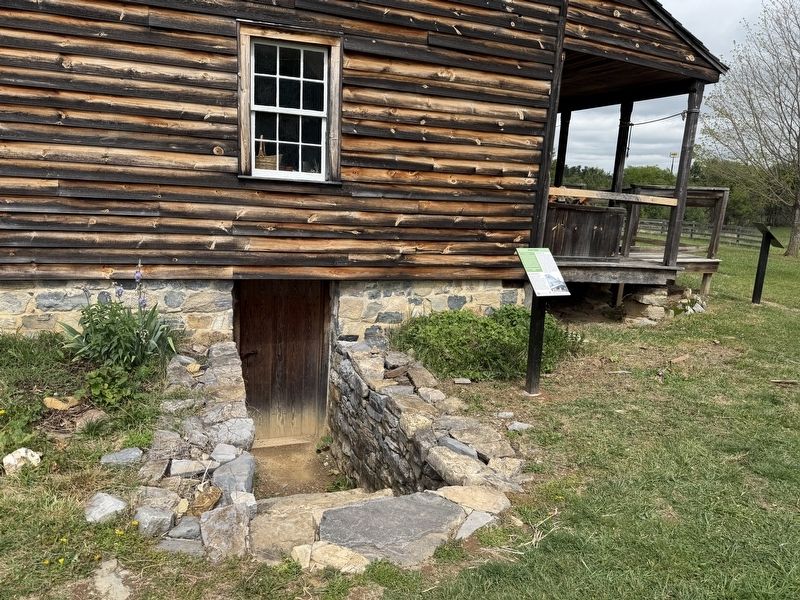
Root Cellar

Keeping it Fresh
Root vegetables like carrots, turnips, and beets were kept in the root cellar. Cheese, cider, beer, and other food items were also kept in the locked cellar. Conditions had to be consistent to ensure everything stayed preserved. The space had to be humid and could not get too cold from frost. Sand, straw, and ash were commonly used to protect produce. Eggs were coated in oil or grease and buried in ash.
Natural Refrigerator
Designed for long-term storage, root cellars provided cool, dark, slightly humid conditions, ideal for root vegetables and other produce. If the main house did not have a root cellar, sometimes families dug small caves into hillsides or pits in the ground and used those for storing food items.
[Sidebar:]
Molasses Take new sweet cider from the press made from sweet apples and boil it down as thick as West India molasses. Four or five barrels will make one of good molasses. It should be boiled in brass and not burned as that would injure the flavor. It will keep in the cellar and is said to be as good and for many purposes better than West India molasses.
The Skillful Housewife' Book
(1853)
[Caption:]
Entrance to the original root cellar.
Erected by Frontier
this page online
Topics. This historical marker is listed in these topic lists: Agriculture • Settlements & Settlers.
Location. 38° 7.611′ N, 79° 2.645′ W. Marker is in Staunton, Virginia. It can be reached from Frontier Drive north of Barterbrook Road, on the right when traveling north. Touch for map. Marker is at or near this postal address: 1274 Richmond Rd, Staunton VA 24401, United States of America. Touch for directions.

Regionally, this marker is in the Shenandoah Valley. It is also in the American South and specifically in the Upper South. Globally, it is in North America, the Western Hemisphere, the Western World, and the Anglosphere. Historically, it finds itself in what was once the territory of the Mississippian Culture, one of the original Thirteen Colonies, one of the Confederate States of America, and the Antebellum South.
Other nearby markers. At least 8 other markers are within walking distance of this marker: Main House (here, next to this marker); Meat House (here, next to this
Credits. This page was last revised on May 1, 2026. It was originally submitted on May 1, 2026, by Devry Becker Jones of Washington, District of Columbia. This page has been viewed 14 times since then. Photos: 1, 2. submitted on May 1, 2026, by Devry Becker Jones of Washington, District of Columbia.
