Staunton, Virginia — The American South (Mid-Atlantic)
African-American Church, 1860s
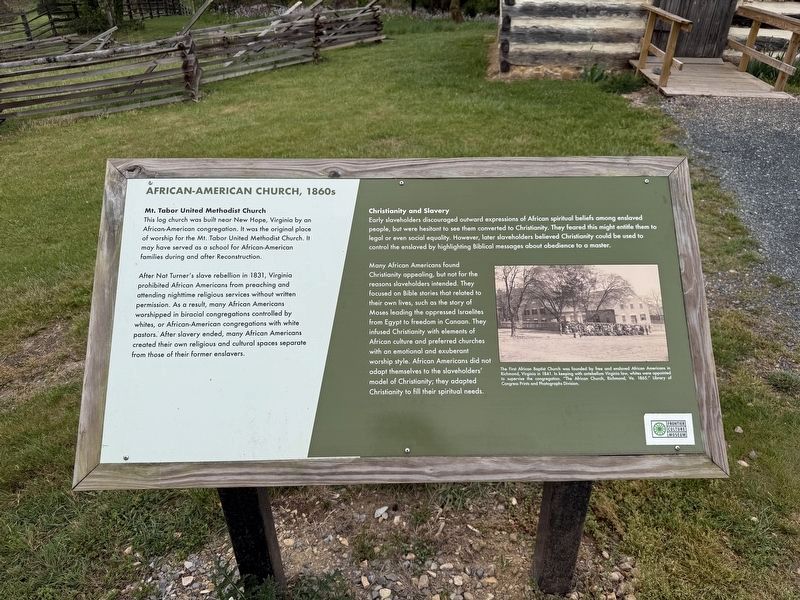
Mt. Tabor United Methodist Church
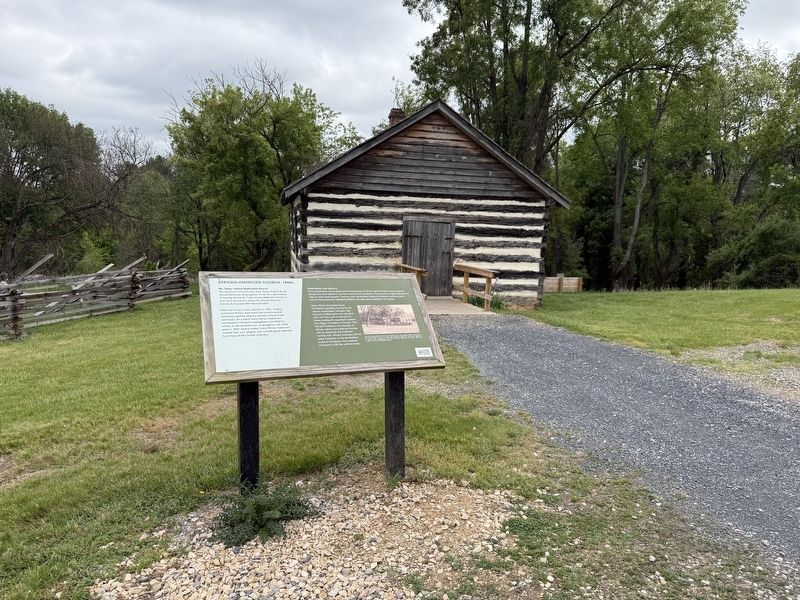
This log church was built near New Hope, Virginia by an African-American congregation. It was the original place of worship for the Mt. Tabor United Methodist Church. It may have served as a school for African-American families during and after Reconstruction.
After Nat Turner's slave rebellion in 1831, Virginia prohibited African Americans from preaching and attending nighttime religious services without written permission. As a result, many African Americans worshipped in biracial congregations controlled by whites, or African-American congregations with white pastors. After slavery ended, many African Americans created their own religious and cultural spaces separate from those of their former enslavers.
Christianity and Slavery
Early slaveholders discouraged outward expressions of African spiritual beliefs among enslaved people, but were hesitant to see them converted to Christianity. They feared this might entitle them to legal or even social equality. However, later slaveholders believed Christianity could be used to control the enslaved by highlighting Biblical messages
this page online
Many African Americans found Christianity appealing, but not for the reasons slaveholders intended. They focused on Bible stories that related to their own lives, such as the story of Moses leading the oppressed Israelites from Egypt to freedom in Canaan. They infused Christianity with elements of African culture and preferred churches with an emotional and exuberant worship style. African Americans did not adapt themselves to the slaveholders' model of Christianity; they adapted Christianity to fill their spiritual needs.
[Caption:]
The First African Baptist Church was founded by free and enslaved African Americans in Richmond, Virginia in 1841. In keeping with antebellum Virginia law, whites were appointed to supervise the congregation. "The African Church, Richmond, Va. 1865." Library of Congress Prints and Photographs Division.
Erected by Frontier Culture Museum.
Topics. This historical marker is listed in these topic lists: African Americans • Civil Rights • Religion & Religious Structures. A significant historical year for this entry is 1831.
Location. 38° 7.619′ N, 79° 2.795′ W.

Regionally, this marker is in Virginia’s Shenandoah Valley. It is also in the American South and specifically in the Upper South. Globally, it is in North America, the Western Hemisphere, the Western World, and the Anglosphere. Historically, it finds itself in what was once the territory of the Mississippian Culture, one of the original Thirteen Colonies, one of the Confederate States of America, and the Antebellum South.
Other nearby markers. At least 8 other markers are within walking distance of this marker: Bake Oven (about 400 feet away, measured in a direct line); Garden (about 400 feet away); Shenandoah Valley, 1820s (about 500 feet away); Main House (about 500 feet away); a different marker also named Shenandoah Valley, 1820s (about 500 feet away); Valley of Virginia, 1820s (about 500 feet away); Valley of Virginia, 1760s (about 600 feet away); Schoolhouse, 1840s (about 600 feet away). Touch for a list and map of all markers in Staunton.
Credits. This page was last revised on May 2, 2026. It was originally submitted on May 2, 2026, by Devry Becker Jones of Washington, District of Columbia. This page has been viewed 19 times since then. Photos: 1, 2. submitted on May 2, 2026, by Devry Becker Jones of Washington, District of Columbia.
