Holborn in Camden in Greater London, England, United Kingdom — Northwestern Europe (the British Isles)
John Harrison

Photographed by Andrew Ruppenstein, April 24, 2026
1. John Harrison Marker
John Harrison
1693-1776
inventor of the Marine Chronometer
lived and died in a house on this site
Erected 1954 by London County Council.
Topics. This historical marker is listed in this topic list: Science & Medicine.
Location. 51° 31.135′ N, 0° 7.126′ W. Marker is in Camden, England, in Greater London. It is in Holborn. It is at the intersection of Dane Street and Red Lion Street, on the left when traveling north on Dane Street. Touch for map. Marker is at or near this postal address: 12 Red Lion Street, Camden, England WC1R 4QH, United Kingdom. Touch for directions.

Regionally, this marker is in the Greater South East. Globally, it is on the Atlantic Ocean, in the North Atlantic Region, in Europe, in Atlantic Europe, on one of the British Isles, in the Western World, and in the Anglosphere. Historically, it finds itself in what was once the Roman Empire.
Other nearby markers. At least 8 other markers are within walking distance of this marker: History of Red Lion Square Gardens 1960 - Present (a few steps from this marker); Fanny Wilkinson
this page online
Also see . . . John Harrison (Wikipedia). Overview:
John Harrison (3 April [O.S. 24 March] 1693 – 24 March 1776) was an English carpenter and clockmaker who invented the marine chronometer, a long-sought-after device for solving the problem of how to calculate longitude while at sea.(Submitted on May 2, 2026.)
Harrison's solution revolutionized navigation and greatly increased the safety of long-distance sea travel. The problem he solved had been considered so important following the Scilly naval disaster of 1707 that the British Parliament was offering financial rewards of up to £20,000 (equivalent to£3.83 million in 2025) under the 1714 Longitude Act, though Harrison never received the full reward due to political rivalries. He presented his first design in 1730, and worked over many years on improved designs, making several advances in time-keeping technology, finally turning to what were called sea watches. Harrison gained support from the Longitude Board in building and testing his designs. Towards the end of his life, he received recognition and a reward from Parliament.Photographed by Andrew Ruppenstein, April 24, 20262. John Harrison Marker - wide view
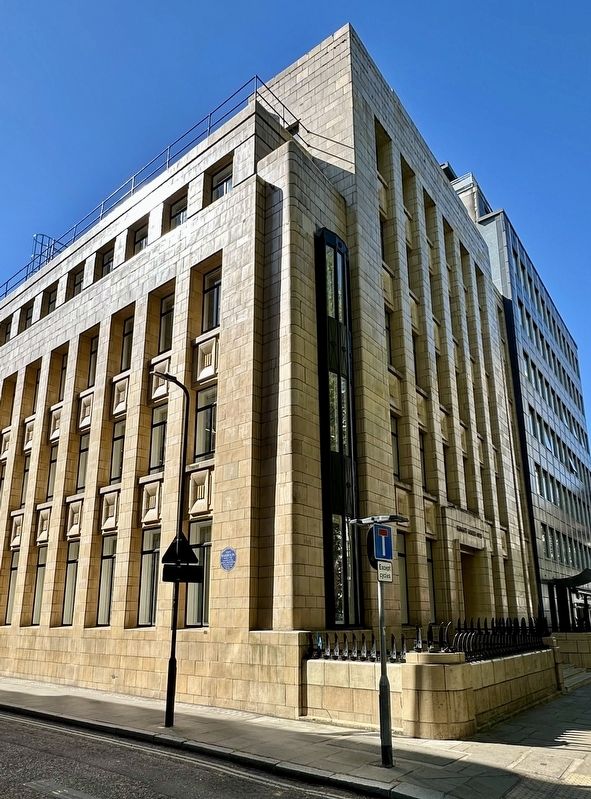
Additional keywords. blue plaque
Credits. This page was last revised on May 2, 2026. It was originally submitted on May 2, 2026, by Andrew Ruppenstein of Lamorinda, California. This page has been viewed 12 times since then. Photos: 1, 2. submitted on May 2, 2026, by Andrew Ruppenstein of Lamorinda, California.
