Fitzrovia in City of Westminster in Greater London, England, United Kingdom — Northwestern Europe (the British Isles)
David Edward Hughes
Photographed by Andrew Ruppenstein, April 26, 2026
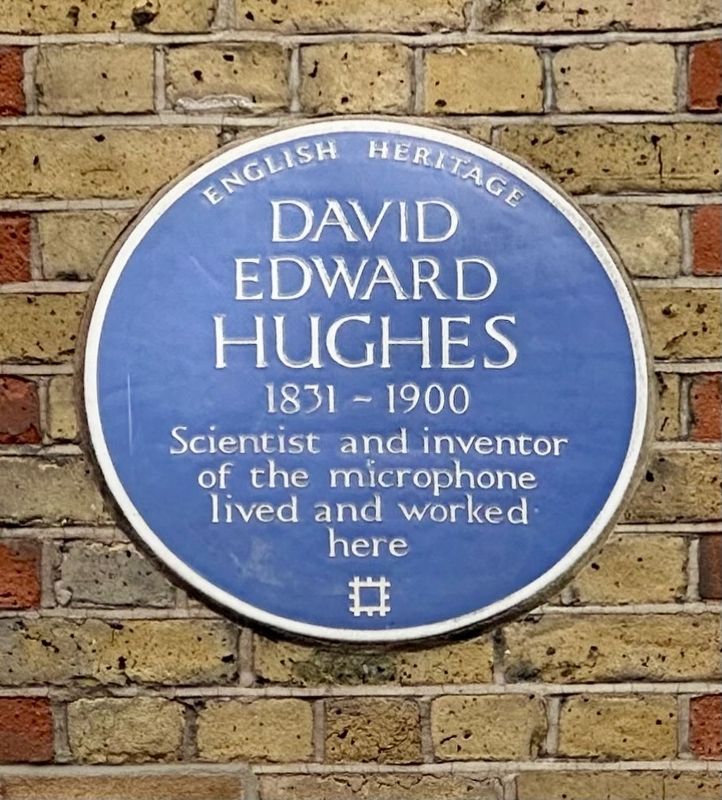
1. David Edward Hughes Marker
David Edward Hughes
1831-1900
Scientist and inventor of the microphone
lived and worked here
Erected 1991 by English Heritage.
Topics. This historical marker is listed in this topic list: Science & Medicine.
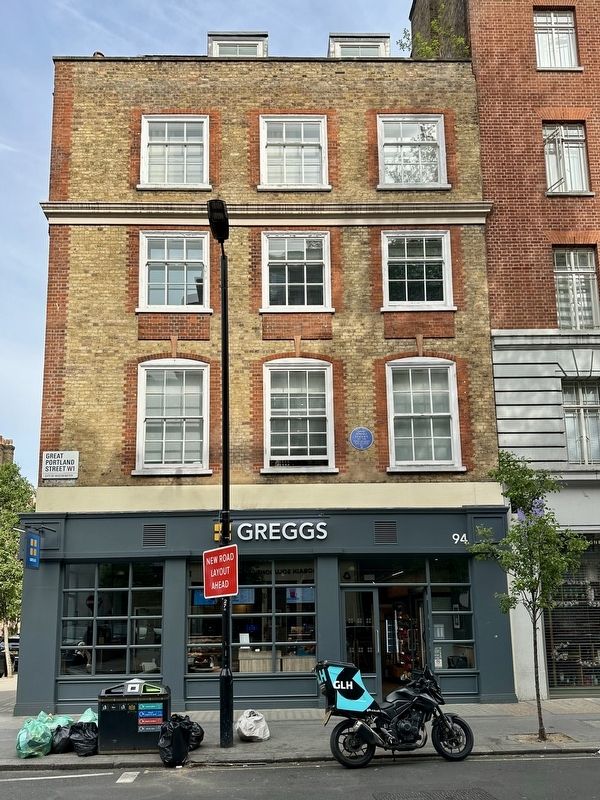
Location. 51° 31.128′ N, 0° 8.52′ W. Marker is in City of Westminster, England, in Greater London. It is in Fitzrovia. It is at the intersection of Great Portland Street and Langham Street, on the right when traveling north on Great Portland Street. Touch for map. Marker is at or near this postal address: 94 Great Portland Street, City of Westminster, England W1W 7NU, United Kingdom. Touch for directions.

Regionally, this marker is in London and in the Greater South East. Globally, it is on the Atlantic Ocean, in the North Atlantic Region, in Europe, in Atlantic Europe, on one of the British Isles, in the Western World, and in the Anglosphere. Historically, it finds itself in what was once the Roman Empire.
Other nearby markers. At least 8 other markers are within walking distance of this marker: Edmond Malone (within shouting distance
this page online
Also see . . . David Edward Hughes. Overview:
David Edward Hughes (16 May 1830 – 22 January 1900), was a Welsh-American inventor, practical experimenter, and professor of music known for his work on the printing telegraph and the microphone. He is generally considered to have been born in London but his family moved around that time so he may have been born in Corwen, Wales.(Submitted on May 3, 2026.)
His family moved to the U.S. while he was a child and he became a professor of music in Kentucky. In 1855 he patented a printing telegraph. He moved back to London in 1857 and further pursued experimentation and invention, coming up with an improved carbon microphone in 1878.
In 1879 he identified what seemed to be a new phenomenon during his experiments: electricsparks generated in one device could be heard in a separate portable microphone apparatus he had set up. It was most probably radio transmissions but this was nine years before electromagnetic radiation was a proven concept and Hughes was convinced by others that his discovery was simply electromagnetic induction.Photographed by Andrew Ruppenstein, April 26, 20262. David Edward Hughes Marker - wide view
Additional keywords. blue plaque
Credits. This page was last revised on May 3, 2026. It was originally submitted on May 3, 2026, by Andrew Ruppenstein of Lamorinda, California. This page has been viewed 13 times since then. Photos: 1, 2. submitted on May 3, 2026, by Andrew Ruppenstein of Lamorinda, California.
