Farringdon in Camden in Greater London, England, United Kingdom — Northwestern Europe (the British Isles)
The London Steam Carriage
Photographed by Andrew Ruppenstein, April 24, 2026
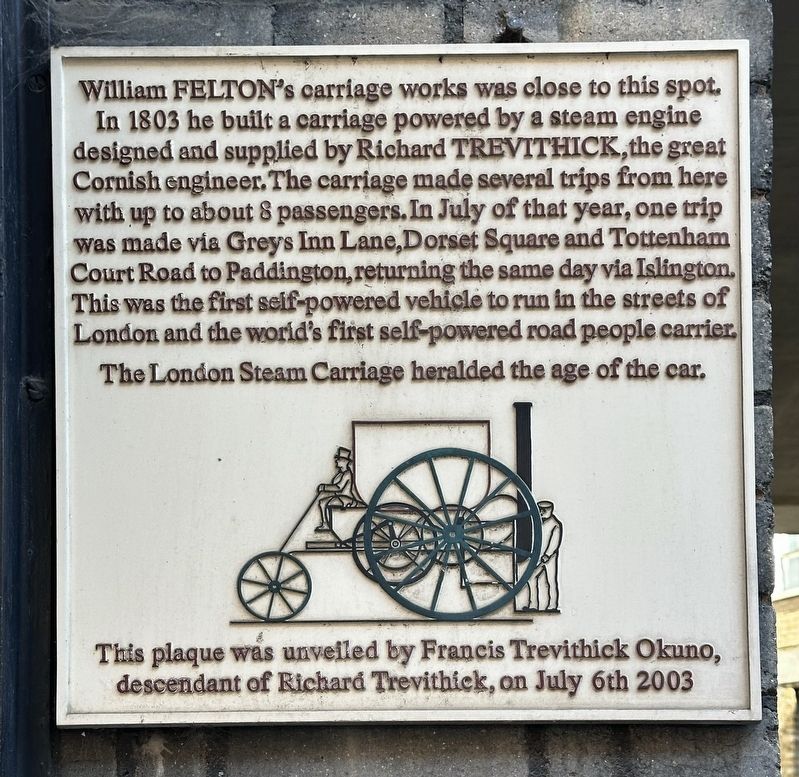
1. The London Steam Carriage Marker
William FELTON's carriage works was close to this spot.
In 1803 he built a carriage powered by a steam engine designed and supplied by Richard TREVITHICK, the great Cornish engineer. The carriage made several trips from here with up to about 8 passengers. In July of that year, one trip was made via Greys Inn Lane, Dorset Square and Tottenham Court Road to Paddington, returning the same day via Islington. This was the first self-powered vehicle to run in the streets of London and the world's first self-powered road people carrier.
The London Steam Carriage heralded the age of the car.
This plaque was unveiled by Francis Trevithick Okuno, descendant of Richard Trevithick, on July 6th 2003
Topics. This historical marker is listed in this topic list: Roads & Vehicles. A significant historical month for this entry is July 1803.
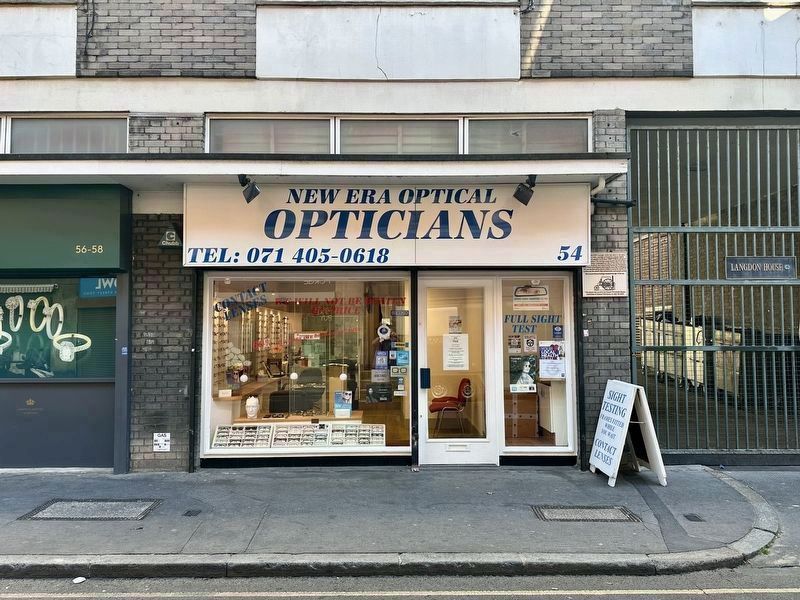
Location. 51° 31.245′ N, 0° 6.575′ W. Marker is in Camden, England, in Greater London. It is in Farringdon. It is on Leather Lane north of St Cross St. Touch for map. Marker is at or near this postal address: 54 Leather Lane, Camden, England EC1N 7TP, United Kingdom. Touch for directions.

Regionally,
this page online
Other nearby markers. At least 8 other markers are within walking distance of this marker: Robert W. Paul (within shouting distance of this marker); Wren House (about 90 meters away, measured in a direct line); Sir Hiram Maxim (about 120 meters away); Arandora Star Memorial (about 150 meters away); St Peter’s Italian Church - 1863 (about 150 meters away); Prudential World War I Memorial (about 210 meters away); Prudential World War II Memorial (about 210 meters away); Zeppelin Raid (about 240 meters away). Touch for a list and map of all markers in Camden.
Also see . . . London Steam Carriage (Wikipedia). Excerpt:
The London Steam Carriage was an early steam-powered road vehicle constructed by Richard Trevithick in 1803 and the world's first self-propelled passenger-carrying vehicle.…(Submitted on May 4, 2026.)
…The vehicle was assembled atFelton's carriage works at Leather Lane, London, the engine components having been brought from Falmouth where they were made.Photographed by Andrew Ruppenstein, April 24, 20262. The London Steam Carriage Marker - wide viewThe marker can be seen here just to the right of the door. (And if it can’t be seen, well there’s people right there next to the marker who could help on this one.)
Following its completion, the London Steam Carriage was driven about 10 miles (16 km) through the streets of London to Paddington and back via Islington, with seven or eight passengers, at a speed of 4–9 miles per hour (6.4–14.5 km/h), the streets having been closed to other traffic.
On a subsequent evening, Trevithick and his colleague crashed the carriage into some house railings and, as a result of this, plus lack of interest in the carriage by potential purchasers, and its demonstrations having exhausted the inventors' financial resources, it was eventually scrapped.
Credits. This page was last revised on May 4, 2026. It was originally submitted on May 4, 2026, by Andrew Ruppenstein of Lamorinda, California. This page has been viewed 21 times since then. Photos: 1, 2. submitted on May 4, 2026, by Andrew Ruppenstein of Lamorinda, California.
