Melbourne, Victoria, Australia — Oceania
Earth, mother
| — | Royal Botanic Gardens - Melbourne | — |
Photographed by Dean Barton-Ancliffe, April 14, 2026
1. Earth, mother Marker
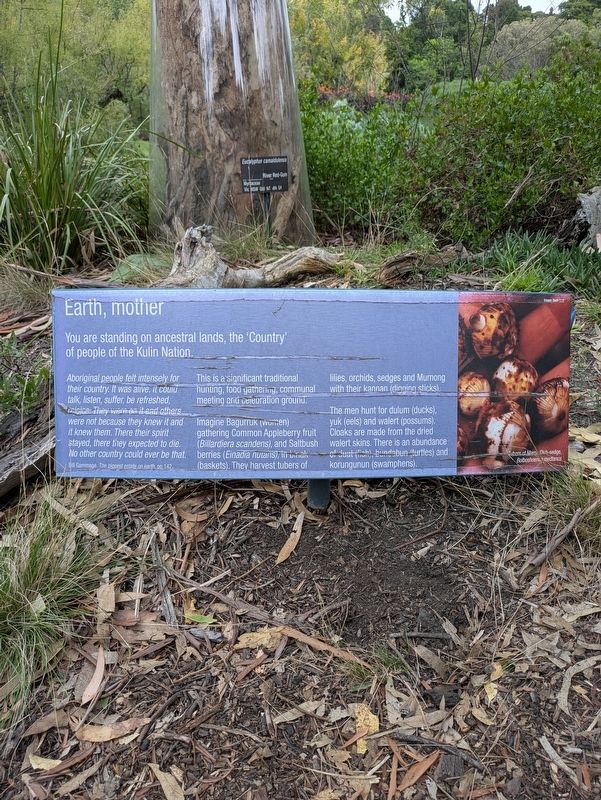
Earth, mother
You are standing on ancestral lands, the 'Country' of people of the Kulin Nation.
Aboriginal people felt intensely for their country. It was alive, it could talk, listen, suffer, be refreshed, rejoice. They were on it and others were not because they knew it and it knew them. There their spirit stayed, there they expected to die. No other country could ever be that.
Bill Gamage the biggest estate on earth. pg 142
This is a significant traditional hunting, food gathering, communal meeting and curation ground.
Imagine Bagurruk (women) gathering Common Appleberry fruit (Billardiera scandens), and Saltbush berries (Einadia nutans), in binak (baskets). They harvest tubers of lilies, orchids, sedges and Murnong with their kannan (digging sticks).
The men hunt for dulum (ducks), yuk (eels) and walert (possums). Cloaks are made from the dried walert skins. There is an abundance of duat (fish), bundabun (turtles) and korungunun (swamphens).
Topics. This historical marker is listed in this topic list: Indigenous Peoples and Communities.
Location. 37° 49.696′ S, 144° 58.835′ E.
this page online

Regionally, it is in Oceania, Australasia, the Pacific Ocean, South Pacific, the Pacific Rim, the Western World, and the Anglosphere. Historically, it finds itself in what was once a British colony.
Other nearby markers. At least 8 other markers are within walking distance of this marker: Murong or Yam Daisy (a few steps from this marker); Victoria's Grassy Woodland (within shouting distance of this marker); Taming the river (within shouting distance of this marker); Victoria's Native Orchids (within shouting distance of this marker); Botanic Gardens Curators or Directors (about 150 meters away, measured in a direct line); Director's Residence Royal Botanic Gardens (approx. 0.3 kilometers away); Morell (Anderson Street) Monier Arch Bridge (approx. 0.4 kilometers away); Carlo Catani (approx. 0.4 kilometers away). Touch for a list and map of all markers in Melbourne.
Also see . . . A Kulin Estate.
Photographed by Dean Barton-Ancliffe, April 14, 2026
2. Earth, mother Marker in the Gardens
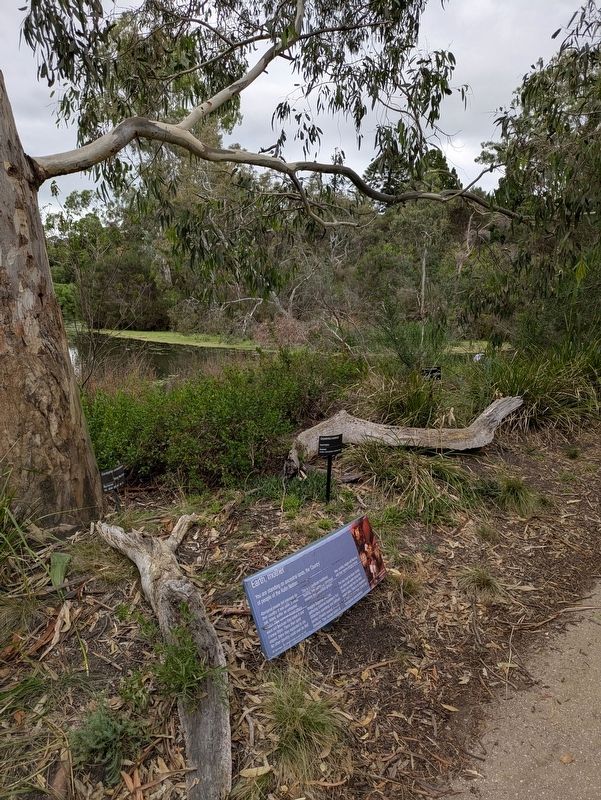
Before European settlement, West Melbourne Swamp played an important rôle in the Kulin world. Once or twice a year people from all of the language groups that made up the Kulin nation would gather in the area around the lower Yarra River. Hundreds of people would camp in traditional sites around the river and over a period of three or four weeks take part in meetings, ceremonies, and social gatherings. Gatherings of such numbers were possible only because of the many wetlands close to the lower reaches of the river. These waterscape features were the most productive areas in the region. People from the clans of Watha Wurrung speakers came from the Bellarine Peninsula and camped on the rising ground adjacent to West Melbourne Swamp. Boon Wurrung speakers traditionally camped on the ridge along the south side of the river, in the area that now includes the Botanic Gardens. From there they had easy access to a large freshwater billabong. People from Taung Wurrung country, in the Goulburn and Ovens River valleys, set up their camps adjacent to the Yarra in the Collingwood area, where there were wetlands. The local clans, of the Woi Wurrung language group, made use of the many wetlands that flanked the river on its northern side, upstream of Princes Bridge.(Submitted on May 5, 2026, by Dean Barton-Ancliffe of Rowville, Victoria.)
Credits. This page was last revised on May 6, 2026. It was originally submitted on May 5, 2026, by Dean Barton-Ancliffe of Rowville, Victoria. This page has been viewed 13 times since then. Photos: 1, 2. submitted on May 5, 2026, by Dean Barton-Ancliffe of Rowville, Victoria. • Andrew Ruppenstein was the editor who published this page.
