Carrabelle in Franklin County, Florida — The American South (South Atlantic)
From Sails to Rails
Late 1800s
| — | History Timeline | — |
Photographed by Cosmos Mariner, June 16, 2025
1. From Sails to Rails Marker
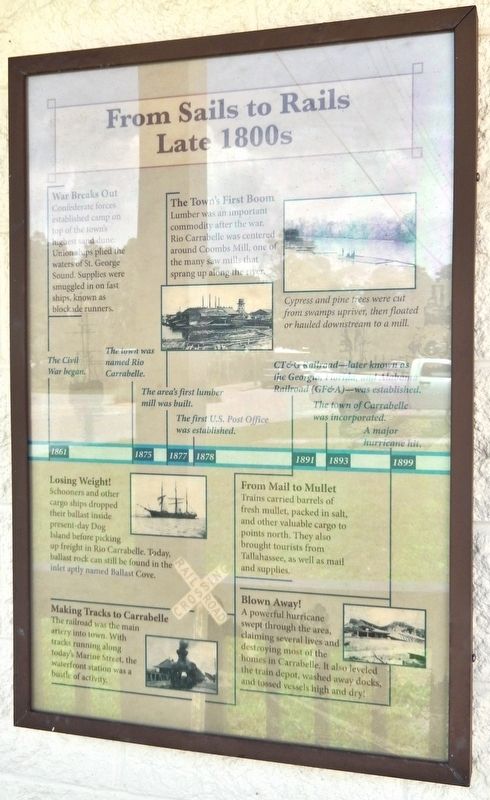
1861 • The Civil War Began.
War Breaks Out
Confederate forces established camp on top of the town’s highest sand dune. Union ships plied the waters of St. George Sound. Supplies were smuggled in on fast ships, known as blockade runners.
1875 • The town was named Rio Carrabelle.
Losing Weight!
Schooners and other cargo ships dropped their ballast inside present-day Dog Island before picking up freight in Rio Carabelle. Today, ballast rock can still be found in the inlet aptly named Ballast Cove.
1877 • The area’s first lumber mill was built.
The Town’s First Boom
Lumber was an important commodity after the war. Rio Carrabelle was centered around Coombs Mill, one of the many saw mills that sprang up along the river. Cypress and pine trees were cut from swamps upriver, then floated or hauled downstream to a mill.
1878 • The first U.S. Post Office was established.
1891 • CT&G Railroad — later known as the Georgia, Florida, and Alabama Railroad (GF&A) — was established.
Making Tracks to Carrabelle
The railroad was the main artery into town. With tracks running along today’s Marine Street, the waterfront station was a bustle of activity.
From Mail to Mullet
Trains carried barrels of fresh mullet, packed in salt, and other valuable cargo to points north. They also brought tourists from Tallahassee, as well as mail and supplies.
1893 • The Town of Carrabelle was incorporated.
1899 • A major hurricane hit
Blown Away!
A powerful hurricane swept through the area, claiming several lives and destroying most of the homes in Carrabelle. It also leveled the train depot, washed away docks, and tossed vessels high and dry!
Erected 2009 by Florida Coastal Management Program, Florida Department of Environmental Protection, and National Oceanic and Atmospheric Administration.
Topics. This historical marker is listed in these topic
this page online
Location. 29° 50.838′ N, 84° 39.84′ W. Marker is in Carrabelle, Florida, in Franklin County. It is at the intersection of Marine Street and Avenue F South, on the right when traveling south on Marine Street. The marker is mounted on the north side of the Carrabelle Riverwalk & Wharf public restroom building. Touch for map. Marker is in this post office area: Carrabelle FL 32322, United States of America. Touch for directions.

Regionally, this marker is on the Florida Panhandle. It is also in the American South, specifically in the Deep South, and on the Gulf Coast. Globally, it is in the North Atlantic Region, North America, a Gulf of Mexico state, the Western Hemisphere, the Western World, and the Anglosphere. Historically, it finds itself in what was once New Spain, the territory of the Mississippian Culture, one of the Confederate States of America, and the Antebellum South.
Other nearby markers. At least 8 other markers are within walking distance of this marker: From Boom to Bust... and Back Again!
Photographed by Cosmos Mariner, June 16, 2025
2. Carrabelle Riverwalk & Wharf Public Restrooms
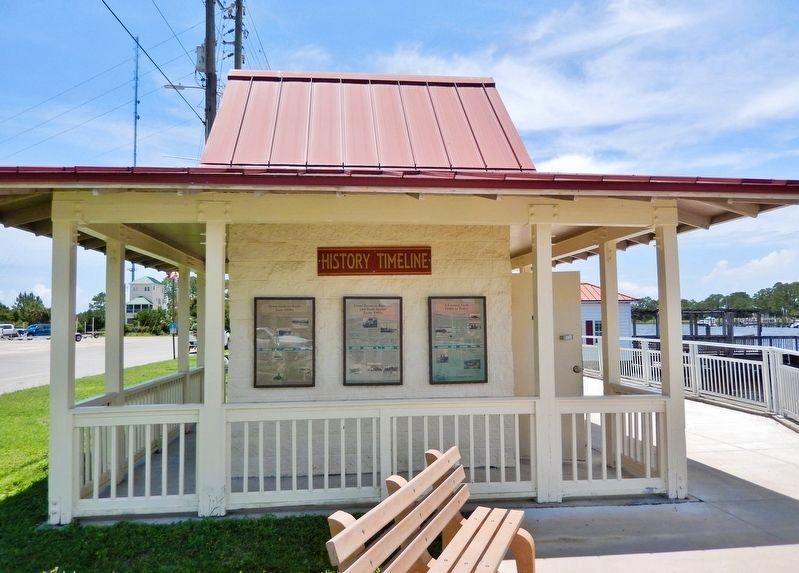
Looking south; the Carrabelle River is on the right. This marker is the leftmost of three interpretive panels on the north side of the building.
Related markers. Click here for a list of markers that are related to this marker. Carrabelle Riverwalk & Wharf — History Timeline
Also see . . . 1899 Carrabelle Hurricane (Wikipedia).
Excerpt: The 1899 Carrabelle hurricane caused significant damage in the Dominican Republic and the Florida Panhandle of the United States. The second tropical cyclone and second hurricane of the 1899 Atlantic hurricane season, the storm was first observed south of the Dominican Republic on July 28, 1899. The storm made landfall near Islamorada, Florida on July 30. It then brushed Southwest Florida before emerging into the Gulf of Mexico. The storm began to re-intensify on July 31 and became a hurricane later that day. Early on August 1, it peaked with winds of 100 mph, several hours before making landfall near Apalachicola, Florida.(Submitted on May 9, 2026, by Cosmos Mariner of Cape Canaveral, Florida.)At the time of the storm, it was described as “the most disastrous cyclone that ever visited this section of Florida.” The city of Carrabelle was devastated; only nine houses in the city remained intact. According to the mayor, about 200 families were left homeless. Losses in the city reached approximately $100,000. One fatality occurred when a house collapsed on a woman; numerous other people in the area sustained injuries. At least 57 shipping vessels were destroyed, including 14 barques, 40 small boats, and 3 pilot boats. Losses for these ships collectively totaled about $375,000.
Credits. This page was last revised on May 10, 2026. It was originally submitted on May 6, 2026, by Cosmos Mariner of Cape Canaveral, Florida. This page has been viewed 19 times since then. Photos: 1, 2. submitted on May 9, 2026, by Cosmos Mariner of Cape Canaveral, Florida.
