
Morro Bay in San Luis Obispo County, California — The American West (Pacific Coastal)
Oyster Farming in Morro Bay
Photographed by Jason Voigt, March 24, 2026
1. Oyster Farming in Morro Bay Marker
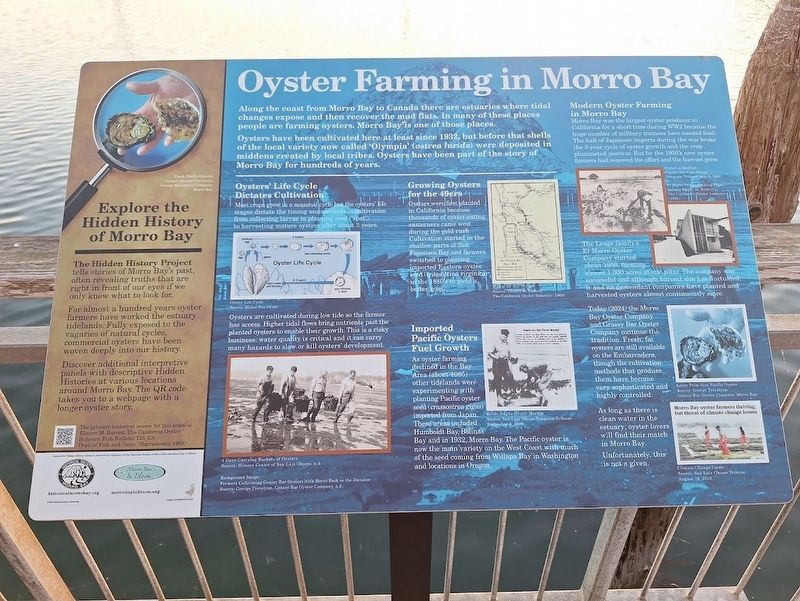
Along the coast from Morro Bay to Canada there are estuaries where tidal changes expose and then recover the mud flats. In many of these places people are farming oysters. Morro Bay is one of those places.
Oysters have been cultivated here at least since 1932, but before that shells of the local variety now called "Olympia" (ostrea lurida) were deposited in middens created by local tribes. Oysters have been part of the story of Morro Bay for hundreds of years.
Oysters' Life Cycle Dictates Cultivation
Most crops grow in a seasonal cycle but the oysters' life stages dictate the timing and methods of cultivation from collecting larvae to planting seed ('spat') to harvesting nature oysters after about 3 years.
Oysters are cultivated during low tide so the farmer has access. Higher tidal flows bring nutrients past the planted oysters to enable their growth. This is a risky business: water quality is critical and it can carry many hazards to slow or kill oysters' development.
Growing Oysters for the 49ers
Oysters were first planted in California because thousands of oyster-eating easterners came west during the
this page online
Imported Pacific Oysters Fuel Growth
As oyster farming declined in the Bay Area (about 1905) other tidelands were experimenting with planting Pacific oyster seed (crassostrea gigas) imported from Japan. These areas included Humboldt Bay, Bolinas Bay and in 1932, Morro Bay. The Pacific oyster is now the main variety on the West Coast with much of the seed coming from Willapa Bay in Washington and locations in Oregon.
Modern Oyster Farming in Morro Bay
Morro Bay was the largest oyster producer in California for a short time during WW2 because the huge number of military trainees here needed food. The halt of Japanese imports during the war broke the 3-year cycle of oyster growth and the crop plummeted postwar. But by the 1950's new oyster farmers had renewed the effort and the harvest grew.
The Leage family's El Morro Oyster Company started about 1950, farming almost 1,000 acres at one point. The company was successful and although
Photographed by Jason Voigt, March 24, 2026
2. Oyster Farming in Morro Bay Marker
Today (2024) the Morro Bay Oyster Company and Grassy Bar Oyster Company continue the tradition. Fresh, fat oysters are still available on the Embarcadero, though the cultivation methods that produce them have become very sophisticated and highly controlled.
As long as there is clean water in the estuary, oyster lovers will find their match in Morro Bay.
Unfortunately, this is not a given.
(aside:)
Explore the Hidden History of Morro Bay The Hidden History Project tells stories of Morro Bay's past, often revealing truths that are right in front of our eyes if we only knew what to look for.
For almost a hundred years oyster farmers have worked the estuary tidelands. Fully exposed to the vagaries of natural cycles, commercial oysters have been woven deeply into our history.
Discover additional interpretive panels with descriptive Hidden Histories at various locations around Morro Bay. The QR code takes you to a webpage with a longer oyster story.
Erected by Historical Society of Morro Bay and Morro Bay In Bloom.
Topics. This historical marker is listed in these topic lists: Agriculture • Industry & Commerce • War, World II. A significant historical year for this entry is 1932.
Location. 35° 21.95′ N, 120° 51.224′ W. Marker is in Morro Bay, California, in San Luis Obispo County. It can be reached from Embarcadero. Marker (along with several others) is located along a boardwalk pathway behind restaurants and tail businesses. Touch for map. Marker is at or near this postal address: 801 Embarcadero, Morro Bay CA 93442, United States of America. Touch for directions.

Regionally, this marker is on the Central Coast and specifically on the Coast Ranges. It is also on the American Pacific Coast. Globally, it is in North America, on the Ring of Fire, in the Pacific Rim, in the Western Hemisphere, in the Western World, and in the Anglosphere. Historically, it finds itself in what was once New Spain and also Mexico’s Alta California.
Other nearby markers. At least 8 other markers are within walking distance of this marker: Morro Bay Women in Fishing (a few steps from this marker); A Deep Dive into Morro Bay's History (within shouting distance of this marker); A Working Waterfront: The Boatyard (within shouting distance of this marker); A Royal Game (within shouting distance of this marker); Change On The Embarcadero: The Machine Shop (about 300 feet away, measured in a direct line); A Bridge to the Sandspit (about 400 feet away); The Abalone of Morro Bay (about 500 feet away); Fishermen Lost at Sea Memorial (about 600 feet away). Touch for a list and map of all markers in Morro Bay.
Credits. This page was last revised on May 17, 2026. It was originally submitted on May 6, 2026, by Jason Voigt of Glen Carbon, Illinois. This page has been viewed 18 times since then. Photos: 1. submitted on May 6, 2026, by Jason Voigt of Glen Carbon, Illinois. 2. submitted on May 8, 2026, by Jason Voigt of Glen Carbon, Illinois.
