Fitzrovia in City of Westminster in Greater London, England, United Kingdom — Northwestern Europe (the British Isles)
Olaudah Equiano

Photographed by Andrew Ruppenstein, April 26, 2026
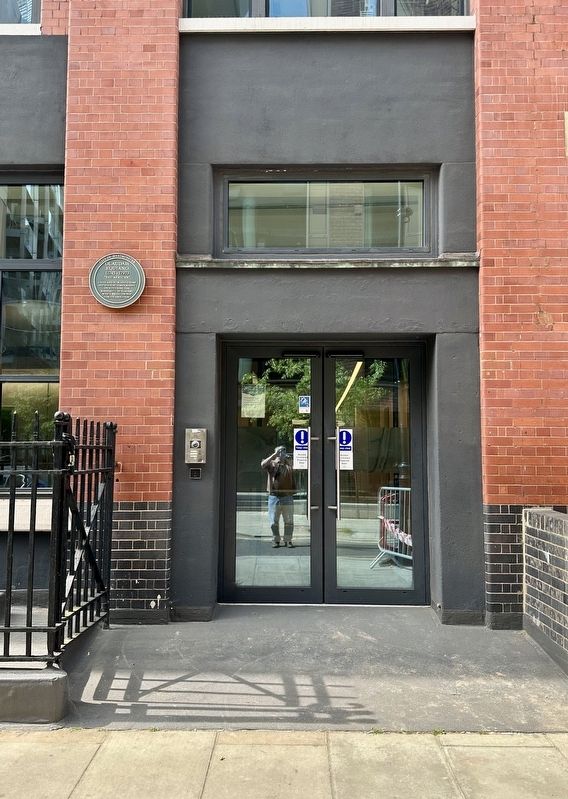
1. Olaudah Equiano Marker
Olaudah Equiano
(1745-1797)
"The African"
Lived and published here in 1789 his autobiography on suffering the barbarity of slavery, which paved the way for its abolition
Topics and series. This historical marker is listed in these topic lists: Abolition & Underground RR • Arts, Letters, Music. In addition, it is included in the City of Westminster Green Plaques series list. A significant historical year for this entry is 1789.
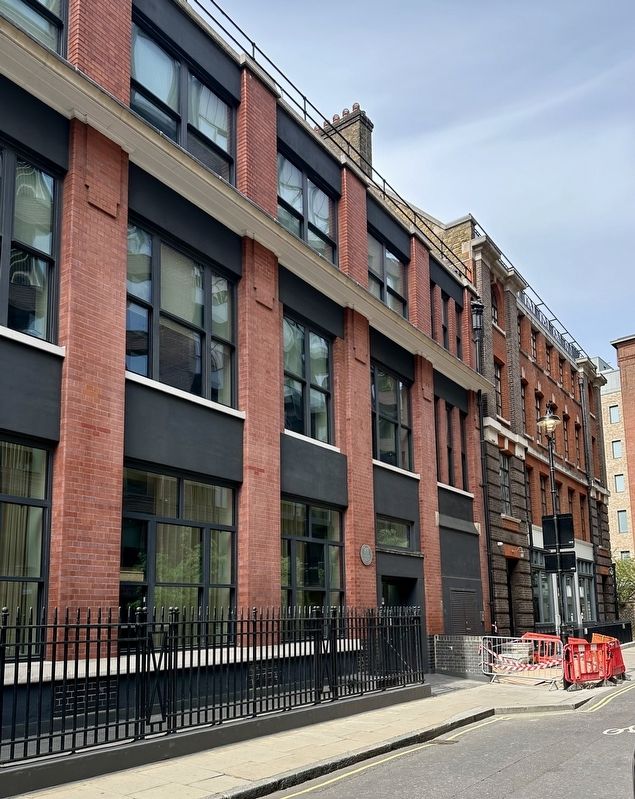
Location. 51° 31.17′ N, 0° 8.334′ W. Marker is in City of Westminster, England, in Greater London. It is in Fitzrovia. It is on Riding House Street, on the right when traveling west. Touch for map. Marker is at or near this postal address: 67-73 Riding House Street, City of Westminster, England W1T 3BF, United Kingdom. Touch for directions.

Regionally, this marker is in London and in the Greater South East. Globally, it is on the Atlantic Ocean, in the North Atlantic Region, in Europe, in Atlantic Europe, on one of the British Isles, in the Western World, and in the Anglosphere. Historically, it finds itself in what was once the Roman Empire.
Other nearby markers. At least
this page online
Related markers. Click here for a list of markers that are related to this marker.
Also see . . .
1. Olaudah Equiano (Wikipedia). Overview:
Olaudah Equiano (c. 1745 – 31 March 1797), known for most of his life as Gustavus Vassa, was a writer and abolitionist. According to his memoir, he was from the village of Essaka, presumed to be in present-day southern Nigeria. Enslaved as a child in West Africa, he was shipped to the Caribbean and sold to a Royal Navy officer. He was sold twice more before purchasing his freedom in 1766.(Submitted on May 6, 2026.)
Asa freedman in London, Equiano supported the British abolitionist movement, becoming one of its leading figures in the 1780s. Equiano was part of the abolitionist group the Sons of Africa, whose members were Africans living in Britain. His 1789 autobiography, The Interesting Narrative of the Life of Olaudah Equiano, sold so well that nine editions were published during his life and helped secure passage of the British Slave Trade Act 1807, which abolished the slave trade in Britain. The Interesting Narrative gained renewed popularity among scholars in the late 20th century and remains a useful primary source.Photographed by Andrew Ruppenstein, April 26, 20262. Olaudah Equiano Marker - wide view
2. Olaudah Equiano: The Remarkable Life of an African Writer and Abolitionist (Black History Month). Excerpt:
…Equiano also wrote and spoke extensively about the need to end slavery. He wrote several other books and pamphlets on the subject, and he became a leading voice in the abolitionist movement. He argued that the slave trade was immoral and that it violated the basic rights of human beings. He also criticised the treatment of enslaved people, and he called for their liberation and the(Submitted on May 6, 2026.)abolition of the slave trade.Photographed by Andrew Ruppenstein, April 26, 20263. Olaudah Equiano Marker - wider view
Equiano used his status as a successful businessman and well-travelled individual to gain access to influential people and advocate for the abolition of the slave trade. He wrote letters and gave speeches to members of Parliament, as well as to other influential figures in British society. He also helped to organise and support campaigns to end slavery.
Equiano’s work helped to change the attitudes of many people towards the slave trade, and he was instrumental in pushing for legislative change. The British government eventually passed the Abolition of the Slave Trade Act in 1807, which prohibited the transatlantic slave trade. The act was a major victory for the abolitionist movement, and it was a significant step towards the eventual abolition of slavery..
Credits. This page was last revised on May 6, 2026. It was originally submitted on May 6, 2026, by Andrew Ruppenstein of Lamorinda, California. This page has been viewed 10 times since then. Photos: 1, 2, 3. submitted on May 6, 2026, by Andrew Ruppenstein of Lamorinda, California.
