The Planters Exchange

The Planters Exchange has been officially listed in the National Register of Historic Places
September 17, 1999
Topics and series. This historical marker is listed in these topic lists: Agriculture • Architecture • Industry & Commerce • Notable Buildings. In addition, it is included in the National Register of Historic Places (NRHP) series list. A significant historical year for this entry is 1928.
Location. 30° 37.496′ N, 84° 24.984′ W. Marker is in Havana, Florida, in Gadsden County. It is on 2nd Street Northwest just north of 8th Avenue West, on the left when traveling north. The marker is mounted on the east/front facade of the historic Planters Exchange building. Touch for map. Marker is at or near this postal address: 204 2nd Street Northwest, Havana FL 32333, United States of America. Touch for directions.

Regionally, this marker is in Greater Tallahassee and on the Florida Panhandle. It is also in the American South and specifically in the Deep South. Globally, it is in the North Atlantic Region, North America, a Gulf of Mexico state, the Western Hemisphere, the Western World, and the Anglosphere.
this page online
Other nearby markers. At least 8 other markers are within 4 miles of this marker, measured as the crow flies: Town of Havana (within shouting distance of this marker); Old Spanish Trail (about 300 feet away, measured in a direct line); POW★MIA (approx. 0.3 miles away); The Price of Freedom Veterans Memorial (approx. 0.3 miles away); Purple Heart (approx. 0.3 miles away); Havana High School Site (approx. 0.4 miles away); Vickers Cemetery (approx. 2½ miles away); Dr. Malcolm Nicholson Home (approx. 3.4 miles away). Touch for a list and map of all markers in Havana.
Regarding The Planters Exchange. National Register of Historic Places № 99001147.
From the National Register Nomination prepared by Wayne Gregory & Robert O. Jones, 8/1999:
The Planter's Exchange is significant in the areas of Commerce and Industry. Beginning in 1928, the company became the premier manufacturer of fertilizer, and supplier of pesticides, agricultural and general farm suppliesneeded by the shade tobacco growers in all of Gadsden and Madison Counties, Florida, as well as south Grady and Decatur Counties, Georgia.Photographed by Cosmos Mariner, September 22, 20242. The Planters Exchange MarkerThe marker is mounted above the bench at the center of the retail storefront.Three Gregory Brothers (Clyde, Ben, and Tom) started the Planters Exchange in 1928. By 1931, Clyde the manager decided to go to law school. The other brothers, not wanting to be active in the business either, sought out investors and an active manager. They incorporated in September 1931 with W. L. Williams, a railroad agent, as manager with ownership. Potter Woodbery and Tom Delacy, who were growers and processors of shade tobacco, were brought in as investors with 1/3 ownership. Ben and Tom Gregory, also tobacco growers with significant cattle and timber interests, retained 1/3 ownership.
Despite the onset of the Great Depression of the 1930s, this group prospered, and with the leadership of W. L. Williams, The Planter's Exchange, Inc. became a tremendous asset to the community. Williams served as mayor of the town of Havana from 1939 to 1944, and Woodbery was a long-time County Commissioner of Gadsden County. The business contributed for over fifty years to the West Florida Livestock Association.
Photographed by Cosmos Mariner, September 22, 20243. The Planters Exchange — Retail Storefront
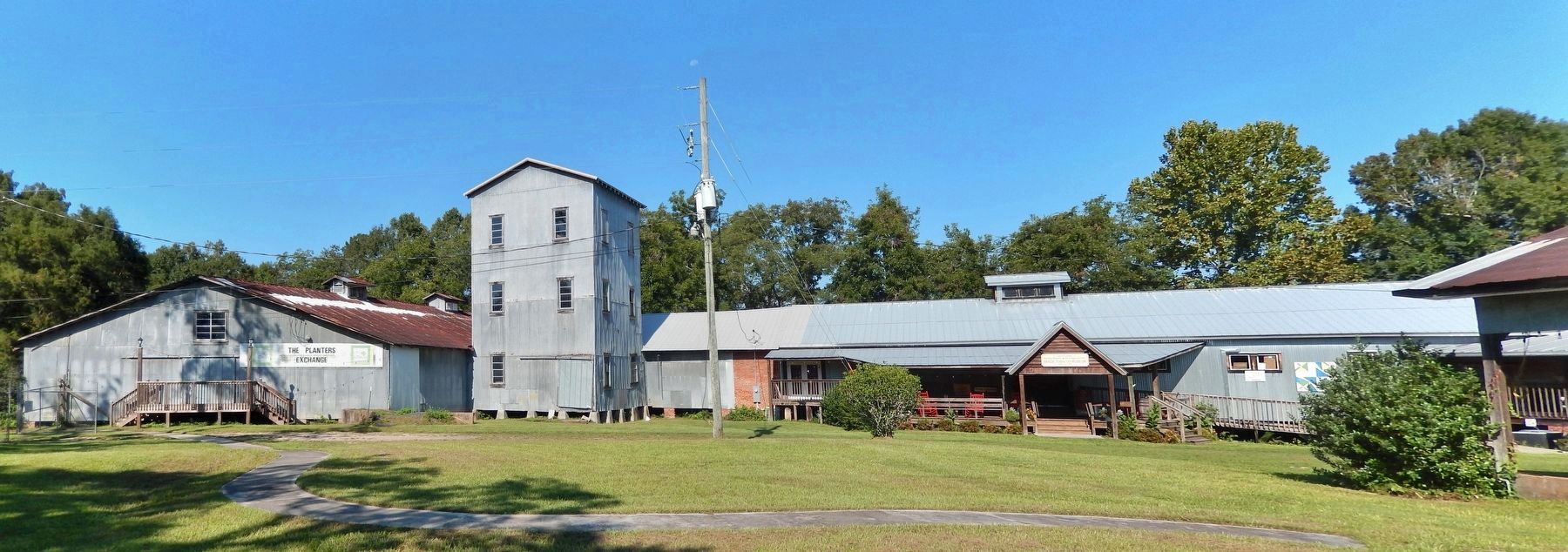
From the National Register Nomination: In about 1932, a brick storefront with a fixed glass display front was connected to the east side of the warehouse. In 1938 the brick store more than doubled in size, being enlarged to the south. A second store front was created facing east on Second Street. Both have large display windows, and both have large single door entrances. The brick store sections have continuous brick foundations and brick exterior walls. A continuous parapet rises across the front, east elevation of the building.Although times were not easy for the early period of The Planter's Exchange, times began to improve quickly during and after World War II. The Planter's Exchange was locally famous for its PEX Brand tobacco fertilizers. In its early years, the Planter's Exchange used a small fertilizer mixer, weighed the product by a platform scale, and produced hand-sewn 200 lb. bags of fertilizer as a finished product. Prior to this, fertilizer was shipped in with very little local input as to the specific needs, and with little quality control. The Planter's Exchange began to offer soil analysis for two acres and larger and, coupled with good service, the business began to grow. In the mid 1940's, plans were made for a new and more efficient mixer plant. A three-story vertical mill was installed in 1948, and was state-of-the-art for the time, and is still in the building. During the late forties and fifties, this mill produced about 10,000 tons of shade tobacco fertilizer each year. This was approximately 75 to 80% of the total used by the regional market. This equipment operated with minor maintenance until 1993 when it was shut down still in operating
condition.Photographed by Cosmos Mariner, September 22, 20244. The Planters Exchange — Tower & North WarehouseFrom the National Register Nomination: A tall three-story portion in the center of the complex houses a vertical mill. The warehouse and processing plant is a one story, wood building with corrugated metal sides and roof. The warehouse runs in a northeasterly direction aligned with the railroad tracks.The company was the first to handle charcoal for curing the cigar wrapper tobacco. In 1937, they found a charcoal plant near Pensacola, Florida, that had been getting the tar out of pine stumps and throwing the charcoal away. A franchise to sell the product was obtained, and charcoal was delivered to nearly every tobacco farmer in the area. In the fifties, propane gas burners became available, and the market for charcoal quickly disappeared.
The Planter's Exchange bought secondhand cheesecloth from the Connecticut area growers to sell to local area growers to reuse for one year. The cloth cover was essential for proper leaf thickness to roll a good cigar. The Connecticut valley area was the only other area where shade tobacco was grown in the United States. The company also sold new cloth that could be used for two years. Further, The Planter's Exchange repurchased this cloth from local farmers when it was too ragged to be used. They cleaned the cloth, compressed it into bales, and shipped it to various parts of the country where it was used for ground cover or cleaning rags.
The Planter's Exchange was the first to buy and
ship pole beans and other produce grown by area farmers. By truck and by rail, Williams shipped beans to larger city markets such as Atlanta, Birmingham, Nashville, and Louisville. This produce business was operated extensively and successfully for about 20 years until the state farmers markets came into existence in the region. The competition being very keen, this produce portion of the business was discontinued about 1950.Photographed by Cosmos Mariner, September 22, 20245. The Planters Exchange — Tower & South WarehouseThe company also sold insurance that related to the shade tobacco industry, such as fire, windstorm, hail, and truck and auto coverage. The Exchange was also a primary center for information about the region's industry.
While there were a few good years in the 1960s, these years showed the beginning of the collapse of the shade tobacco industry. Increased costs and declining demand made it more difficult to grow shade tobacco profitably; the last small crop was grown about 1976. Efforts were made with some success to continue the Exchange as a supplier of a broader spectrum of agricultural supplies such as seed, feed, and hardware, and continue to manufacture fertilizer for vegetables, pastures, and row crops.
This business increased until about 1985, leveled out, and then began to decline. At this time, a nursery was started and more diverse retailing was introduced. The fertilizer plant was closed in 1993. In 1996, to preserve part of the warehouse and generate rental income, approximately 5,000 square feet was renovated in the section along 9th Avenue. The work was completed and the spaces were rented, but could not be sustained, and it was closed after about one year. About the same time, the retail operation of about 9,000 square feet was improved and renovated.Photographed by Cosmos Mariner, September 22, 20246. The Planters Exchange — Delivery/Pick-up ShelterFrom the National Register Nomination: An additional three resources contribute to the nomination: a separate wooden building, a truck weighing scale and scale shelter, and an open sided delivery/pick-up shelter which are a part of the Exchange.


Also see . . . The Planters Exchange (Museum Website).
Excerpt: The Shade Tobacco Museum, Havana History & Heritage Society. Opened in 2021 housing archives from the shade tobacco industry in Gadsden County Florida. All tools and processes used for the growing and processing of shade tobacco which is used for the wrapper of fine handmade cigars. The museum goal centers around educating the public about the boom times during the last century of shade tobacco production. They feature changing exhibits and speakers from the industry.(Submitted on May 11, 2026, by Cosmos Mariner of Cape Canaveral, Florida.)
Credits. This page was last revised on May 11, 2026. It was originally submitted on May 7, 2026, by Cosmos Mariner of Cape Canaveral, Florida. This page has been viewed 20 times since then. Photos: 1, 2, 3, 4, 5, 6, 7. submitted on May 11, 2026, by Cosmos Mariner of Cape Canaveral, Florida.
