City of London in Greater London, England, United Kingdom — Northwestern Europe (the British Isles)
Holy Trinity Priory
Photographed by Andrew Ruppenstein, April 25, 2026
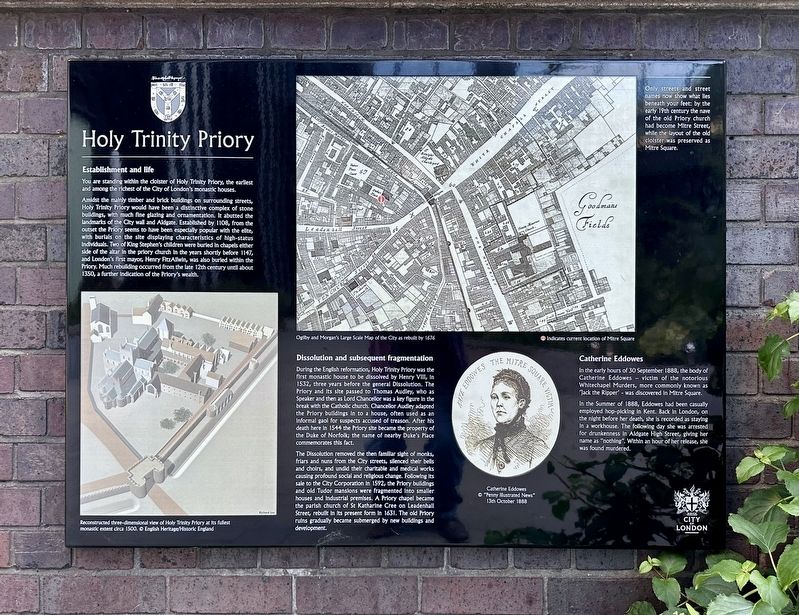
1. Holy Trinity Priory Marker
Establishment and life
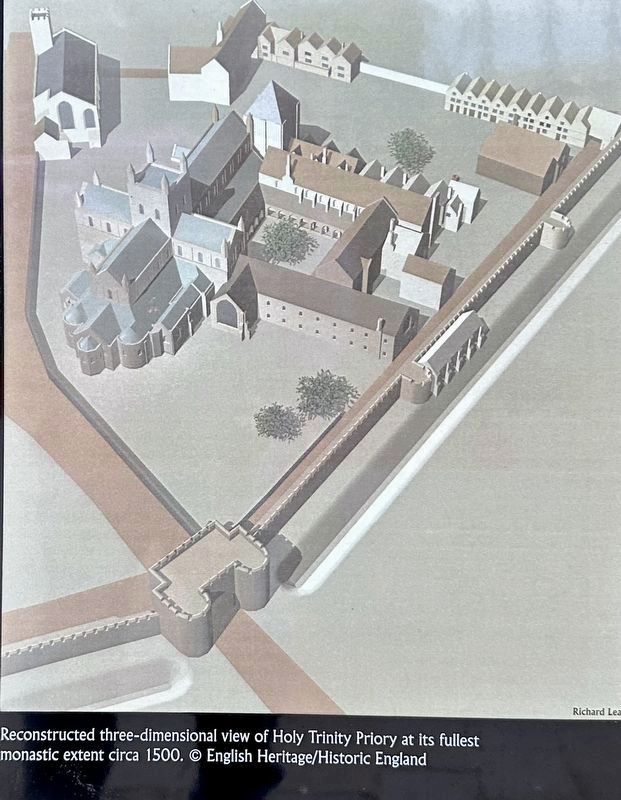
You are standing within the cloister of Holy Trinity Priory, the earliest and among the richest of the City of London's monastic houses.
Amidst the mainly timber and brick buildings on surrounding streets, Holy Trinity Priory would have been a distinctive complex of stone buildings, with much fine glazing and ornamentation. It abutted the landmarks of the City wall and Aldgate. Established by 1108, from the outset the Priory seems to have been especially popular with the elite, with burials on the site displaying characteristics of high-status individuals. Two of King Stephen's children were buried in chapels either side of the altar in the priory church in the years shortly before 1147, and London's first mayor, Henry FitzAilwin, was also buried within the Priory. Much rebuilding occurred from the late 12th century until about 1350, a further indication of the Priory's wealth.
Dissolution and subsequent fragmentation
During the English reformation, Holy Trinity Priory was the first monastic house to be dissolved by Henry VIII, in 1532, three years before the general Dissolution.
this page online
Catherine Eddowes
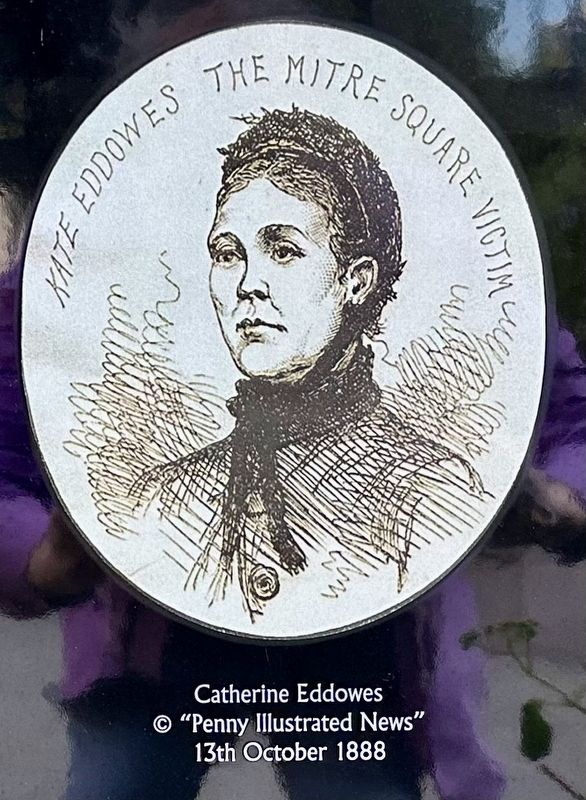
In the early hours of 30 September 1888, the body of Catherine Eddowes — victim of the notorious Whitechapel Murders, more commonly
Photographed by Andrew Ruppenstein, April 25, 2026
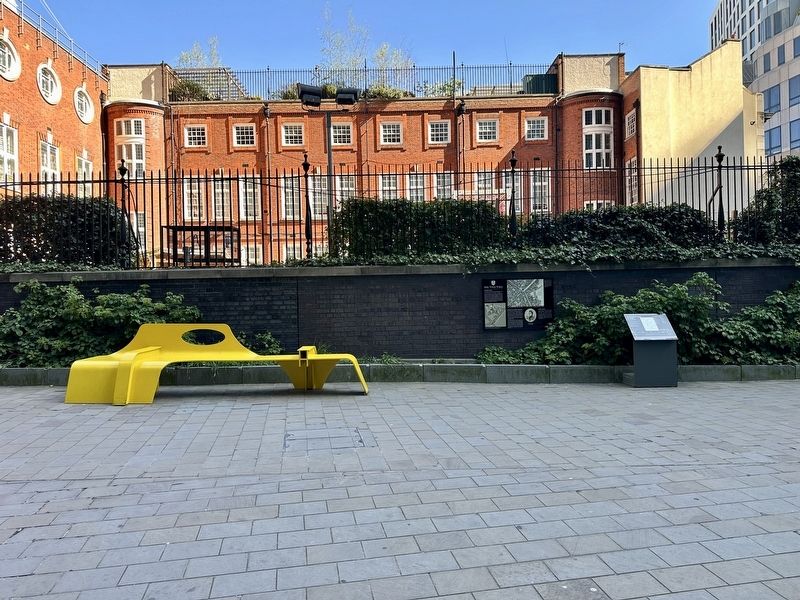
2. Holy Trinity Priory Marker - wide view
In the Summer of 1888, Eddowes had been casually employed hop-picking in Kent. Back in London, on the night before her death, she is recorded as staying in a workhouse. The following day she was arrested for drunkenness in Aldgate High Street, giving her name as “nothing”. Within an hour of her release, she was found murdered.
Erected by City of London.
Topics. This historical marker is listed in these topic lists: Religion & Religious Structures • Women. A significant historical date for this entry is September 30, 1888.
Location. 51° 30.83′ N, 0° 4.667′ W. Marker is in City of London, England, in Greater London. It is at the intersection of Saint James's Passage and Mitre Square, on the left when traveling west on Saint James's Passage. Touch for map. Marker is in this post office area: City of London, England EC3A 5DE, United Kingdom. Touch for directions.

Regionally, this marker is in London and in the Greater South East. Globally, it is on the Atlantic Ocean, in the North Atlantic Region, in Europe, in Atlantic Europe, on one of the British Isles, in the Western
Richard Lea, English Heritage/Historic England
3. Marker illustration: Reconstructed view of Holy Trinity Priory
Other nearby markers. At least 8 other markers are within walking distance of this marker: A different marker also named Holy Trinity Priory (here, next to this marker); The Great Synagogue Dukes Place (within shouting distance of this marker); Aldgate (about 90 meters away, measured in a direct line); Site of First Synagogue (about 90 meters away); Tylers’ and Bricklayers’ Hall (about 120 meters away); Phillis Wheatley (about 120 meters away); The London Wall Walk - 07 (about 120 meters away); East India Arms (about 180 meters away). Touch for a list and map of all markers in City of London.
Photographed by Penny Illustrated News, October 13, 1888
4. Marker illustration: Catherine Eddowes
Credits. This page was last revised on May 9, 2026. It was originally submitted on May 9, 2026, by Andrew Ruppenstein of Lamorinda, California. This page has been viewed 19 times since then. Photos: 1, 2, 3, 4. submitted on May 9, 2026, by Andrew Ruppenstein of Lamorinda, California.
