East End in Melbourne, Victoria, Australia — Oceania
The Windsor Hotel
Photographed by Dean Barton-Ancliffe, May 5, 2026
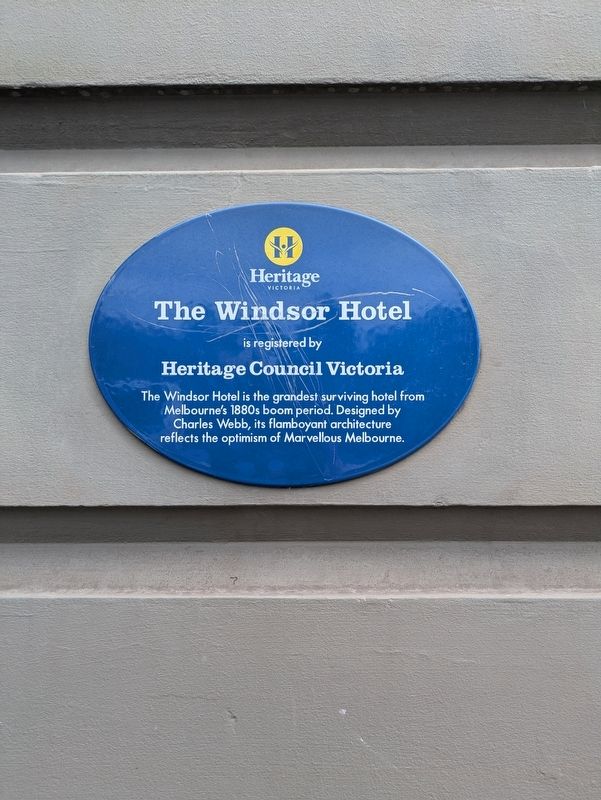
1. The Windsor Hotel Marker
The Windsor Hotel
is registered by
Heritage Council Victoria
The Windsor Hotel is the grandest surviving hotel from Melbourne's 1880s boom period. Designed by Charles Webb, its flamboyant architecture reflects the optimism of Marvellous Melbourne.
Erected by Heritage Victoria.
Topics. This historical marker is listed in these topic lists: Architecture • Colonial Era. A significant historical year for this entry is 1880.
Location. 37° 48.719′ S, 144° 58.391′ E. Marker is in Melbourne, Victoria. It is in East End. It is on Spring Street 0.1 kilometers north of Little Collins Street, on the left when traveling north. Touch for map. Marker is at or near this postal address: 111 Spring Street, Melbourne VIC 3004, Australia. Touch for directions.

Regionally, it is in Oceania, in Australasia, in the Pacific Ocean, in South Pacific, on the Pacific Rim, in the Western World, and in the Anglosphere. Historically, it finds itself in what was once a British colony.
Other nearby markers. At least 8 other markers are within walking distance of this marker: Adam Lindsay Gordon 1932 (within shouting distance
this page online
Also see . . . Hotel Windsor. Victorian Heritage Database
Construction of the Hotel Windsor commenced in 1883 for George Nipper of the shipping firm Nipper and See. Designed by Charles Webb and built by Thomas Cockram and Company, it was originally known as the Grand Hotel. The building was extended and became known as the Grand Coffee Palace in time to accommodate visitors to the Centenary Exhibition of 1888. It was re-named the Windsor Hotel in 1920.(Submitted on May 10, 2026, by Dean Barton-Ancliffe of Rowville, Victoria.)
The Grand Coffee Palace Company Limited, headed by James Munro and James Balfour, was formed to purchase the Grand Hotel and convert it into a temperance hotel in 1886. Renamed the GrandCoffee Palace, liquor was banned from the premises and the hotel became the flagship of the temperance movement. James Munro, Premier of Victoria in 1890, and James Balfour, who entered parliament in 1866, were both well known leaders in the temperance movement in Victoria.Photographed by Dean Barton-Ancliffe, May 5, 20262. The Windsor Hotel
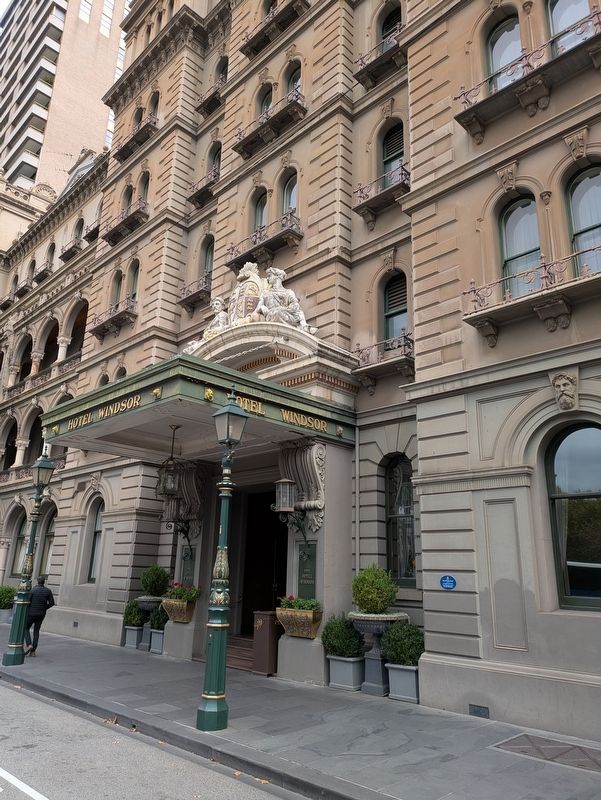
The original section of the hotel was built on the corner of Spring and Little Collins Streets in a Renaissance Revival style. The main Spring Street facade was symmetrical, with a five-storey central section containing three arcaded lower levels, flanked by six-storey corner towers. In 1887-88 the building was extended to the north along Spring Street, by the same architect, Charles Webb. A symmetrical facade was again achieved with the duplication of the existing facade and the addition of a central entrance bay. Mansard roofs were added to the central towers flanking the entrance, providing a French Renaissance character, and a stone sculpture was installed above a segmental pediment of the main entrance. Attributed to John Simpson Mackennal, who also worked on the interior and exterior decoration of Parliament House, the sculpture of 'Peace and Plenty' incorporates two reclining figures and a central shield containing the English and Australian Coat of Arms.
Credits. This page was last revised on May 11, 2026. It was originally submitted on May 10, 2026, by Dean Barton-Ancliffe of Rowville, Victoria. This page has been viewed 23 times since then. Photos: 1, 2. submitted on May 10, 2026, by Dean Barton-Ancliffe of Rowville, Victoria. • Andrew Ruppenstein was the editor who published this page.
