Douglas in Chicago in Cook County, Illinois — The American Midwest (Great Lakes)
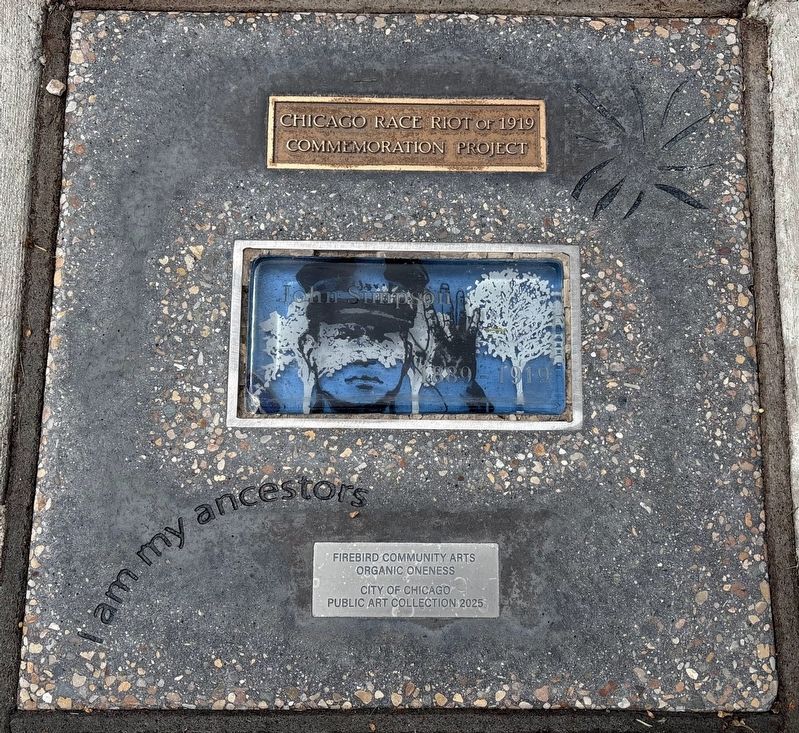
John Simpson
1889-1919
| — | Chicago Race Riot of 1919 Commemoration Project | — |
Photographed by Sean P. Flynn, May 13, 2026
1. John Simpson Marker
Erected 2025 by Chicago Race Riot of 1919 Commemoration Project.
Topics and series. This historical marker is listed in these topic lists: African Americans • Disasters • Law Enforcement. In addition, it is included in the Chicago Race Riot of 1919 Commemoration Project, Illinois series list. A significant historical date for this entry is July 28, 1928.
Location. 41° 50.294′ N, 87° 37.5′ W. Marker is in Chicago, Illinois, in Cook County. It is in Douglas. It is on East 31st Street near South Wabash Avenue, on the right when traveling east. The marker is embedded into the sidewalk, not far from the Illinois Institute of Technology's Kacek Hall. Touch for map. Marker is at or near this postal address: 3100 S Wabash Ave, Chicago IL 60616, United States of America. Touch for directions.

Regionally, this marker is on Chicago’s South Side and in Chicago’s Bronzeville. It is also in the American Midwest. Globally, it is in North America, on the Great Lakes, in the Western Hemisphere, in the Western World, and in the Anglosphere. Historically, it finds itself in what was once the Viceroyalty of
this page online
Other nearby markers. At least 8 other markers are within walking distance of this marker: Votes for Women (about 500 feet away, measured in a direct line); Unity Hall (approx. 0.2 miles away); Sidney A. Kent House (approx. 0.2 miles away); Our Hometown: Chicago (approx. 0.2 miles away); a different marker also named Our Hometown: Chicago (approx. 0.2 miles away); Paul Laurence Dunbar (approx. 0.2 miles away); Armour Flats (approx. 0.3 miles away); Pilgrim Baptist Church (approx. 0.3 miles away). Touch for a list and map of all markers in Chicago.
More about this marker. The sidewalk marker is one of several erected by the Chicago Race Riot of 1919 Commemoration Project in remembrance of those killed during the deadly racial violence that gripped Chicago in the summer of 1919. Inspired by the Stolpersteine ("Stumbling Stones") project in Europe, which erects sidewalk markers honoring Holocaust victims, these markers in Chicago have been placed on sidewalks at sites where people were killed in 1919.
Regarding John Simpson. John Simpson
Photographed by Sean P. Flynn, May 13, 2026
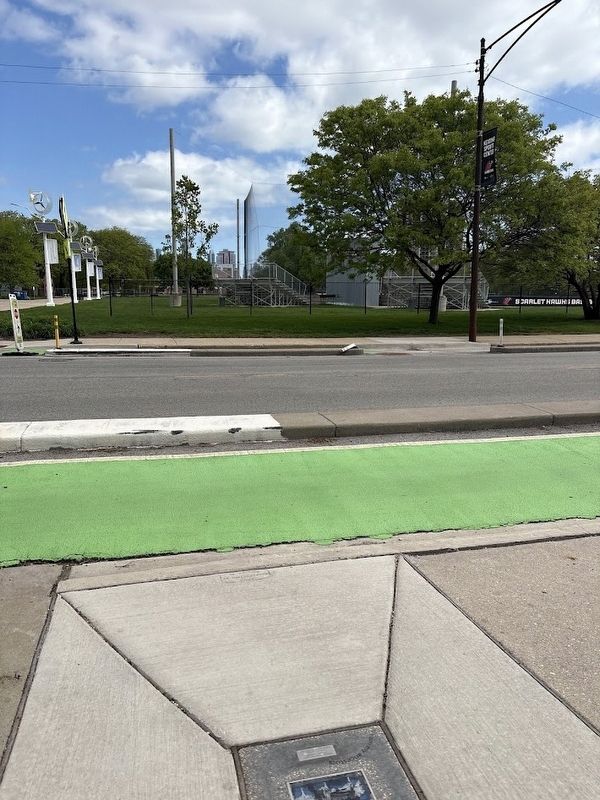
2. John Simpson Marker at 31st Street
Illinois Tech's baseball field is across the street, and Chicago's downtown skyline is in the far distance.
On July 27, 1919, Eugene Williams, a Black 17-year-old, was riding in a homemade raft with four friends in Lake Michigan when it accidentally floated past the invisible boundary that demarcated what was a de-facto "whites-only" part of the beach. A white man, George Stauber, threw stones at the boys and killed Williams. The scene set off a wave of protests followed by a week of racially driven violence. Between July 27 and Aug. 3, 38 people died (23 were Black and 15 white), more than 500 were injured, and more than 1,000 people, most of them
Photographed by Sean P. Flynn, May 13, 2026
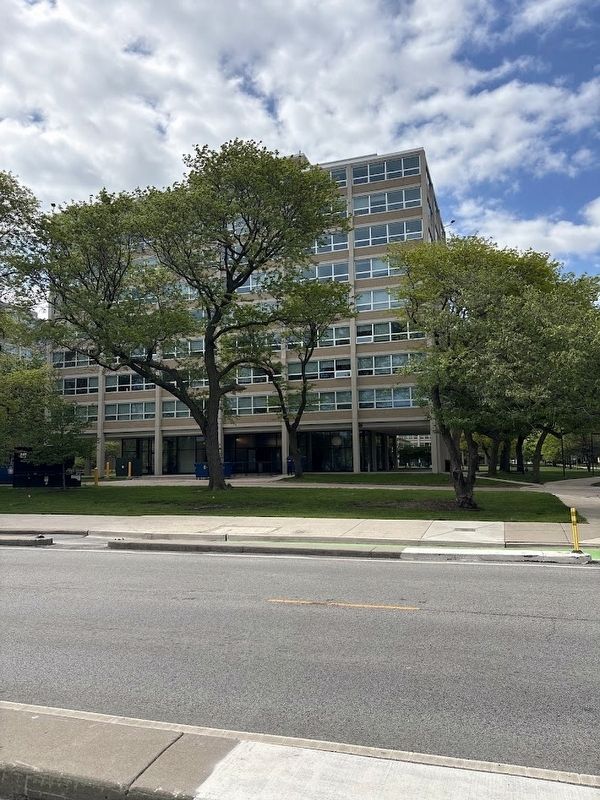
3. John Simpson Marker
The marker is in the sidewalk near the Illinois Institute of Technology's Kacek Hall.
A day later, Simpson was shot and killed in the chaos that ensued, although the details of his death remain uncertain more than 100 years later. One report said that he was shot by a band of Black men that he was attempting to arrest at 31st and Wabash (near this spot) because the group had been accused of looting stores on State Street. The city's official report on the rioting, however, found that he was killed by a Black poolroom owner with whom he had had a previous conflict. Whatever the case, Simpson died of his wounds at Mercy Hospital and was buried at Lincoln Cemetery in Blue Island, a suburb south of Chicago.
Also see . . . John Simpson. The official website of the Chicago Race Riot of 1919 Commemoration Project shares the story of John Simpson, who was killed near this spot on July 28, 1919. (Submitted on May 13, 2026, by Sean P. Flynn of Oak Park, Illinois.)
Credits. This page was last revised on September 29, 2026. It was originally submitted on May 13, 2026, by Sean P. Flynn of Oak Park, Illinois. This page has been viewed 9 times since then. Photos: 1, 2, 3. submitted on May 13, 2026, by Sean P. Flynn of Oak Park, Illinois.
