North Capitol in Nashville in Davidson County, Tennessee — The American South (East South Central)
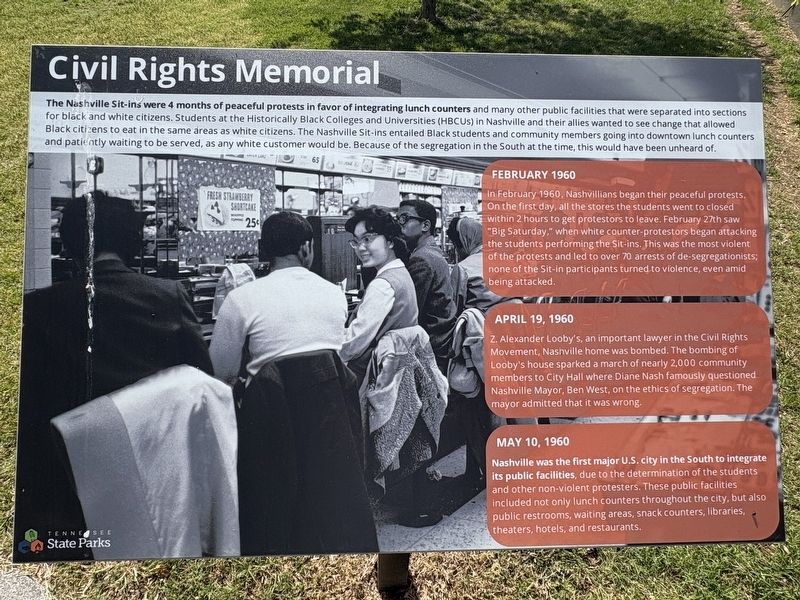
Civil Rights Memorial
Photographed by Darren Jefferson Clay, May 9, 2026
1. Civil Rights Memorial
The Nashville Sit-ins were 4 months of peaceful protests in favor of integrating lunch counters and many other public facilities that were separated into sections for black and white citizens. Students at the Historically Black Colleges and Universities (HBCUs) in Nashville and their allies wanted to see change that allowed Black citizens to eat in the same areas as white citizens. The Nashville Sit-ins entailed Black students and community members going into downtown lunch counters and patiently waiting to be served, as any white customer would be. Because of the segregation in the South at the time, this would have been unheard of.
February 1960
In February 1960, Nashvillians began their peaceful protests. On the first day, all the stores the students went to closed within 2 hours to get protestors to leave. February 27th saw "Big Saturday," when white counter-protestors began attacking the students performing the Sit-ins. This was the most violent of the protests and led to over 70 arrests of de-segregationists; none of the Sit-in participants turned to violence, even amid being attacked.
April 19, 1960
Z.
this page online
May 10, 1960
Nashville was the first major U.S. city in the South to integrate its public facilities, due to the determination of the students and other non-violent protesters. These public facilities included not only lunch counters throughout the city, but also public restrooms, waiting areas, snack counters, libraries, theaters, hotels, and restaurants.
Erected by Tennessee State Parks.
Topics. This historical marker and memorial is listed in this topic list: Civil Rights. A significant historical month for this entry is February 1960.
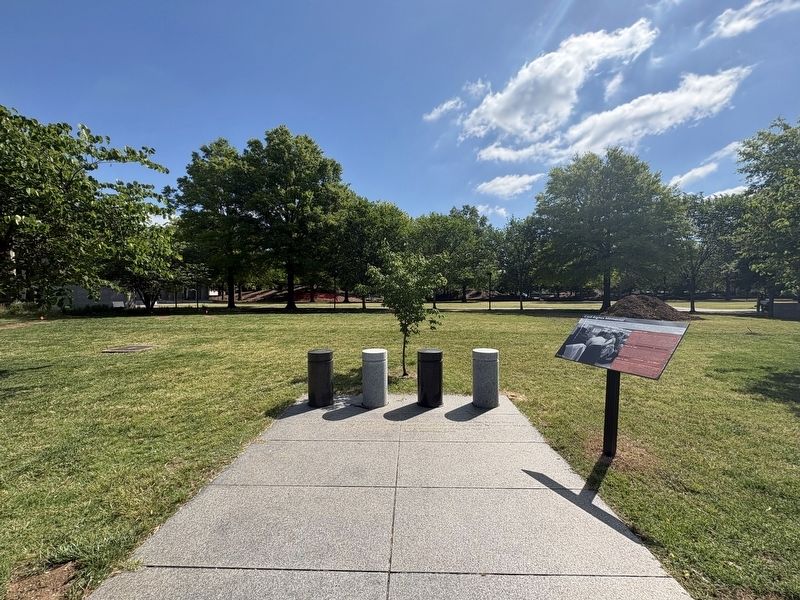
Location. 36° 10.331′ N, 86° 47.335′ W. Marker is in Nashville, Tennessee, in Davidson County. It is in North Capitol. It is on 7th Avenue North south of Jefferson Street, on the left when traveling south. Touch for map. Marker is at or near this postal address: 1966 7th Ave N,
Photographed by Darren Jefferson Clay, May 9, 2026
2. Civil Rights Memorial

Regionally, this marker and memorial is in Middle Tennessee. It is also in the American South and specifically in the Upper South. Globally, it is in North America, the Western Hemisphere, the Western World, and the Anglosphere. Historically, it finds itself in what was once the territory of the Mississippian Culture, one of the Confederate States of America, and the Antebellum South.
Other nearby markers. At least 8 other markers are within walking distance of this marker: The state's first three community colleges (here, next to this marker); Ingram Book Group (here, next to this marker); Milligan College (here, next to this marker); Jack Daniels and George Dickel distilleries (here, next to this marker); John F. Kennedy at Vanderbilt University (here, next to this marker); Nashville and Davidson County (here, next to this marker); Dr. Dorothy Brown (here, next to this marker); St. Jude Children's Research Hospital (here, next to this marker). Touch for a list and map of all markers in Nashville.
Credits. This page was last revised on May 16, 2026. It was originally submitted on May 13, 2026, by Darren Jefferson Clay of Duluth, Georgia. This page has been viewed 19 times since then. Photos: 1, 2. submitted on May 14, 2026, by Darren Jefferson Clay of Duluth, Georgia. • James Hulse was the editor who published this page.
