Bathurst Quay in Toronto, Ontario — Central Canada (North America)
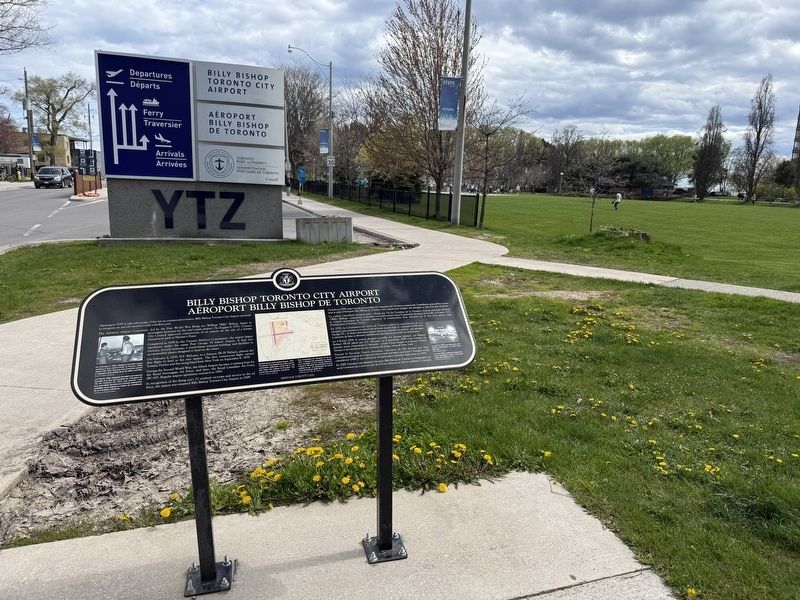
Billy Bishop Toronto City Airport
⎯⎯⎯
Aéroport Billy Bishop de Toronto
Photographed by Caroline Record, May 10, 2026
1. Billy Bishop Toronto City Airport Marker

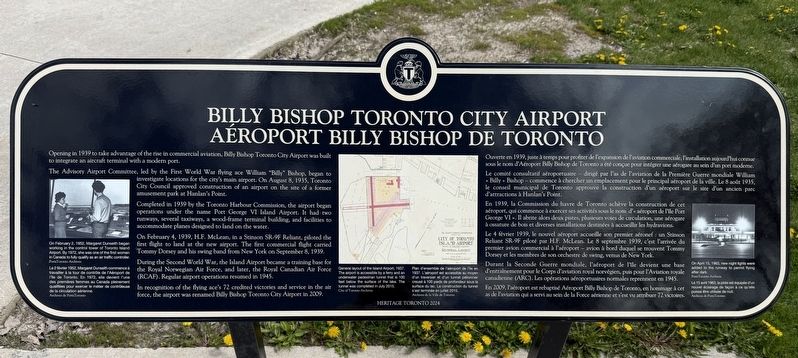
Opening in 1939 to take advantage of the rise in commercial aviation, Billy Bishop Toronto City Airport was built to integrate an aircraft terminal with a modern port.
The Advisory Airport Committee, led by the First World War flying ace William "Billy" Bishop, began to investigate locations for the city's main airport. On August 8, 1935, Toronto City Council approved construction of an airport on the site of a former amusement park at Hanlan's Point.
Completed in 1939 by the Toronto Harbour Commission, the airport began operations under the name Port George VI Island Airport. It had two runways, several taxiways, a wood-frame terminal building, and facilities to accommodate planes designed to land on the water.
On February 4, 1939, H.F. McLean, in a Stinson SR-9F Reliant, piloted the first flight to land at the new airport. The first commercial flight carried Tommy Dorsey and his swing band from New York on September 8, 1939.
During the Second World War, the Island Airport became a training base for the Royal Norwegian Air Force, and later, the Royal Canadian Air
this page online
In recognition of the flying ace's 72 credited victories and service in the air force, the airport was renamed Billy Bishop Toronto City Airport in 2009.
Ouverte en 1939, juste à temps pour profiter de l’expansion de l’aviation commerciale, l’installation aujourd’hui connue sous le nom d’Aéroport Billy Bishop de Toronto a été conçue pour intégrer une aérogare au sein d’un port moderne.
Le comité consultatif aéroportuaire — dirigé par l’as de l’aviation de la Première Guerre mondiale William « Billy » Bishop — commence à chercher un emplacement pour le principal aéroport de la ville. Le 8 août 1935, le conseil municipal de Toronto approuve la construction d’un aéroport sur le site d’un ancien parc d’attractions à Hanlan’s Point.
En 1939, la Commission du havre de Toronto achève la construction de cet aéroport, qui commence à exercer ses activités sous le nom d’« aéroport de l’île Port George VI ». Il abrite alors deux pistes, plusieurs voies de circulation, une aérogare à ossature de bois et diverses installations destinées à accueillir
Photographed by Caroline Record, May 10, 2026
2. Billy Bishop Toronto City Airport Marker
Le 4 février 1939, le nouvel aéroport accueille son premier aéronef : un Stinson Reliant SR-9F piloté par H.F. McLean. Le 8 septembre 1939, c’est l’arrivée du premier avion commercial à l’aéroport — avion à bord duquel se trouvent Tommy Dorsey et les membres de son orchestre de swing, venus de New York.
Durant la Seconde Guerre mondiale, l’aéroport de l’île devient une base d’entraînement pour le Corps d’aviation royal norvégien, puis pour l’Aviation royale canadienne (ARC). Les opérations aéroportuaires normales reprennent en 1945.
En 2009, l’aéroport est rebaptisé Aéroport Billy Bishop de Toronto, en hommage à cet as de l’aviation qui a servi au sein de la Force aérienne et s’est vu attribuer 72 victoires.
Erected 2024 by Heritage Toronto.
Topics and series. This historical marker is listed in these topic lists: Air & Space • War, World II • Women. In addition, it is included in the Canada, Toronto Heritage series list. A significant historical date for this entry is September 8, 1939.
Location. 43° 38.12′ N, 79° 23.888′ W. Marker is in Toronto, Ontario. It is in Bathurst Quay. It is on Eireann Quay, on the
3. Billy Bishop Toronto City Airport Marker photo
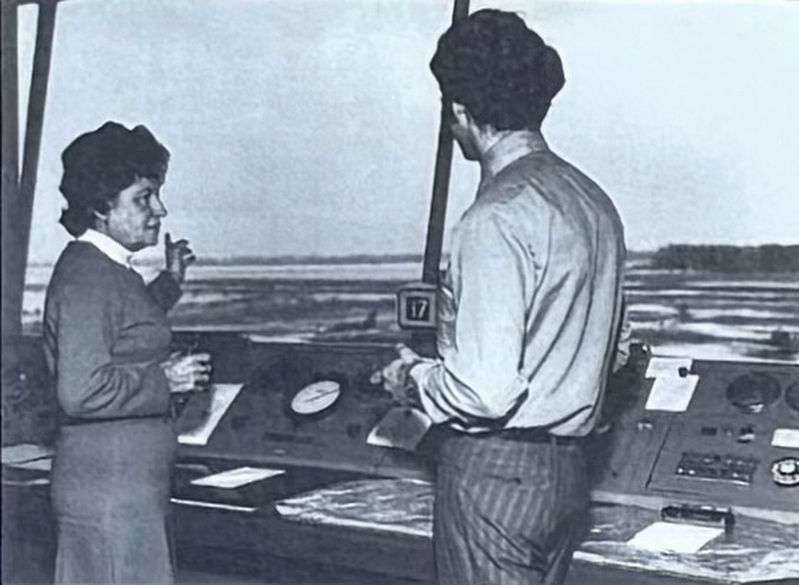
On February 2, 1952, Margaret Dunseith began working in the control tower of Toronto Island Airport. By 1972, she was one of the first women in Canada to fully qualify as an air traffic controller.

Regionally, this marker is in Greater Toronto and on the Golden Horseshoe. It is also in Central Canada. Globally, it is in North America, on the Great Lakes, in the Western Hemisphere, in the Western World, and in the Anglosphere. Historically, it finds itself in what was once a British colony, the Viceroyalty of New France, the Haudenosaunee (Iroquois) Confederacy, and Rupert’s Land.
Other nearby markers. At least 8 other markers are within walking distance of this marker: Little Norway (within shouting distance of this marker); Ben Dunkelman (approx. 0.4 kilometers away); 8-Inch Shell Gun (Serial No. 406) (approx. half a kilometer away); No. 1 (East) Blockhouse (approx. half a kilometer away); Circular, or Government House, Battery (approx. half a kilometer away); Brick Magazine (approx. 0.6 kilometers away); No. 2 (Centre) Blockhouse (approx. 0.6 kilometers away); Well and Well House (approx. 0.6 kilometers away). Touch for a list and map of all markers in Toronto.
Credits. This page was last revised on May 17, 2026. It was originally submitted on May 14, 2026, by Caroline Record of Montréal, Québec. This page has been viewed 27 times since then. Photos: 1, 2, 3. submitted on May 14, 2026, by Caroline Record of Montréal, Québec. • Andrew Ruppenstein was the editor who published this page.
