Arkansas City in Desha County, Arkansas — The American South (West South Central)
Desha County
Robert Cavelier, Sieur de la Salle
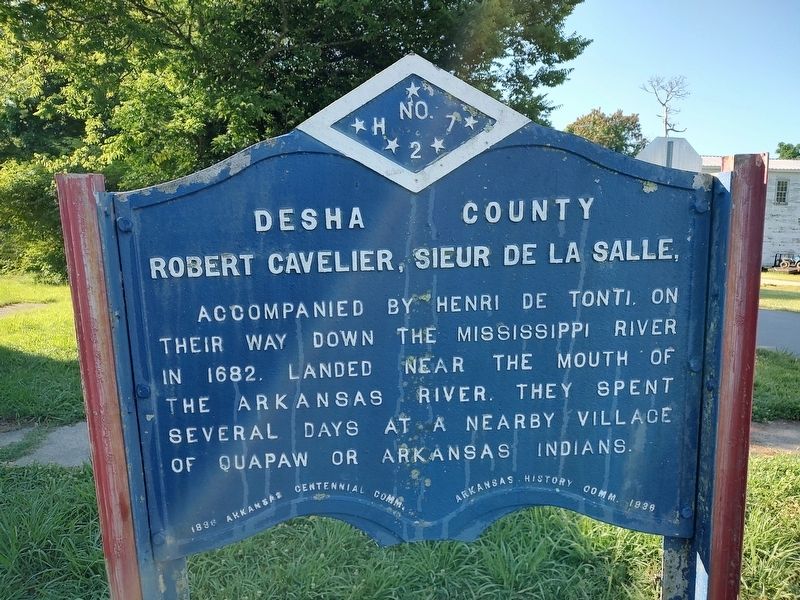
Photographed by Jimmy Emerson, May 13, 2026
1. Desha County Marker
Erected 1936 by Arkansas History and Centennial Commissions. (Marker Number H 27.)
Topics and series. This historical marker is listed in these topic lists: Exploration • Indigenous Peoples and Communities. In addition, it is included in the Arkansas Centennial Commission series list. A significant historical year for this entry is 1682.
Location. 33° 36.416′ N, 91° 12.188′ W. Marker is in Arkansas City, Arkansas, in Desha County. It is on Capitol Street near Kate Adams Avenue, on the right when traveling east. Touch for map. Marker is at or near this postal address: 202 Capitol Street, Arkansas City AR 71630, United States of America. Touch for directions.

Regionally, this marker is in the Arkansas Delta, in the Mississippi Alluvial Plain, and in the Quapaw Homeland. It is also in the American South, specifically in the Deep South, in the Upper South, in the Mississippi Delta, in the Piney Woods, and in the
this page online
Other nearby markers. At least 8 other markers are within 9 miles of this marker, measured as the crow flies: Flood of 1927 (a few steps from this marker); The X. O. Pindall Law Office (a few steps from this marker); Arkansas City Commercial Historic District (about 600 feet away, measured in a direct line); Arkansas City River Port (about 800 feet away); a different marker also named Desha County (approx. 0.2 miles away); John H. Johnson Cultural & Educational Museum (approx. ¼ mile away); Mississippi River Blues: The 1927 Flood (approx. 7.4 miles away in Mississippi); William Fisher Johnson (approx. 8.3 miles away in Mississippi). Touch for a list and map of all markers in Arkansas City.
Another marker is no longer nearby. The Great Flood of 1927 (was approx. 7.6 miles away in Mississippi
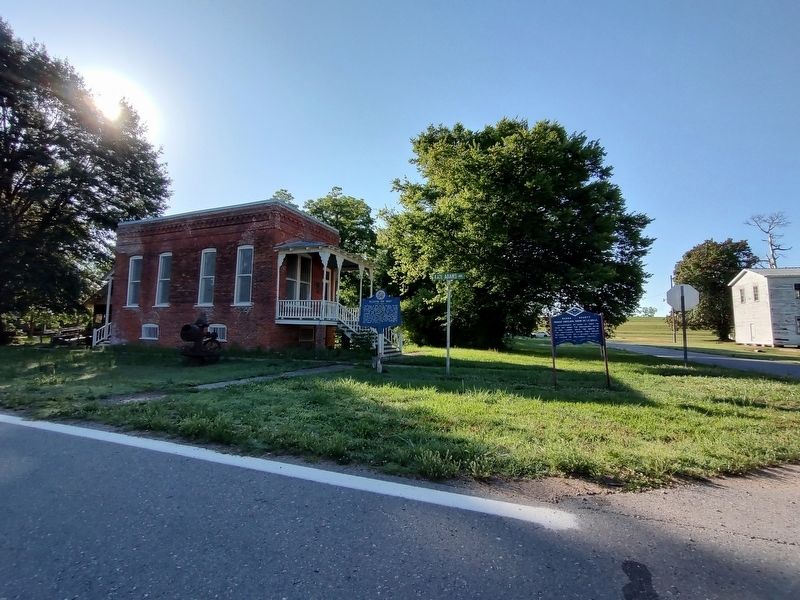
Photographed by Jimmy Emerson, May 13, 2026
2. Desha County Marker
Also see . . . René-Robert Cavelier, Sieur de La Salle (1643–1687) (Encyclopedia of Arkansas). Excerpt:
… By the 1670s, La Salle secured a patent of nobility and a seigniorial grant from the French king for land in North America. Aided by de Tonti, La Salle cultivated important military, social, and political alliances with Indian tribes in the Mississippi River Valley. Reaching Arkansas in 1682, La Salle and his men stopped at the Quapaw village of Kappa, a settlement located on the Mississippi River approximately twenty miles south of the mouth of the White River, where, after initial suspicion, the tribe received them cordially. Before leaving the Quapaw, La Salle erected a column bearing the coat of arms of Louis XIV and a painted cross at Kappa. From this moment until Spanish domination of Louisiana in the 1760s, the Quapaw allied themselves with the French to obtain firearms and manpower to face their enemies; they also traded, formed political alliances, and even intermarried with them. It was an advantageous relationship for both the Quapaw and the French. Following this ceremony, La Salle made a land grant to his trusted friend, de Tonti, who established a small trading post that would become Arkansas’s first permanent European settlement, Arkansas Post (Arkansas County), in 1686.(Submitted on May 14, 2026.)
Credits. This page was last revised on May 14, 2026. It was originally submitted on May 14, 2026, by Jimmy Emerson of Dalton, Georgia. This page has been viewed 18 times since then. Photos: 1, 2. submitted on May 14, 2026, by Jimmy Emerson of Dalton, Georgia. • Andrew Ruppenstein was the editor who published this page.
