Chatham in Pittsylvania County, Virginia — The American South (Mid-Atlantic)
Bilhartz, Hall & Co.
Gunmaker for the Confederacy
Photographed by Craig Swain, February 17, 2013
1. Bilhartz, Hall & Co. Marker
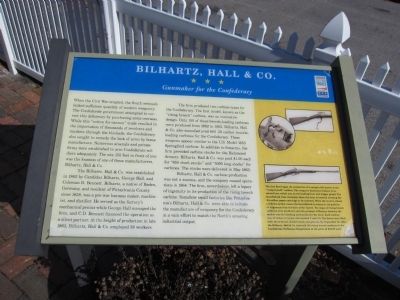
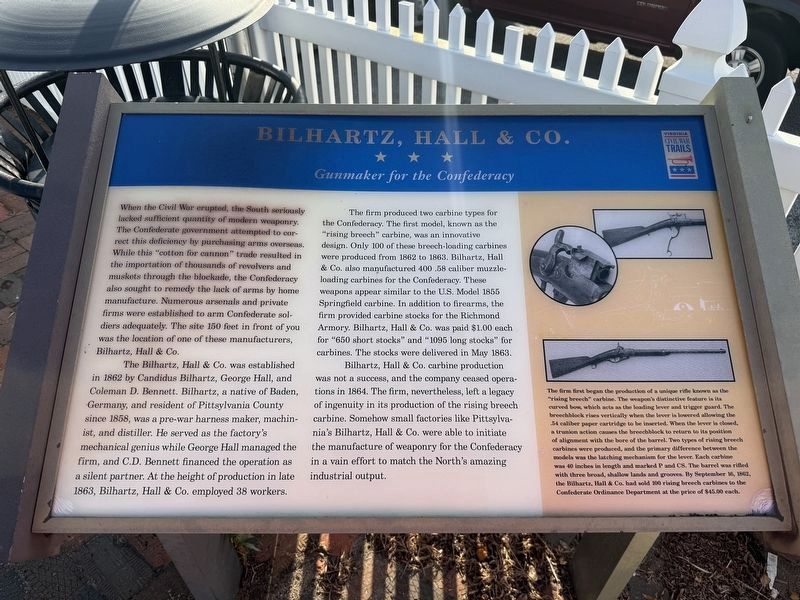
When the Civil War erupted, the South seriously lacked sufficient quantity of modern weaponry. The Confederate government attempted to correct this deficiency by purchasing arms overseas. While this "cotton for cannon" trade resulted in the importation of thousands of revolvers and muskets through the blockade, the Confederacy also sought to remedy the lack of arms by home manufacture. Numerous arsenals and private firms were established to arm Confederate soldiers adequately. The site 150 feet in front of you was the location of one of these manufacturers, Bilhartz, Hall & Co.
The Bilhartz, Hall & Co. was established in 1862 by Candidus Bilhartz, George Hall and Coleman D. Bennett. Bilhartz, a native of Baden, Germany, and resident of Pittsylvania County since 1858, was a pre-war harness maker, mechanist, and distiller. He served as the factory's mechanical genius while George Hall managed the firm, and C.D. Bennett financed the operation as a silent partner. At the height of production in late 1863, Bilhartz, Hall & Co. employed 38 workers.
The firm produced two carbine types for the Confederacy. The first mode,
this page online
Bilhartz, Hall & Co. carbine production was not a success, and the company ceased operations in 1864. The firm, nevertheless, left a legacy of ingenuity in its production of raising breech carbine. Somehow small factories like Pittsylvania's Bilhartz, Hall & Co. were able to initiate the manufacture of weaponry for the Confederacy in a vain effort to match the North's amazing industrial output.
[Sidebar:]
The firm first began the production of a unique rifle known as the "rising breech" carbine. The weapon's distinctive feature is its curved bow, which acts as the loading lever and trigger guard. The breechblock rises vertically when the lever is lowered allowing the .54 caliber paper cartridge to be inserted. When the lever is closed, a trunion action causes the breechblock to return to its position of alignment with the bore of the barrel. Two types of rising breech carbines were produced, and the primary difference between the models was the latching mechanism for the lever. Each carbine was 40 inches in length and marked P and CS. The barrel was rifled with three broad, shallow lands and grooves. By September 16, 1862, the Bilhartz, Hall, & Co. had sold 100 rising breech carbines to the Confederate Ordinance Department at the price of $45.00 each.
Erected 2001
Photographed by Devry Becker Jones (CC0), July 2, 2026
2. Bilhartz, Hall & Co. Marker
The marker has weathered but remains generally legible.
Topics and series. This historical marker is listed in this topic list: War, US Civil. In addition, it is included in the Virginia Civil War Trails series list. A significant historical month for this entry is May 1863.
Location. 36° 49.64′ N, 79° 23.882′ W. Marker has been reported damaged. Marker is in Chatham, Virginia, in Pittsylvania County. It is at the intersection of Main Street and Center Street, on the right when traveling north on Main Street. Touch for map. Marker is at or near this postal address: 37 Main St, Chatham VA 24531, United States of America. Touch for directions.

Regionally, this marker is in Southern Virginia, specifically in the Piedmont, and in Southside Virginia. It is also in the American South and specifically in the Upper South. Globally, it is in North America, the Western Hemisphere, the Western World, and the Anglosphere. Historically, it finds itself in what was once the territory of the Mississippian Culture, one of the original Thirteen Colonies, one of the Confederate States of America, and the Antebellum South.
Other nearby markers. At least 8 other markers
Photographed by C. Ryan Dodson, May 8, 2026
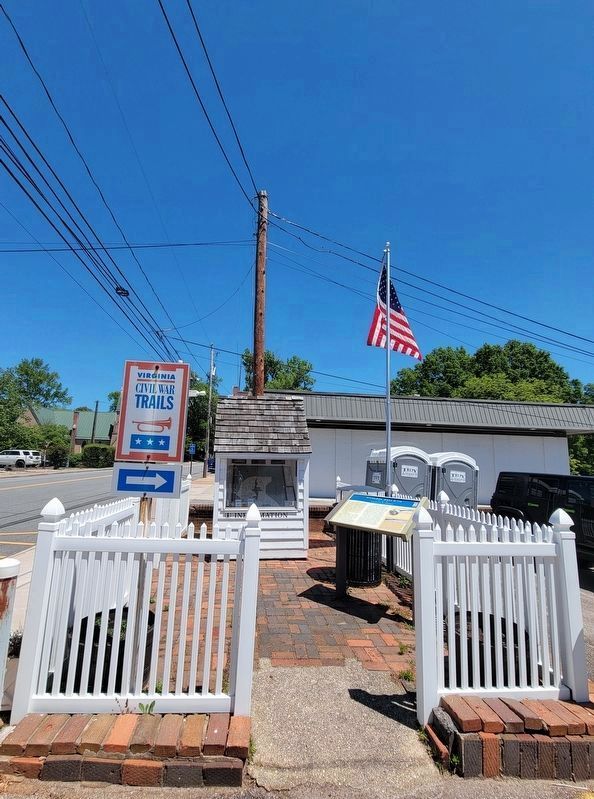
3. Bilhartz, Hall & Co. Marker next to an information kiosk
Regarding Bilhartz, Hall & Co.. "Ordinance" should be "Ordnance" (no "i").
Also see . . . Marker dedication ceremony.
Confederate re-enactors revived history Saturday at the dedication of the Civil War Trails marker designating the Bilharz, Hall Gun Works Factory.(Submitted on May 14, 2026, by C. Ryan Dodson of Danville, Virginia.)
Pittsylvania County's first Civil War Trails marker was dedicated Saturday commemorating the Bilharz, Hall & Company Gun Works which made rifles for the Confederacy from 1862 until 1864.
Photographed by Craig Swain, February 17, 2013
4. Bilhartz, Hall & Co. Marker

Photographed by Confederate Citizens Files
5. Receipt for Carbine Stocks

Photographed by Confederate Citizens Files
6. Recept for Breechloading Carbines
Credits. This page was last revised on July 5, 2026. It was originally submitted on April 6, 2013, by Craig Swain of Leesburg, Virginia. This page has been viewed 1,280 times since then and 94 times this year. Last updated on May 14, 2026, by C. Ryan Dodson of Danville, Virginia. Photos: 1. submitted on April 6, 2013, by Craig Swain of Leesburg, Virginia. 2. submitted on July 5, 2026, by Devry Becker Jones of Washington, District of Columbia. 3. submitted on May 14, 2026, by C. Ryan Dodson of Danville, Virginia. 4, 5, 6. submitted on April 6, 2013, by Craig Swain of Leesburg, Virginia. • Devry Becker Jones was the editor who published this page.
