Dupont Circle in Northwest Washington in Washington, District of Columbia — The American Northeast (Mid-Atlantic)
Samuel Hahnemann Monument
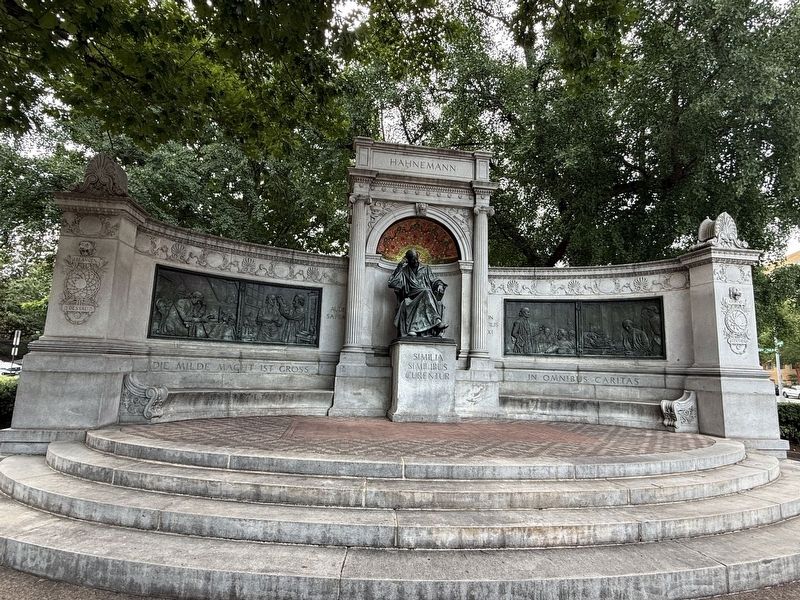

Erlangen • Dessau • Leipzig • Coethen
Meissen April 11 1755
Paris July 2 1843
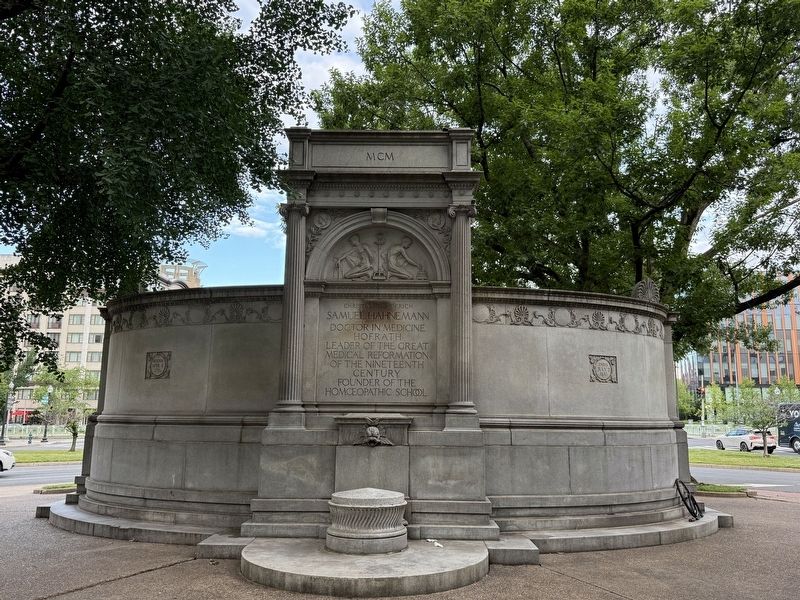
Samuel Hahnemann
Doctor in Medicine
Hofrath
Leader of the great
medical reformation
of the nineteenth
century
Founder of the
Homœopathic School
Erected 1900 by American Institute of Homeopathy; Julius Harder, architect; Charles Henry Niehaus, sculptor.
Topics. This historical marker and monument is listed in this topic list: Science & Medicine. A significant historical date for this entry is April 11, 1755.
Location. 38° 54.436′ N, 77° 2.144′ W. Marker is in Northwest Washington in Washington, District of Columbia. It is in Dupont Circle. It is at the intersection of Scott Circle Northwest and Rhode Island Avenue Northwest, on the right when traveling north on Scott Circle Northwest. Touch for map. Marker is at or near this postal
this page online

Regionally, this marker and monument is in the Washington Metropolitan Area. It is also in the American Northeast, in the Upper South, in the Mid-Atlantic, in the Tidewater, and in the Chesapeake Bay Region. Globally, it is in North America, the Western Hemisphere, the Western World, and the Anglosphere.
Other nearby markers. At least 8 other markers are within walking distance of this marker: This House was Occupied by Alexander Graham Bell (within shouting distance of this marker); Winfield Scott (within shouting distance of this marker); The Budapest Lad (Pesti Srac) Statue (about 300 feet away, measured in a direct line); Daniel Webster Memorial (about 400 feet away); Embassy of the Republic of the Philippines (about 500 feet away); Old Chancery of the Embassy of the Republic of the Philippines in the United States (about 500 feet away); U.S. Daughters of 1812 Library and Museum (about 600 feet away); Independence of Kazakhstan (about 600 feet away). Touch for a list and map of all markers in Northwest Washington.
Also see . . . Samuel Hahnemann Monument.
Links to National Register of Historic Places Registration Form (Submitted on August 9, 2026, by Larry Gertner of New York, New York.)
Additional keywords. pseudoscience; history of science; philosophy of science
Credits. This page was last revised on August 9, 2026. It was originally submitted on May 15, 2026, by Devry Becker Jones of Washington, District of Columbia. This page has been viewed 21 times since then. Photos: 1, 2. submitted on May 15, 2026, by Devry Becker Jones of Washington, District of Columbia.
