Drottningholm in Stockholm in Ekerö, Stockholm County, Sweden — Northern Europe (Scandinavia)
Broderiparterren
Photographed by Col. James F. Jamison, USMC (Ret), May 17, 2026
1. Broderiparterren Marker

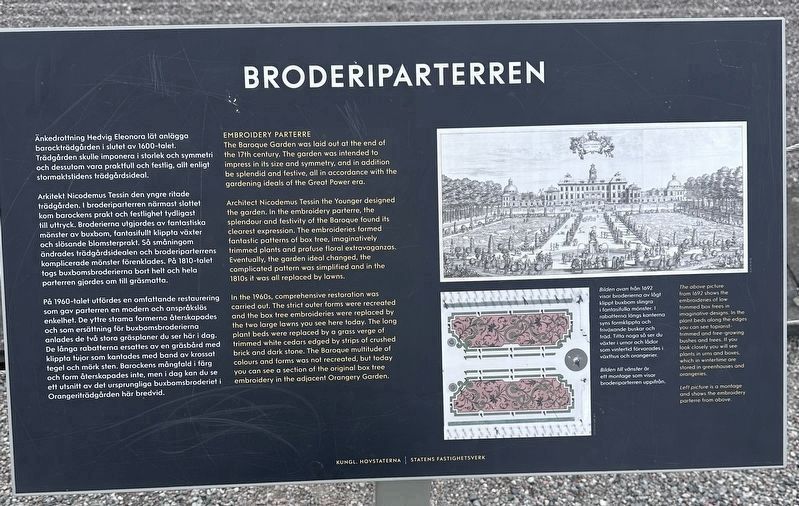
Arkitekt Nicodemus Tessin den yngre ritade trädgården. I broderiparterren närmast slottet kom barockens prakt och festlighet tydligast till uttryck. Broderierna utgjordes av fantastisko mönster av buxbom, fantasifullt klippta växter och slösande blomsterprakt. Så småningom ändrades trädgårdsidealen och broderiparterrens komplicerade mönster förenklades. På 1810-talet, togs buxbomsbroderierna bort helt och hela parterren gjordes om till gräsmatta.
På 1960-talet utfördes en omfattande restaurering som gav parterren en modern och anspråkslös enkelhet. De yttre strama formerna &terskapades och som ersättning för buxbomsbroderierna anlades de tvo stora gräsplaner du ser här i dag. De långa rabattera ersattes av en grösbård med klippta tujor som kantades med band av krossat tegel och mörk sten. Barockens mångfald i färg och form återskapades inte, men i dag kan du se ett utsnitt av det ursprungliga
this page online
The Baroque Garden was laid out at the end of the 17th century. The garden was intended to impress in its size and symmetry, and in addition be splendid and festive, all in accordance with the gardening ideals of the Great Power era.
Architect Nicodemus Tessin the Younger designed the garden. In the embroidery parterre, the splendour and festivity of the Baroque found its clearest expression. The embroideries formed in fantastic patterns of box tree, imaginatively trimmed plants and profuse floral extravaganzas. Eventually, the garden ideal changed, the complicated pattern was simplified and in the 1810s it was all replaced by lawns.
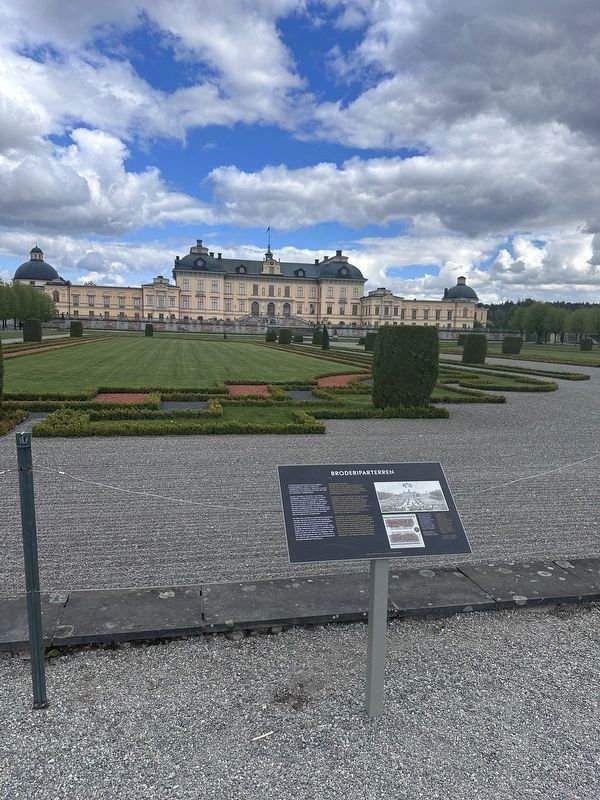
In the 1960s, comprehensive restoration was carried out. The strict outer forms were recreated and the box tree embroideries were replaced by the two large lawns you see here today. The long plant beds were replaced by a grass verge of trimmed white cedars edged by strips of crushed brick and dark stone. The Baroque multitude of colours and forms was not recreated, but today you can see a section of the original box tree
Photographed by Col. James F. Jamison, USMC (Ret), May 17, 2026
2. Drottningholm Palace in the distance
Erected by Kungl. Hovstaterna, Statens Fastighetsverk.
Topics. This historical marker is listed in these topic lists: Architecture • Parks & Recreational Areas.
Location. 59° 19.27′ N, 17° 53.007′ E. Marker is in Stockholm, Stockholms län (Stockholm County), in Ekerö. It is in Drottningholm. It can be reached from no nearby street. Touch for map. Marker is in this post office area: Stockholm, Stockholms län 178 93, Sweden. Touch for directions.

Regionally, it is in Europe, the European Union, Scandinavia, the Nordic Countries, the Schengen Area, and the Western World.
Other nearby markers. At least 8 other markers are within 11 kilometers of this marker, measured as the crow flies: Stadshuset / City Hall (approx. 9.8 kilometers away); Carl Eldhs Brantingsmonument / Carl Eldh's Branting Monument (approx. 9.8 kilometers away); Brantingska Huset / The Branting House (approx. 9.8 kilometers away); LO-Huset / LO Building (approx. 9.9 kilometers away); Gamla Tekniska Högskolan / The Old Technical University (approx. 10 kilometers
Photographed by Col. James F. Jamison, USMC (Ret), May 17, 2026
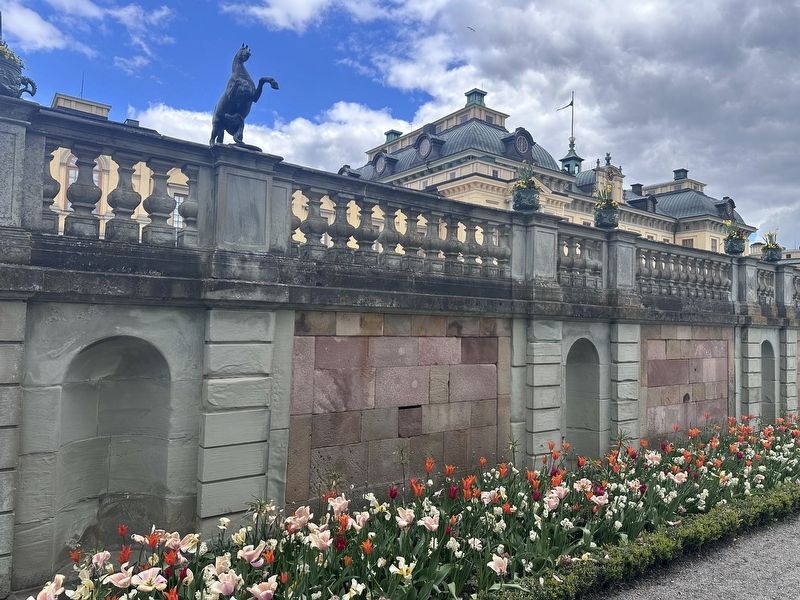
3. Drottningholm Palace garden
Also see . . . Drottningholm Palace (Wikipedia). Overview:
Drottningholm Palace (Swedish: Drottningholms slott), or Drottningholm, one of Sweden's royal palaces, situated near Sweden's capital Stockholm, is the private residence of the Swedish royal family.(Submitted on May 20, 2026.)
Located on Lovön island in Stockholm County's Ekerö Municipality, it was built in the late 17th century and was a regular summer residence of the Swedish royal court through most of the 18th century.
Credits. This page was last revised on June 18, 2026. It was originally submitted on May 17, 2026, by Col. James F. Jamison, USMC (Ret) of Coronado, California. This page has been viewed 23 times since then. Photos: 1, 2, 3. submitted on May 17, 2026, by Col. James F. Jamison, USMC (Ret) of Coronado, California. • Andrew Ruppenstein was the editor who published this page.
