Snow Lake in Desha County, Arkansas — The American South (West South Central)
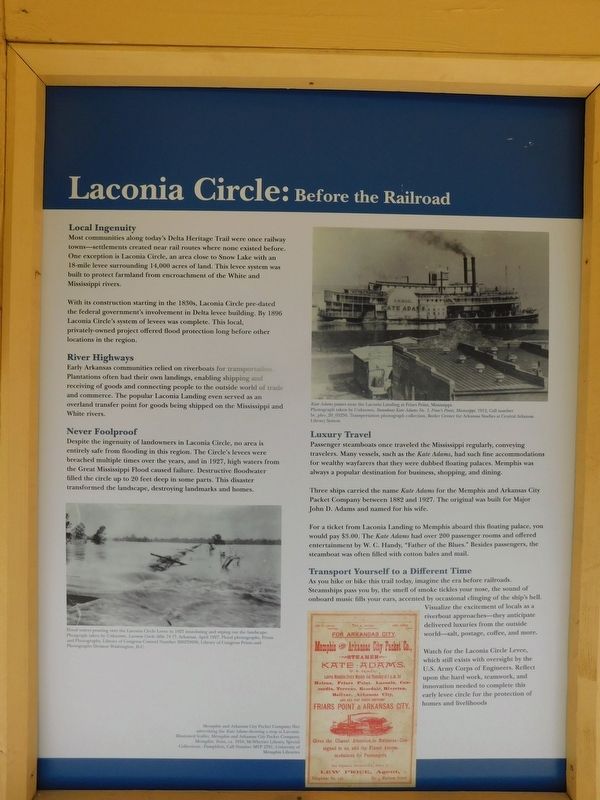
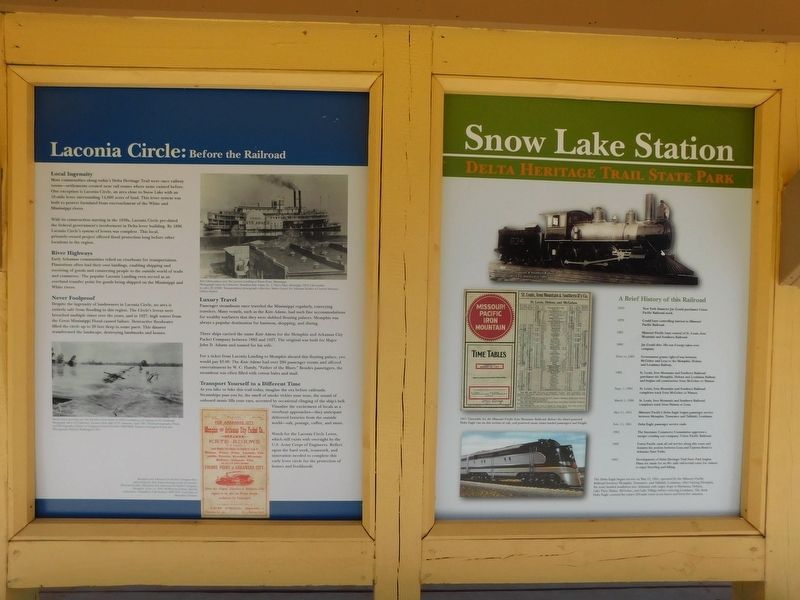
Laconia Circle: Before the Railroad
Photographed by Jimmy Emerson, May 13, 2026
1. Laconia Circle Marker
Most communities along today's Delta Heritage Trail were once railway town-settlements created near rail routes where none existed before. One exception is Laconia Circle, an area close to Snow Lake with an 18-mile levee surrounding 14,000 acres of land. This levee system was built to protect farmland from encroachment of the White and Mississippi rivers. With its construction starting in the 1830s, Laconia Circle pre-dated the federal government's involvement in Delta levee building. By 1896 Laconia Circle's system of levees was complete. This local, privately owned project offered flood protection long before other locations in the region.
River Highways
Early Arkansas communities relied on riverboats for transportation. Plantations often had their own landings, enabling shipping and receiving of goods and connecting people to the outside world of trade and commerce. The popular Laconia Landing even served as an overland transfer point for goods being shipped on the Mississippi and White rivers.
Never Foolproof
Despite the ingenuity of landowners in Laconia Circle, no area is entirely
this page online
Luxury Travel
Passenger steamboats once traveled the Mississippi regularly, conveying travelers. Many vessels, such as the Kate Adams, had such fine accommodations for wealthy wayfarers that they were dubbed floating palaces. Memphis was always a popular destination for business, shopping, and dining. Three ships carried the name Kate Adams for the Memphis and Arkansas City Packet Company between 1882 and 1927. The original was built for Major John D. Adams and named for his wife. For a ticket from Laconia Landing to Memphis aboard this floating place, you would pay $5.00. The Kate Adams had over 200 passenger rooms and offered entertainment by W. C. Handy, "Father of the Blues". Besides passengers, the steamboat was often filled with cotton bales and mail.
Transport Yourself to a Different Time
As you
Photographed by Jimmy Emerson, May 13, 2026
2. Laconia Circle Marker
Text under photo to the left: Flood waters flowing over the Laconia Circle Levee in 1927 inundating and wiping out the landscape. Photograph taken by Unknown. Laconia Mile 74-75. Flood photographs, Prints and photographs, Library of Congress Control Number 200270930, Library of Congress Prints and Photographs Division, Washington, DC.
Text by the packet on bottom:
Memphis and Arkansas City Packet Company flier advertising the Kate Adams showing a stop at Laconia. Illustrated Leaflet, Memphis and Arkansas City
Photographed by Jimmy Emerson, May 13, 2026
3. Snow Lake Station
Text under the steamboat picture:
Kate Adams passes near the Laconia Landing at Friars Point, Mississippi. Photograph taken by Unknown, Steamboat Kate Adams No 3, Friar's Point, Mississippi , 1912. Call number bc_pho_20_05250. Transportation photograph collection, Butler Center for Arkansas Studies at Central Arkansas Library System.
Topics. This historical marker is listed in these topic lists: Disasters • Entertainment • Waterways & Vessels. A significant historical year for this entry is 1927.
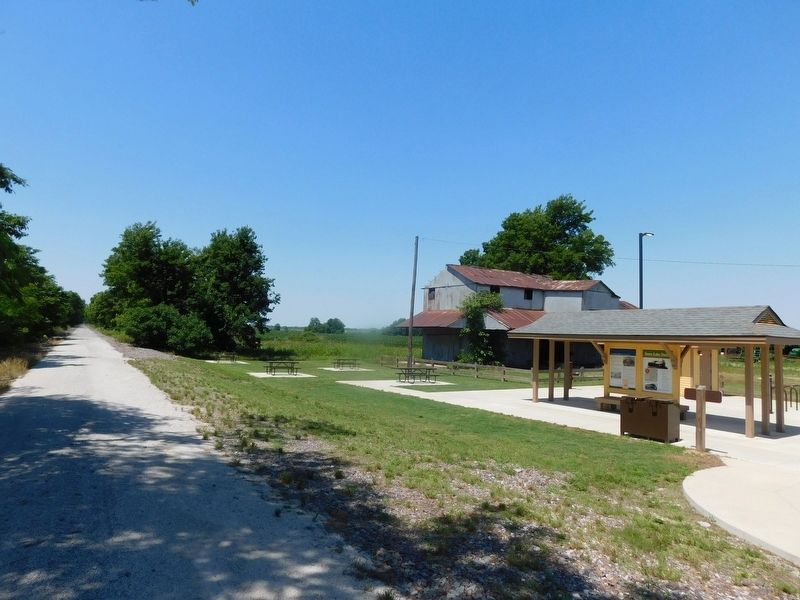
Location. 34° 3.599′ N, 91° 1.361′ W. Marker is in Snow Lake, Arkansas, in Desha County. It is on AR - 44. Touch for map. Marker is at or near this postal address: 1597 AR-44, Snow Lake AR 72379, United States of America. Touch for directions.

Regionally, this marker is in the Arkansas Delta, in the Mississippi Alluvial Plain, and in the Quapaw Homeland. It is also in the American South, specifically in the Deep South, in the Upper South, in the Mississippi Delta, in the Piney Woods, and in the Great River Road Region. Globally, it is in North America, the Western Hemisphere, the Western World, and the Anglosphere. Historically, it finds itself in what was once the Viceroyalty of New France, the territory of the Mississippian Culture, the Louisiana Purchase, one of the Confederate States of America, and the Antebellum South.
Other nearby markers. At least 5 other markers are within 14 miles of this marker, measured as the crow flies: Snow Lake Station (here, next to this marker); a different marker also named Snow Lake Station (within shouting distance of this marker); Snow Lake: Transformed by the Rail (within shouting distance of this marker); Otis Clay (approx. 10.2 miles away in Mississippi); Grace Episcopal Church (approx. 14.1 miles away in Mississippi).
Credits. This page was last revised on May 17, 2026. It was originally submitted on May 17, 2026, by Jimmy Emerson of Dalton, Georgia. This page has been viewed 16 times since then. Photos: 1, 2, 3. submitted on May 17, 2026, by Jimmy Emerson of Dalton, Georgia. • Andrew Ruppenstein was the editor who published this page.
