Burton in Geauga County, Ohio — The American Midwest (Great Lakes)
Natural Gas and Crude Oil
How was it Formed & Trapped? How is it Explored? How is it Drilled & Produced?
Photographed by Craig Doda, May 9, 2026
1. Natural Gas and Crude Oil Marker
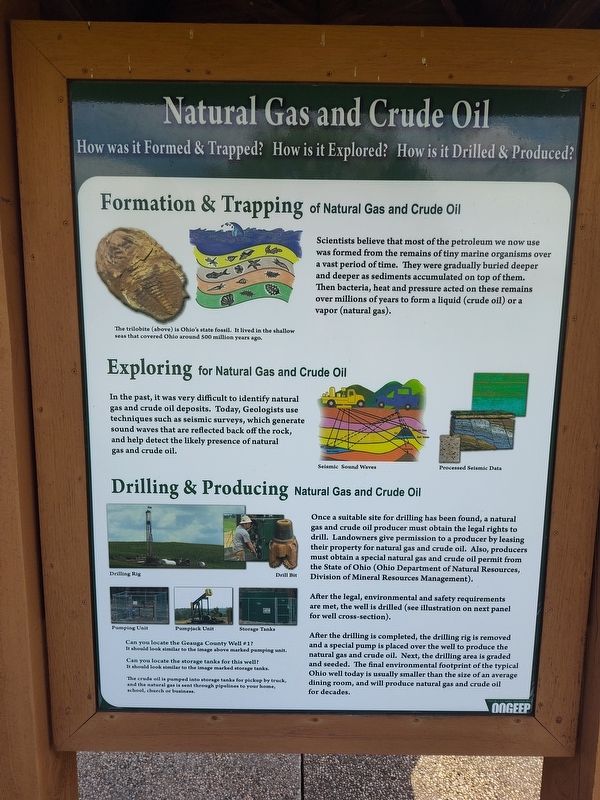
The trilobite (above) is Ohio's state fossil. It lived in the shallow seas that covered Ohio around 500 million years ago.
Formation & Trapping of Natural Gas and Crude Oil
Scientists believe that most of the petroleum we now use was formed from the remains of tiny marine organisms over a vast period of time. They were gradually buried deeper and deeper as sediments accumulated on top of them. Then bacteria, heat and pressure acted on these remains over millions of years to form a liquid (crude oil) or a vapor (natural gas).
Exploring for Natural Gas and Crude Oil
In the past, it was very difficult to identify natural gas and crude oil deposits. Today, Geologists use techniques such as seismic surveys, which generate sound waves that are reflected back off the rock, and help detect the likely presence of natural gas and crude oil.
Drilling & Producing Natural Gas and Crude Oil
Once a suitable site for drilling has been found, a natural gas and crude oil producer must obtain the legal rights to drill. Landowners give permission to a producer by leasing their property for natural gas and crude oil. Also, producers
this page online
After the legal, environmental and safety requirements are met, the well is drilled (see illustration on next panel for well cross-section).
After the drilling is completed, the drilling rig is removed and a special pump is placed over the well to produce the natural gas and crude oil. Next, the drilling area is graded and seeded. The final environmental footprint of the typical Ohio well today is usually smaller than the size of an average dining room, and will produce natural gas and crude oil for decades.
Erected by Ohio Oil & Gas Energy Education Program.
Topics. This historical marker is listed in these topic lists: Industry & Commerce • Natural Resources • Science & Medicine.
Location. 41° 28.027′ N, 81° 8.5′ W. Marker is in Burton, Ohio, in Geauga County. It is at the intersection of Carlton Street and South Cheshire Street, on the right when traveling east on Carlton Street. Touch for map. Marker is
Photographed by Craig Doda, May 9, 2026
2. Natural Gas and Crude Oil Marker

Regionally, this marker is in Greater Cleveland and in the Western Reserve. It is also in the American Midwest. Globally, it is in North America, on the Great Lakes, in the Western Hemisphere, in the Western World, and in the Anglosphere. Historically, it finds itself in what was once the Haudenosaunee (Iroquois) Confederacy, the territory of the Mississippian Culture, and the Northwest Territory.
Other nearby markers. At least 8 other markers are within walking distance of this marker: Geauga County Historical Society Well (here, next to this marker); The Early Years (here, next to this marker); Today there are over 6,000 products refined from Natural Gas and Crude Oil. (here, next to this marker); The Hickox Brick (approx. ¼ mile away); The Burton Village Historic District (approx. 0.3 miles away); Welcome To Burton's Historic District (approx. 0.3 miles away); Burton (approx. 0.3 miles away); Under This Penstock Base (approx. 0.3 miles away). Touch for a list and map of all markers in Burton.
Credits. This page was last revised on May 26, 2026. It was originally submitted on May 18, 2026, by Craig Doda of Napoleon, Ohio. This page has been viewed 17 times since then. Photos: 1, 2. submitted on May 18, 2026, by Craig Doda of Napoleon, Ohio. • Devry Becker Jones was the editor who published this page.
