Elgin in Kane County, Illinois — The American Midwest (Great Lakes)
Elgin Academy Civil War Memorial

1. Elgin Academy Civil War Memorial
Memorial tribute to Elgin Academy's patriotic sons who served in the Great Civil War
1861–1865
Haec Olim Meminisse Juvabit.
John O. Adams • Mark W. Adams • Samuel Anderson • Thomas G. Anderson • Albert G. Andrews • Henry F. Baldwin • Edmund V. Barker • Charles A. Barrows • Chandler Bartlett • William Beye • Clark Braden • Sidney Bradford • Ambrose Brayman • Jacob O. Brinkerhoff • Horace G. Brintnall • Edward M. Brooks • Myron W. Brooks • Charles C. Brown • William H. Brydges • Edgar D. Buck • Charles E. Buell • E.A. Cambridge • Dorr B. Chaffee • Simon E. Chaffee • Oliver P. Chisholm • John Cockerton • Madison B. Cole • Joseph Morris Corron • Edward A. Cummings • James Davidson • William J. Dempster • W.M. Duff • John S. Dumser • William Duncan • Freeman S. Dunklee • E.C. Farnum • Walter Fifield • Daniel Flynn • Barna F. Freeman • William Gage • Edwin Gifford • Fulton Gifford • S. Judson Gifford • Frank T. Gilbert • George P. Gilbert • W.C. Gray • Eugene H. Griggs • Tyler Hamilton • Charles M. Harvey • Frank W. Haskell • Hiram L. Haskell • B. Frank Hassan • Henry C. Hassan
this page online

Photographed by Sean P. Flynn, May 16, 2026
2. Elgin Academy Civil War Memorial Marker
[Plaque on the rear:]
Erected 1909 by Elgin Academy.
Topics. This historical marker and memorial is listed in these topic lists: Education • War, US Civil.
Location. 42° 2.462′ N, 88° 16.645′ W. Marker is in Elgin, Illinois, in Kane County. It is on Park Street near College Street, on the right when traveling west. The marker is on the campus of the Elgin History Museum. Touch for map.
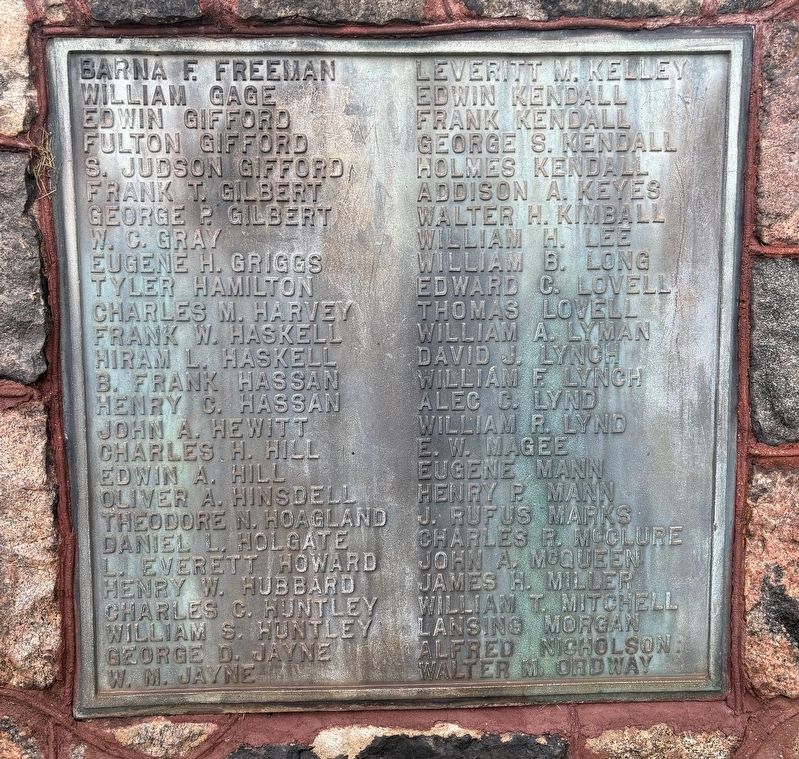
Photographed by Sean P. Flynn, May 16, 2026
3. Elgin Academy Civil War Memorial, second plaque

Regionally, this marker and memorial is in Greater Chicago. It is also in the American Midwest. Globally, it is in North America, on the Great Lakes, in the Western Hemisphere, in the Western World, and in the Anglosphere. Historically, it finds itself in what was once the territory of the Mississippian Culture and also the Northwest Territory.
Other nearby markers. At least 8 other markers are within walking distance of this marker: Memorial Tribute to Elgin Academy's Patriotic Sons Who Served in the Great Civil War, 1861-1865 (here, next to this marker); Elgin National Watch Company Factory Bell (a few steps from this marker); Elgin's Masonic Temple Cornerstone (a few steps from this marker); Old Main (a few steps from this marker); Pioneer Log Cabin of the 1830s (within shouting distance of this marker); Masjid Al-Wājidi (about 300 feet away, measured in a direct line); Veterans Memorial (about 700 feet away); Fremont Recreation Center / Second Baptist Church (about 700 feet away). Touch for a list and map
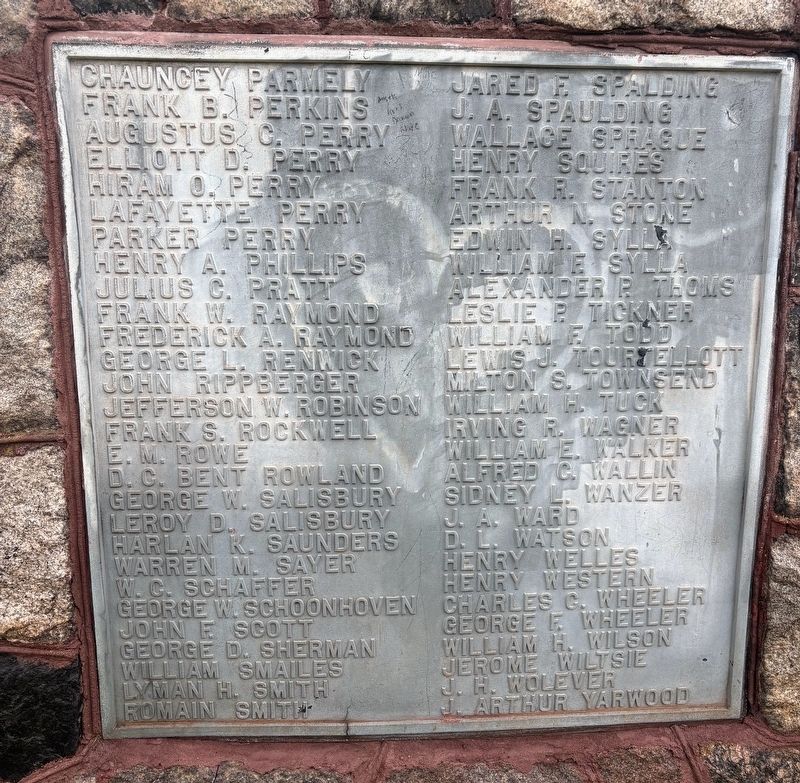
Photographed by Sean P. Flynn, May 16, 2026
4. Elgin Academy Civil War Memorial, third plaque
More about this marker. The memorial is titled "Monument of Peace." It features the barrels of two 12-pounder Napoleon cannons which were cast by the Paul Revere Foundry in 1864 and 1865. According to a nearby historical marker, the cannons were given to Elgin Academy by Act of Congress, and the memorial was dedicated in May 1909 in front of a crowd of about 600 people.
The Latin phrase at the top of the first plaque, Omnia Reliquit Servatum Rem Publicam, translates to "He gives up everything to serve the republic." The second phrase, Haec Olim Meminisse Juvabit, derives from Virgil's Aeneid and is often translated as "One day, we'll look back on these things and smile."
Regarding Elgin Academy Civil War Memorial. Elgin Academy opened in 1856 in the "Old Main" building that still stands today near this memorial. More than 150 Elgin Academy students, teachers, administrators and trustees served in the war, including 19 who died in battle or of disease during the four-year conflict, and 10 more who died soon after the war. Old Main has for several years housed the Elgin History Museum. Elgin Academy

Photographed by Sean P. Flynn, May 16, 2026
5. Elgin Academy Civil War Memorial, fourth plaque
Also see . . . Elgin Academy historical timeline. The school was chartered in 1839 but did not open until 1856, a year after the completion of Old Main. The school closed in 2024. (Submitted on May 20, 2026, by Sean P. Flynn of Oak Park, Illinois.)

Photographed by Sean P. Flynn, May 16, 2026
6. Old Main
The main building of Elgin Academy opened in 1856. The Elgin History Museum currently occupies the building. Elgin Academy closed in 2024.
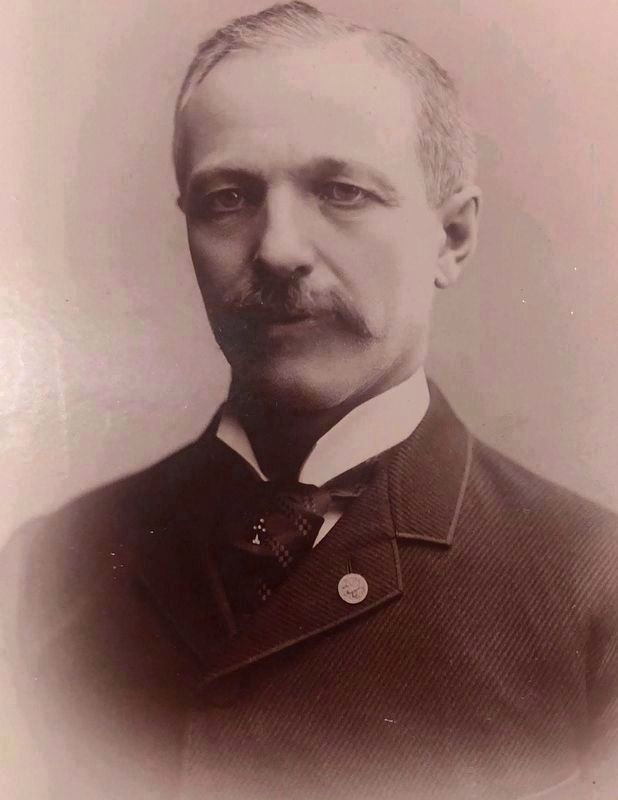
Courtesy of the Oak Park Public Library
7. William Beye
Among the students listed on this memorial is William Beye, a German immigrant who settled in Elk Grove (east of Elgin) in the 1850s. Beye enlisted soon after the outbreak of war in 1861 and served in the 8th Illinois Cavalry, a famed unit that fought with the Army of the Potomac for the duration of the war. Most notably, the 8th was west of Gettysburg on July 1, 1863, when one of its members fired the three-day battle's first shot. The 8th later served as Abraham Lincoln's honor guard while he lay in state after his assassination, and also participated in the pursuit of John Wilkes Booth. After the war, Beye settled west of Chicago in a community called Ridgeland (which later became part of Oak Park), where he served on the local school board. Beye was instrumental in the approval of a new modern new school building; he died of the flu soon after its approval. The school was posthumously renamed in Beye's honor and still operates today, about 35 miles east of this memorial. This photograph of William Beye is part of an archive of photographs commissioned by the Oak Park-based Grand Army of the Republic Post 615 (known as the Phil Sheridan Post) in the 1880s and preserved at the Oak Park Public Library.
Credits. This page was last revised on October 6, 2026. It was originally submitted on May 18, 2026, by Sean P. Flynn of Oak Park, Illinois. This page has been viewed 36 times since then. Photos: 1. submitted on February 19, 2013. 2. submitted on May 18, 2026, by Sean P. Flynn of Oak Park, Illinois. 3, 4, 5, 6. submitted on May 20, 2026, by Sean P. Flynn of Oak Park, Illinois. 7. submitted on July 22, 2023, by Sean P. Flynn of Oak Park, Illinois.
