Prior's-Land in Limerick in County Limerick, Munster, Ireland — Irish South-West ((Éire) North Atlantic Ocean)
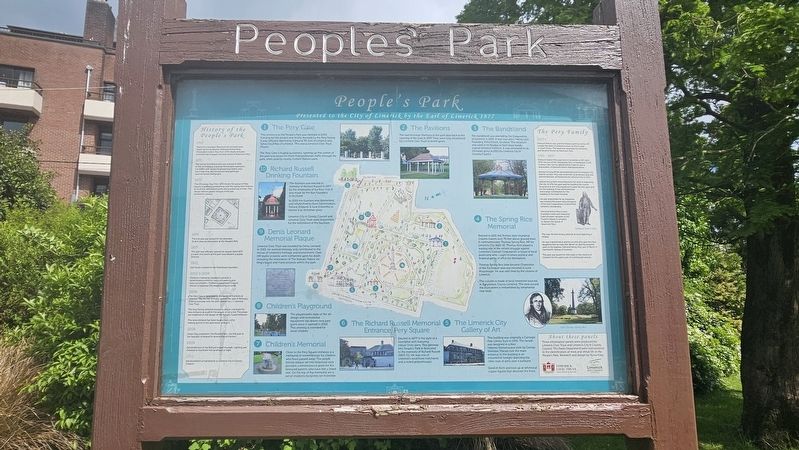
People's Park
Presented to the City of Limerick by the Earl of Limerick, 1877
Photographed by Ian Lefkowitz, May 13, 2026
1. People's Park Marker
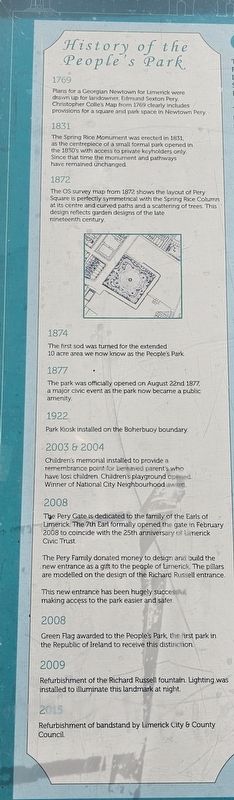
History of the People’s Park
1769
Plans for a Georgian Newtown for Limerick were drawn up for landowner, Edmund Sexton Pery. Christopher Colle’s Map from 1769 clearly includes provisions for a square and park space in Newtown Pery.
1831
The Spring Rice Monument was erected in 1831, as the centrepiece of a small formal park opened in the 1830’s with access to private keyholders only. Since that time the monument and pathways have remained unchanged.
1872
The OS survey map from 1872 shows the layout of Pery Square is perfectly symmetrical with the Spring Rice Column at its centre and curved paths and a scattering of trees. This design reflects garden designs of the late nineteenth century.
1874
The first sod was turned for the extended 10 acre area we now know as the People’s Park.
1877
The park was officially opened on August 22nd 1877, a major civic event as the park now became a public amenity.
1922
Park Kiosk installed on the Boherbuoy boundary.
2003 & 2004
Children’s memorial installed to provide a remembrance point for bereaved parents who have lost children. Children’s playground opened. Winner of National City Neighbourhood
this page online
2008
The Pery Gate is dedicated to the family of the Earls of Limerick. The 7th Earl formally opened the gate in February 2008 to coincide with the 25th anniversary of Limerick Civic Trust. The Pery Family donated money to design and build the new entrance as a gift to the people of Limerick. The pillars are modelled on the design of the Richard Russell entrance. This new entrance has been hugely successful, making access to the park easier and safer.
2008
Green Flag awarded to the People’s Park, the first park in the Republic of Ireland to receive this distinction.
2009
Refurbishment of the Richard Russell fountain. Lighting was installed to illuminate this landmark at night.
2015
Refurbishment of bandstand by Limerick City & County Council.
(Center Panel)
1 The Pery Gate
This entrance to the People’s Park was installed in 2008. Funding for the project was kindly donated by the Pery Family. It was officially opened by Edmund 7th Earl of Limerick and Sylvia Countess of Limerick. This was a Limerick Civic Trust Project.
The Pery Gate is hugely successful, opening up this corner of the park and allows for more fluid pedestrian traffic
Photographed by Ian Lefkowitz, May 13, 2026
2. People's Park Marker (Left inset)
10 Richard Russell Drinking Fountain
The fountain was erected in memory of Richard Russell in 1877 by the employees of his flour mill. It was made by the Sun Foundary in Scotland.
In 2009 the fountain was dismantled and refurbished by Eura Conservation, Telford, England. It took 6 months to restore it to its former glory.
Limerick City & County Council and Limerick Civic Trust were responsible for the restoration of the fountain.
9 Denis Leonard Memorial Plaque
Limerick Civic Trust was founded by Denis Leonard in 1983. He worked tirelessly and contributed to the revival of Limerick’s heritage and environment. Over 144 public projects were completed upon his death including the restoration of The Bishop’s Palace on King’s Island and many projects within this park.
8 Children’s Playground
The playground’s state of the art design and recreational equipment has drawn new park goers since it opened in 2002. This amenity is intended for small children.
7 Children’s Memorial
Close to the Pery Square entrance is a memorial of remembrance for children who have passed away. The simple
Photographed by Ian Lefkowitz, May 13, 2026
3. People's Park Marker (Right inset)
Earl of Limerick, 1877
2 The Pavilions
The two Victorian Pavilions in the park date back to the opening of the park in 1877. They were fully refurbished by Limerick Civic Trust in recent years.
3 The Bandstand
The bandstand was erected by the Corporation of Limerick in 1895. It was manufactured by Lion Foundary, Kirkintilloch, Scotland. The structure was used in its heyday to host brass bands, a great Limerick tradition. It was reinstated to its Victorian glory in 2015 by Limerick City & County Council.
4 The Spring Rice Memorial
Erected in 1831 this Roman style triumphal column towers over 70 feet above ground level. It commemorates Thomas Spring Rice, MP for Limerick City 1820–32. Thomas Rice played a leading role in the reform struggle against Limerick’s ‘Corrupt Corporation’ a clique of local politicians who sought to retain political and financial perks of office for themselves. Thomas Spring Rice later became Chancellor of the Exchequer
Photographed by Ian Lefkowitz, May 13, 2026
4. People's Park Marker
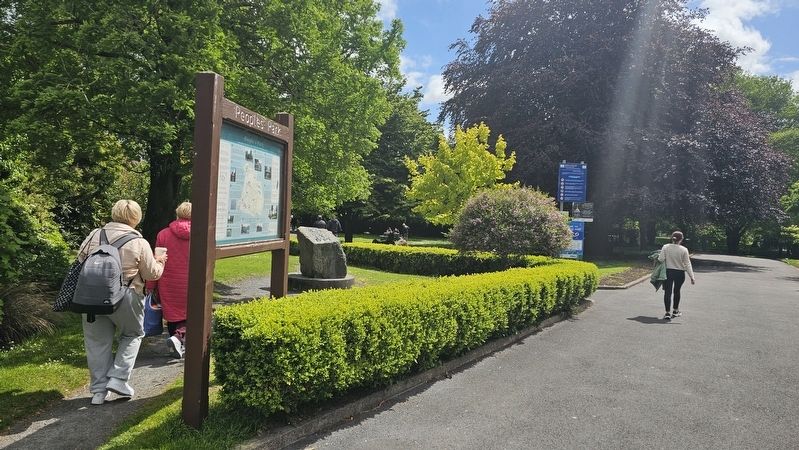
The marker is located on an interior pathway at the northern entrance to the park.
6 The Richard Russell Memorial Entrance, Pery Square
Erected in 1877 in the style of a triumphal arch featuring robust Doric piers. This gateway into People’s Park is dedicated to the memory of Richard Russell (1803–71). He was one of Limerick’s wealthiest merchants and a noted philanthropist.
5 The Limerick City Gallery of Art
This building was originally a Carnegie Free Library built in 1906. The facade was designed in a Neo Hiberno-Romanasque style by George Sheridan. Placed over the main entrance to the building is an ornamental fanlight depicting the cities coat of arms over a sunburst. Stand in front and look up at whimsical copper figures that decorate the front.
(Top right inset)
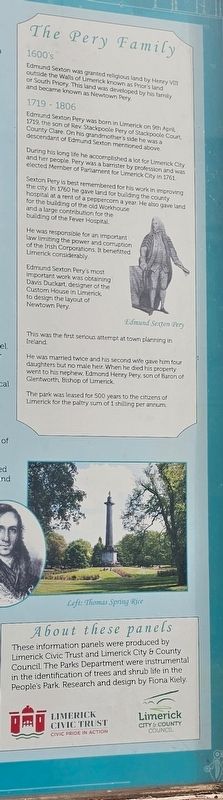
The Pery Family
1600’s
Edmund Sexton was granted religious land by Henry VIII outside the Walls of Limerick known as Prior’s Land or South Priory. This land was developed by his family and became known as Newtown Pery.
1719 – 1806
Edmund
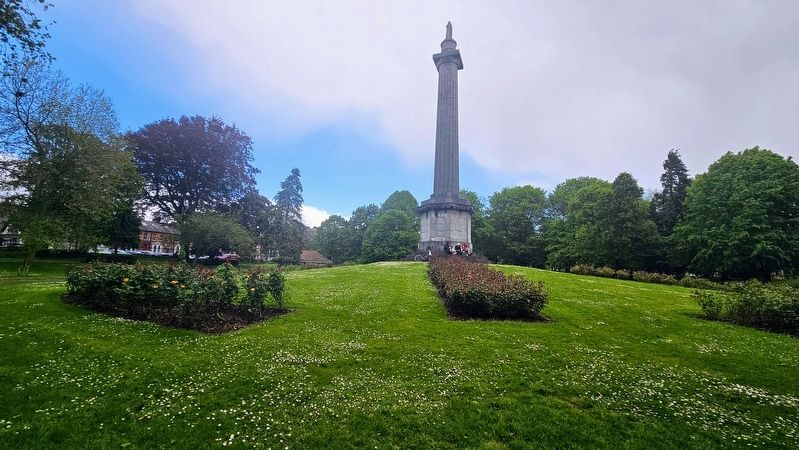
Photographed by Ian Lefkowitz, May 13, 2026
5. The Spring Rice Memorial
During his long life he accomplished a lot for Limerick City and her people. Pery was a barrister by profession and was elected Member of Parliament for Limerick City in 1761.
Sexton Pery is best remembered for his work in improving the city. In 1760 he gave land for building the county hospital at a rent of a peppercorn a year. He also gave land for the building of the old Workhouse and a large contribution for the building of the Fever Hospital.
He was responsible for an important law limiting the power and corruption of the Irish Corporations. It benefitted Limerick considerably.
Edmund Sexton Pery’s most important work was obtaining Davis Duckart, designer of the Custom House in Limerick, to design the layout of Newtown Pery.
Edmund Sexton Pery
This was the first serious attempt at town planning in Ireland.
He was married twice and his second wife gave him four daughters but no male heir. When he died his property went to his nephew, Edmond Henry Pery, son of Baron of Glentworth, Bishop of Limerick.
The park was leased for 500 years to the citizens of Limerick for the paltry sum of 1 shilling per annum.
(Bottom right inset)
About These Panels
These information panels were produced by Limerick Civic Trust and Limerick City & County Council. The Parks Department were instrumental in the identification of trees and shrub life in the People’s Park. Research and design by Fiona Kiely.
Erected by Limerick Civic Trust and Limerick City & County Council.
Topics. This historical marker is listed in these topic lists: Architecture • Parks & Recreational Areas. A significant historical date for this entry is August 22, 1877.
Location. 52° 39.545′ N, 8° 37.688′ W. Marker is in Limerick, Munster, in County Limerick. It is in Prior's-Land. It can be reached from Pery Square near Upper Mallow Street, on the left when traveling west. Touch for map. Marker is at or near this postal address: Pery Square, Limerick, Munster V94 5P27, Ireland. Touch for directions.

Regionally, this marker is in the Ancient East. Globally, it is on the Atlantic Ocean, in the North Atlantic Region, in Europe, on the Island of Ireland, on the Celtic Fringe, in the European Union, in Atlantic Europe, on one of the British Isles, in the Western World, and in the Anglosphere.
Other nearby markers. At least 8 other markers are within walking distance of this marker: Welcome to the People's Park / Fáilte go bPáirc an Phobail (a few steps from this marker); Tait’s Clock (about 120 meters away, measured in a direct line); Denis M. Leonard (about 120 meters away); Limerick Soviet 1919 Proclamation (about 120 meters away); Joseph O’Mara (about 150 meters away); The Georgian House and Garden (about 150 meters away); The Limerick Grand Prix (about 150 meters away); Private James O’Rourke (about 150 meters away). Touch for a list and map of all markers in Limerick.
Credits. This page was last revised on May 20, 2026. It was originally submitted on May 20, 2026, by Ian Lefkowitz of New York, New York. This page has been viewed 20 times since then. Photos: 1, 2, 3, 4, 5. submitted on May 20, 2026, by Ian Lefkowitz of New York, New York. • Andrew Ruppenstein was the editor who published this page.
