Greenville in Butler County, Alabama — The American South (East South Central)
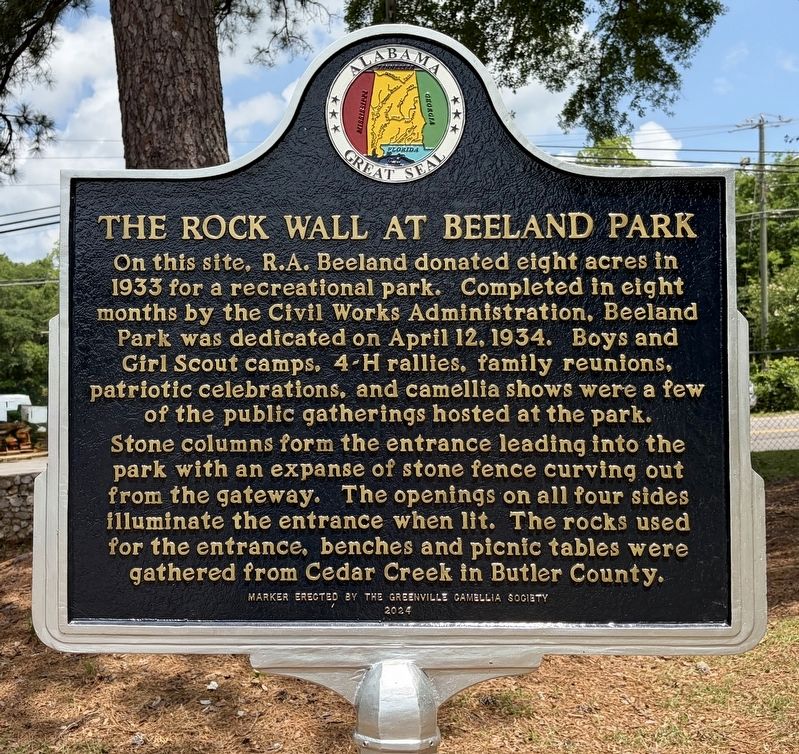
The Rock Wall at Beeland Park
⎯⎯⎯
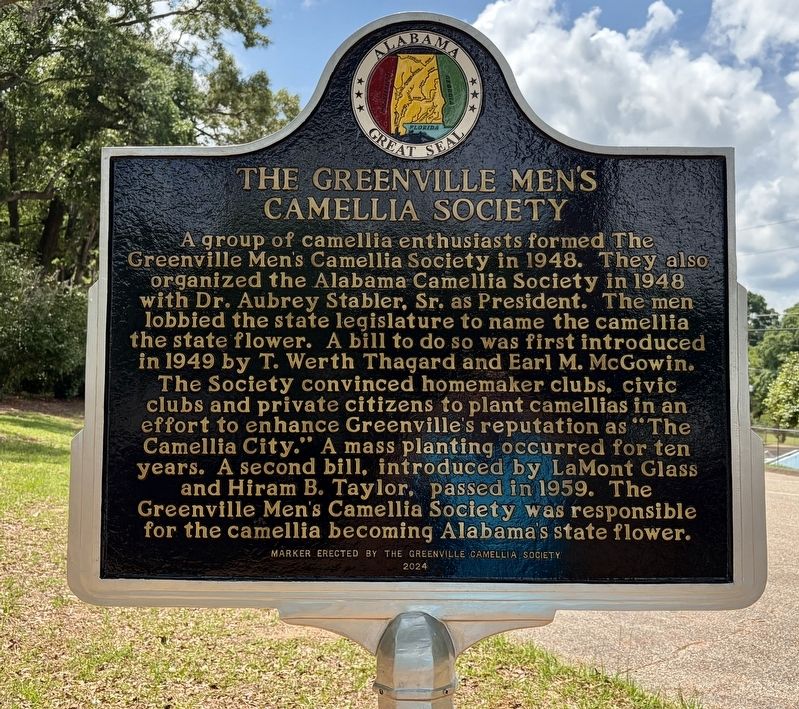
The Greenville Men's Camellia Society
Photographed by Mark Hilton, May 20, 2026
1. The Rock Wall at Beeland Park Marker
this page online
Erected 2026 by the Greenville Camellia Society.
Topics. This historical marker is listed in this topic list: Parks & Recreational Areas. A significant historical date for this entry is April 12, 1934.
Location. 31° 49.813′ N, 86° 36.652′ W. Marker is in Greenville, Alabama, in Butler County. It is on East Commerce Street (Alabama Route 10), on the right when traveling east. Located with Beeland Park. Touch for map. Marker is at or near this postal address: 1016 E Commerce St, Greenville AL 36037, United States of America. Touch for directions.

Regionally, this marker is in the American South, specifically in the Deep South, and in the Black Belt. Globally, it is in North America, a Gulf of Mexico state, the Western Hemisphere, the Western World, and the Anglosphere. Historically, it finds itself in what was
Photographed by Mark Hilton, May 20, 2026
2. The Greenville Men's Camellia Society Marker
Other nearby markers. At least 8 other markers are within walking distance of this marker: The Camellia Gardens at Beeland Park / Registered Camellias of Butler County (within shouting distance of this marker); Operation Desert Storm (approx. 0.4 miles away); Butler County Vietnam War Memorial (approx. 0.4 miles away); Butler County World War I Memorial (approx. 0.4 miles away); Butler County (approx. 0.4 miles away); Site of Confederate Hospital (approx. 0.7 miles away); In Memory of Captain William Butler (approx. 0.7 miles away); Pioneer Cemetery (approx. 0.7 miles away). Touch for a list and map of all markers in Greenville.
More about this marker. Although marker reflects 2024, it was actually placed in May, 2026.
Also see . . . Website for Beeland Park Camellia Gardens. (Submitted on May 20, 2026, by Mark Hilton of Montgomery, Alabama.)
Photographed by Mark Hilton, May 20, 2026
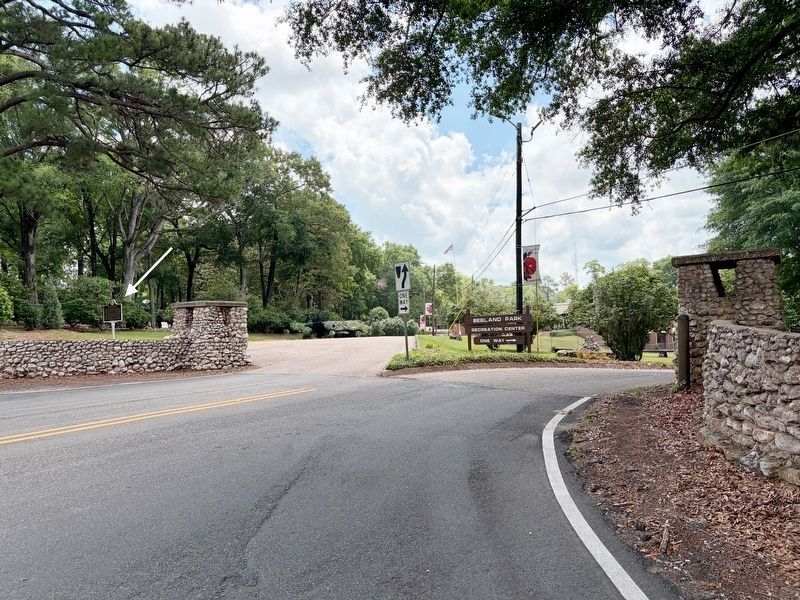
3. The Rock Wall at Beeland Park with marker
White arrow points to marker on left.
Photographed by Mark Hilton, May 20, 2026
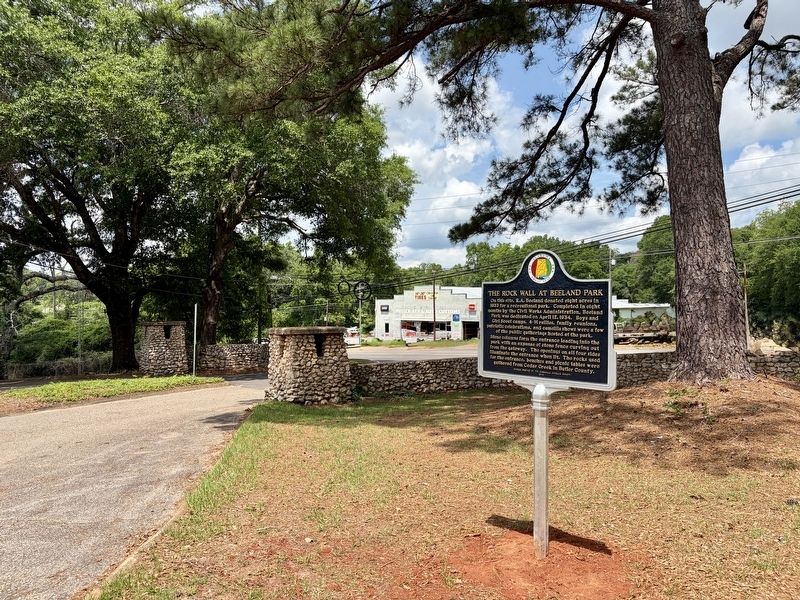
4. The Rock Wall at entrance to Beeland Park.
Credits. This page was last revised on May 20, 2026. It was originally submitted on May 20, 2026, by Mark Hilton of Montgomery, Alabama. This page has been viewed 18 times since then. Photos: 1, 2, 3, 4. submitted on May 20, 2026, by Mark Hilton of Montgomery, Alabama.
