East Melbourne in Melbourne, Victoria, Australia — Oceania
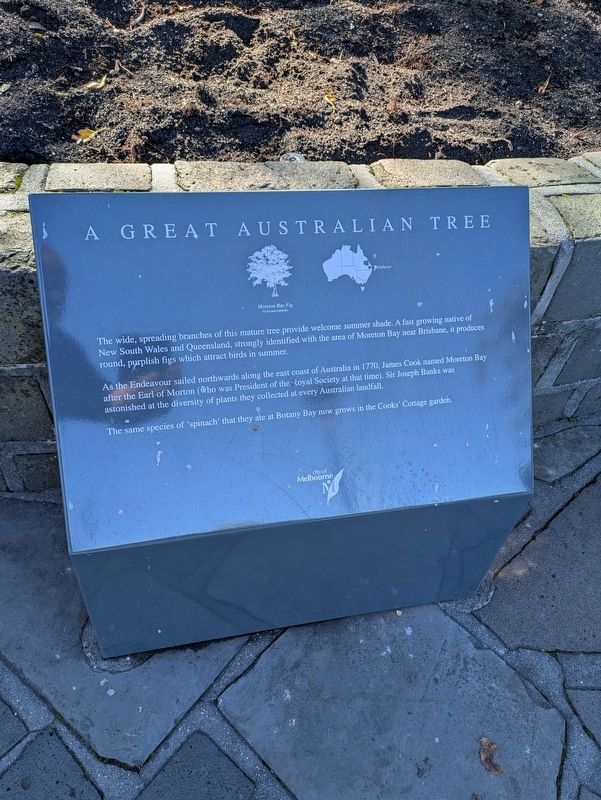
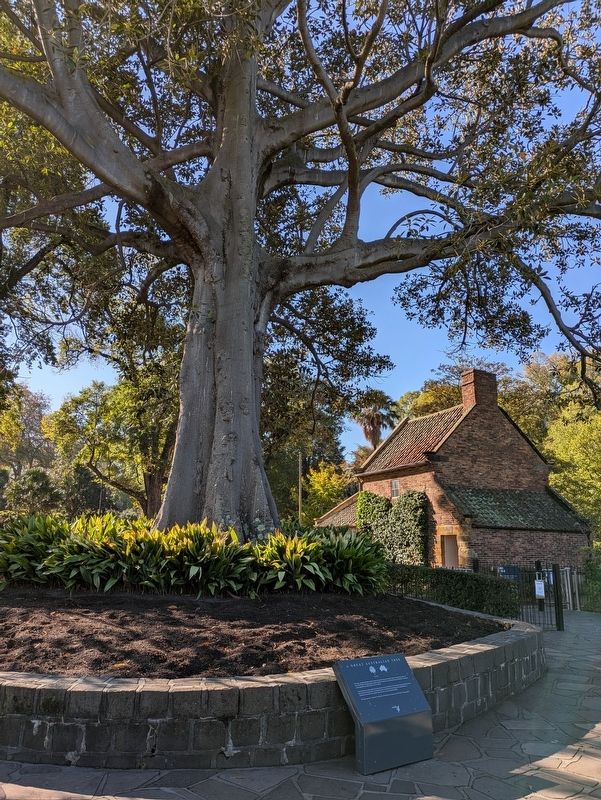
A Great Australian Tree
Moreton Bay Fig
| — | Ficus macrophylla | — |
Photographed by Dean Barton-Ancliffe, May 11, 2026
1. A Great Australian Tree Marker
As the Endeavour sailed northwards along the east coast of Australia in 1770, James Cook named Moreton Bay after the Earl of Morton (who was President of the Royal Society at that time). Sir Joseph Banks was astonished at the diversity of plants they collected at every Australian landfall.
The same species of 'spinach' that they ate at Botany Bay now grows in the Cooks' Cottage garden.
Erected by City of Melbourne.
Topics and series. This historical marker is listed in these topic lists: Exploration • Horticulture & Forestry • Parks & Recreational Areas. In addition, it is included in the Historic Trees series list. A significant historical year for this entry is 1770.
Location. 37° 48.878′ S, 144° 58.755′ E. Marker is in East Melbourne, Victoria, in Melbourne. It can be reached from Wellington Parade (Victoria Route 30) 0.1 kilometers north
this page online

Regionally, it is in Oceania, in Australasia, in the Pacific Ocean, in South Pacific, on the Pacific Rim, in the Western World, and in the Anglosphere. Historically, it finds itself in what was once a British colony.
Other nearby markers. At least 8 other markers are within walking distance of this marker: Captain Cook's Pine (a few steps from this marker); Sinclair's Cottage (about 90 meters away, measured in a direct line); Fitzroy Gardens Welcome (about 120 meters away); Scarred Tree (about 120 meters away); Fitzroy Gardens (about 150 meters away); The Fairies Tree (about 210 meters away); Model Tudor Village (about 210 meters away); John F. Kennedy Memorial (approx. 0.3 kilometers away). Touch for a list and map of all markers in East Melbourne.
Also see . . .
1. Ficus macrophylla. Australian Native Plants Society
The genus Ficus consists of about 800 species distributed throughout India, parts of Asia, the Pacific islands and Australia. There are about 40(Submitted on May 20, 2026, by Dean Barton-Ancliffe of Rowville, Victoria.)Australian species most of which are found in tropical areas.Photographed by Dean Barton-Ancliffe, May 11, 20262. A Great Australian Tree behind the Marker
Ficus macrophylla is a medium to large, spreading tree 15 to 35 metres high with a similar spread. It often has a buttressed trunk. In nature it is a strangler fig – the seed germinates in the canopy of a host tree where the plant grows as an epiphyte while sending down roots to ground level, eventually enlarging and enveloping the host tree and becoming free standing. The large leaves are oval-shaped to elliptical 100-250 mm long, dark glossy green above and rusty beneath. The fruits are 20-25 mm in diameter, yellowish and turning purple when ripe. They occur on stalks from 10-20 mm long.
2. Sir Joseph Banks (1743–1820). Australian Dictionary of Biography
They made collections and observations at Rio de Janeiro, Tierra del Fuego, Tahiti, and during the survey of New Zealand. They took full advantage of landings on the eastern coast of Australia, especially at Botany Bay (28 April–5 May 1770) and at Endeavour River (17 June–3 August), where, however, the beaching of the holed ship unfortunately caused water to flow sternwards, thereby destroying some of the plant specimens, which Banks had 'for safety stowd in the bread room'. By now the 'collection of Plants was … grown so immensely large that it was necessary that some extraordinary care should be taken of them least they should spoil in the books'. Banks recorded his general impressions of the Australian east coast, noting plants, insects, molluscs, reptiles, birds, fish, quadrupeds, etc. as well as Aboriginal customs. Further observations were made on the New Guinea coast and the island of Savu on the way to Batavia, where many members of the expedition, including Banks and Solander, fell victims to fever. Yet studies in natural history and ethnology were continued, vocabularies were compiled, and the journal was kept up to date. Further collections were made at the Cape and St Helena.(Submitted on May 20, 2026, by Dean Barton-Ancliffe of Rowville, Victoria.)
Credits. This page was last revised on May 21, 2026. It was originally submitted on May 20, 2026, by Dean Barton-Ancliffe of Rowville, Victoria. This page has been viewed 21 times since then. Photos: 1, 2. submitted on May 20, 2026, by Dean Barton-Ancliffe of Rowville, Victoria. • Andrew Ruppenstein was the editor who published this page.
