Manzanar National Historic Site near Independence in Inyo County, California — The American West (Pacific Coastal)
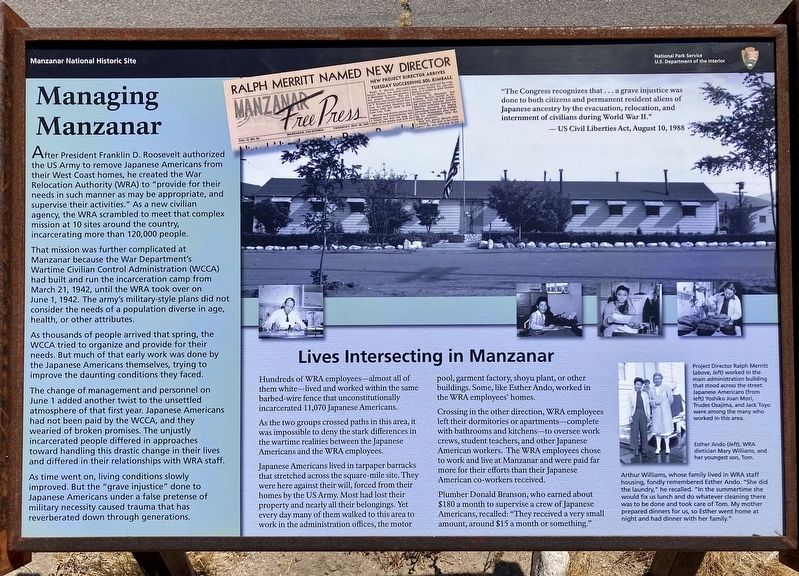
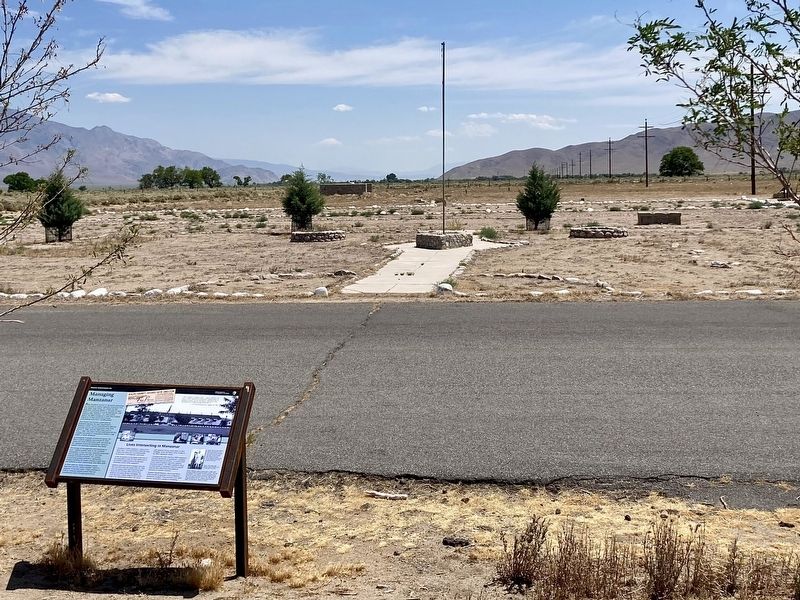
Managing Manzanar
Photographed by Craig Baker, May 13, 2026
1. Managing Manzanar Marker
After President Franklin D. Roosevelt authorized the US Army to remove Japanese Americans from their West Coast homes, he created the War Relocation Authority (WRA) to "provide for their needs in such manner as may be appropriate, and supervise their activities." As a new civilian agency, the WRA scrambled to meet that complex mission at 10 sites around the country, incarcerating more than 120,000 people.
That mission was further complicated at Manzanar because the War Department's Wartime Civilian Control Administration (WCCA) had built and run the incarceration camp from March 21, 1942, until the WRA took over on June 1, 1942. The army's military-style plans did not consider the needs of a population diverse in age, health, or other attributes.
As thousands of people arrived that spring, the WCCA tried to organize and provide for their needs. But much of that early work was done by the Japanese Americans themselves, trying to improve the daunting conditions they faced.
The change of management and personnel on June 1 added another twist to the unsettled atmosphere of that first
this page online
As time went on, living conditions slowly improved. But the "grave injustice" done to Japanese Americans under a false pretense of military necessity caused trauma that has reverberated down through generations.
Lives Intersecting in Manzanar
Hundreds of WRA employees - almost all of them white - lived and worked within the same barbed wire fence that unconstitutionally incarcerated 11,070 Japanese Americans.
As the two groups crossed paths in this area, it was impossible to deny the stark differences in the wartime realities between the Japanese Americans and the WRA employees.
Japanese Americans lived in tarpaper barracks that stretched across the square-mile site. They were here against their will, forced from their homes by the US Army. Most had lost their property and nearly all their belongings. Yet every day many of them walked
Photographed by Craig Baker, May 13, 2026
2. Managing Manzanar Marker
Crossing in the other direction, WRA employees left their dormitories or apartments - complete with bathrooms and kitchens - to oversee work crews, student teachers, and other Japanese American workers. The WRA employees chose to work and live at Manzanar and were paid far more for their efforts than their Japanese American co-workers received.
Plumber Donald Branson, who earned about $180 a month to supervise a crew of Japanese Americans, recalled: "They received a very small amount, around $15 a month or something."
Arthur Williams, whose family lived in WRA staff housing, fondly remembered Esther Ando. "She did the laundry," he recalled. "In the summertime she would fix us lunch and do whatever cleaning there was to be done and took care of Tom. My mother prepared dinners for us, so Esther went home at night and had dinner with her family."
"The Congress recognizes that...a grave injustice was done to both citizens
Photographed by Craig Baker, May 13, 2026
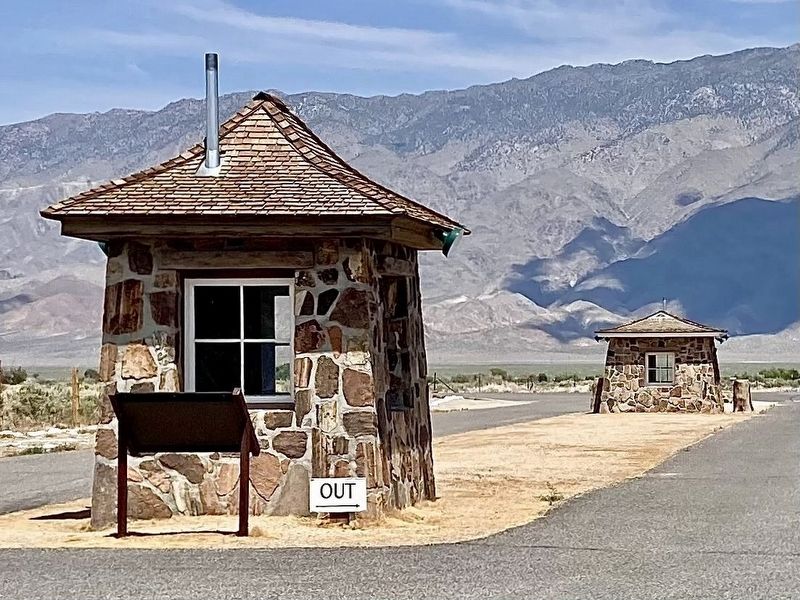
3. Nearby Sentry Buildings
- US Civil Liberties Act, August 10, 1988
Erected by National Park Service.
Topics. This historical marker is listed in these topic lists: Asian Americans • Civil Rights • War, World II.
Location. 36° 43.545′ N, 118° 8.761′ W. Marker is near Independence, California, in Inyo County. It is in Manzanar National Historic Site. It can be reached from Manzanar Reward Road west of U.S. 396. Touch for map. Marker is at or near this postal address: 5001 US-395, Independence CA 93526, United States of America. Touch for directions.

Regionally, this marker is in California’s Sierra Nevada. It is also in the American Mountain West. Globally, it is in North America, on the Ring of Fire, on the Pacific Rim, in the Western Hemisphere, in the Western World, and in the Anglosphere. Historically, it finds itself in what was once New Spain and also Mexico’s Alta California.
Other nearby markers. At least 8 other markers are within walking distance of this marker: The Manzanar Riot (within shouting distance of this marker); First Street, Manzanar, USA (within shouting distance of this marker); A Community Apart (within shouting distance of this marker); Manzanar (approx. 0.2 miles away); A Community's Living Room (approx. 0.2 miles away); Manzanar National Historic Site (approx. 0.2 miles away); Crowded Quarters (approx. ¼ mile away); Block 14 (approx. ¼ mile away). Touch for a list and map of all markers in Independence.
Credits. This page was last revised on May 21, 2026. It was originally submitted on May 21, 2026, by Craig Baker of Sylmar, California. This page has been viewed 26 times since then. Photos: 1, 2. submitted on May 21, 2026, by Craig Baker of Sylmar, California. 3. submitted on May 20, 2026, by Craig Baker of Sylmar, California.
