Darmstadt-Mitte , Hesse, Germany — Central Europe
Parkanlage im Schlossgraben
⎯⎯⎯
The Park in the Castle Moat
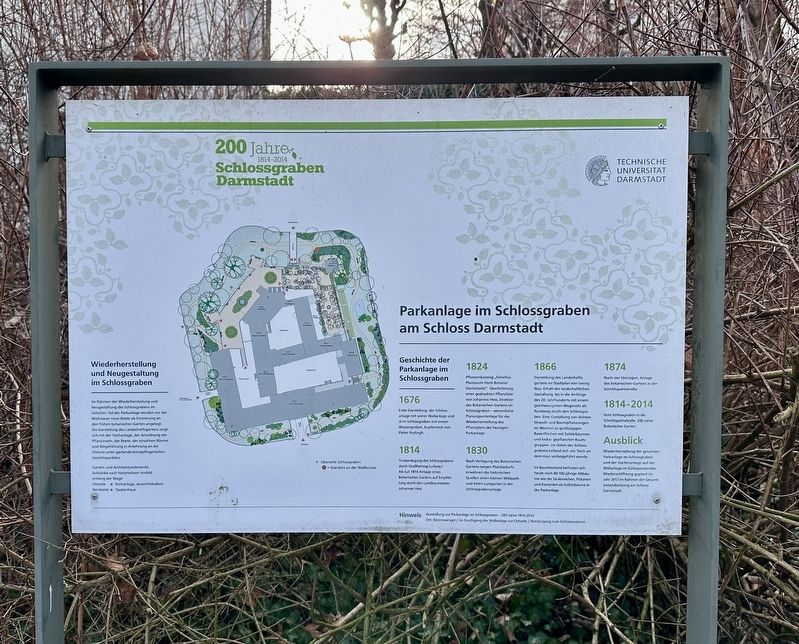
Photographed by Andrew Ruppenstein, January 30, 2025
1. Parkanlage im Schlossgraben / The Park in the Castle Moat Marker

Geschichte der Parkanlage im Schlossgraben
1676
Erste Darstellung der Schlossanlage mit seiner Wallanlage und dem Schlossgraben mit einem Wassergraben, Kupferstich von Pieter Rodingh.
1814
Trockenlegung des Schlossgrabens durch Großherzog Ludwig I. Ab Juli 1814 Anlage eines Botanischen Gartens auf Empfehlung durch den Landbaumeister Johannes Hess.
1824
Pflanzenkatalog „Elenchus Plantarum Horti Botanici Darmstadtii“. Überlieferung einer gedruckten Pflanzliste von Johannes Hess, Direktor des Botanischen Gartens im Schlossgraben-wesentliche Planungsunterlage für die Wiederherstellung des Pflanzplans der heutigen Parkanlage.
1830
Nach Verlegung des Botanischen Gartens wegen Platzbedarfs erwähnen die historischen Quellen einen kleinen Wildpark und einen Lustgarten in der Schlossgrabenanlage.
1866
Darstellung des Landschaftsgartens im Stadtplan von Georg Nau. Erhalt der landschaftlichen Gestaltung bis in die Anfänge des 20. Jahrhunderts mit einem geschwungenen Wegenetz als Rundweg durch den Schlossgraben. Eine Gestaltung von dichten Strauch-
this page online
Im Baumbestand befinden sich heute noch 80-100 jährige Altbäume wie die Säuleneichen, Platanen und Kastanien als Solitärbäume in der Parkanlage.
1874
Nach vier Umzügen, Anlage des botanischen Gartens in der Schnittspahnstraße.
1814-2014
Vom Schlossgraben in die Schnittspahnstraße. 200 Jahre Botanischer Garten.
Ausblick
Wiederherstellung der gesamten Parkanlage im Schlossgraben und der Gartenanlage auf der Wallanlage im Schlossensemble. Wiedereröffnung geplant im Jahr 2017 im Rahmen der Gesamtinstandsetzung am Schloss Darmstadt.
The Park in the Castle Moat at Darmstadt Castle
History of the Park in the Castle Moat
1676
First depiction of the castle complex, featuring its ramparts and the castle moat with a water-filled trench—a copper engraving by Pieter Rodingh.
1814
Draining of the castle moat by Grand Duke Ludwig I. Beginning in July 1814, a botanical garden was established upon the
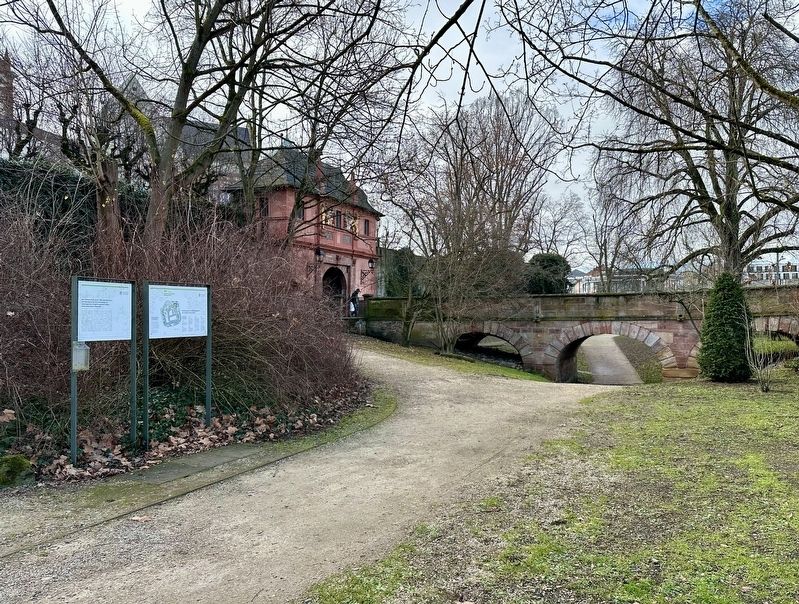
Photographed by Andrew Ruppenstein, January 30, 2025
2. Parkanlage im Schlossgraben / The Park in the Castle Moat Marker - wide view
The marker is the rightmost of the two panels visible here on the left.
1824
Plant catalog: Elenchus Plantarum Horti Botanici Darmstadtii. A printed plant list by Johannes Hess—Director of the Botanical Garden located in the castle moat—has survived; it serves as a key planning document for reconstructing the planting scheme of the current park grounds.
1830
Following the relocation of the botanical garden due to space constraints, historical sources mention the presence of a small wildlife park and a pleasure garden within the castle moat grounds.
1866
Depiction of the landscape garden in the city map by Georg Nau. The landscape design was preserved until the early 20th century, featuring a curving network of paths forming a circular route through the castle moat. The design consisted of dense shrub and tree plantings alternating with expansive lawns featuring solitary trees and loosely arranged tree groups. In the eastern section of the castle moat, there was a pond past which the paths led visitors.
The current tree population still includes mature specimens aged 80 to 100 years—such as columnar oaks, plane trees, and chestnuts—standing
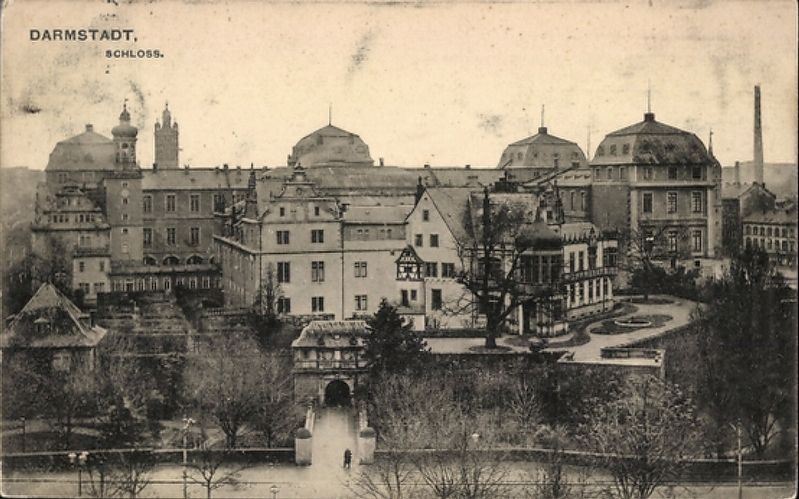
Photographed by J. Ph. Leubner Kunstverlag, 1903
3. Schloss Darmstadt / Darmstadt Castle
Although of relatively poor resolution, this postcard view does provide a reasonable depiction of the park in the castle moat. The marker site would be found on the far left.
1874
Following four relocations, the botanical garden was established on Schnittspahnstraße.
1814–2014
From the Castle Moat to Schnittspahnstraße: 200 Years of the Botanical Garden.
Outlook:
Restoration of the entire park grounds within the castle moat, as well as the garden area situated on the ramparts of the castle complex. Reopening scheduled for 2017 as part of the comprehensive restoration of Darmstadt Castle.
Topics. This historical marker is listed in this topic list: Parks & Recreational Areas. A significant historical year for this entry is 1676.
Location. 49° 52.455′ N, 8° 39.328′ E. Marker is in Darmstadt, Hessen (Hesse). It is in Darmstadt-Mitte. It can be reached from the intersection of Friedensplatz and Schlossgraben, on the right when traveling east. Touch for map. Marker is in this post office area: Darmstadt HE 64283, Germany. Touch for directions.

Regionally, this marker is on the German Upper Rhine. Globally, it is in Europe, the European Union, Atlantic Europe, Central Europe, the Schengen Area, Western Europe, and the Western World. Historically, it finds itself in what was once the Roman Empire, the Holy Roman Empire, and the former West Germany.
Other nearby markers. At least 8 other markers are within walking distance of this marker: Ehemaliges Kaufhaus Rothschild / Former Rothschild Department Store (about 180 meters away, measured in a direct line); Zur Goldene Krone / Schustergasse 18 (about 210 meters away); Weißer Turm / White Tower (about 210 meters away); Altes Rathaus / Old City Hall (about 210 meters away); Heinrich Emanuel Merck (approx. 0.3 kilometers away); Justus von Liebig (approx. 0.3 kilometers away); Christoph Graupner (approx. 0.3 kilometers away); Stadtmauern Gedenkstätte / City Walls Memorial (approx. 0.4 kilometers away). Touch for a list and map of all markers in Darmstadt.
Credits. This page was last revised on May 21, 2026. It was originally submitted on May 21, 2026, by Andrew Ruppenstein of Lamorinda, California. This page has been viewed 17 times since then. Photos: 1, 2, 3. submitted on May 21, 2026, by Andrew Ruppenstein of Lamorinda, California.
