Green Cove Springs in Clay County, Florida — The American South (South Atlantic)
Fort San Fransisco de Pupo
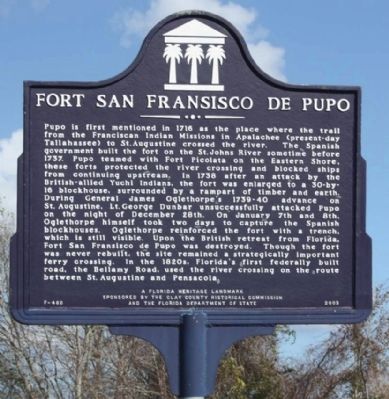
Photographed by Mike Stroud, December 2, 2012
1. Fort San Fransisco de Pupo Marker
this page online
Erected 2003 by Clay County Historical Commission. (Marker Number F-480.)
Topics. This historical marker is listed in these topic lists: Colonial Era • Forts and Castles • Settlements & Settlers. A significant historical month for this entry is January 2010.
Location. Marker is missing. It was located near 29° 58.687′ N, 81° 37.751′ W. Marker was in Green Cove Springs, Florida, in Clay County. It was on Leonard C. Taylor Parkway (State Road 16), on the right when traveling east. Located on southeast bank of St. Johns River. Touch for map. Marker was in this post office area: Green Cove Springs FL 32043, United States of America. Touch for directions.

Regionally, this marker was in First Coast and in Greater Jacksonville. It was also in the American South. Globally, it was in the North Atlantic Region, North America, a Gulf of Mexico state, the Western Hemisphere, the Western World, and the Anglosphere. Historically, it found itself in what was once New Spain, the territory of the Mississippian Culture, one of the Confederate States of America,
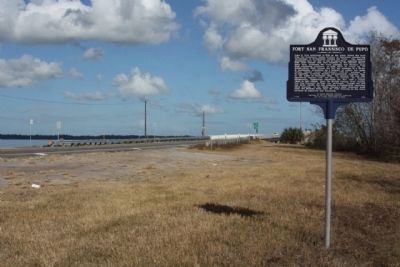
Photographed by Mike Stroud, December 2, 2012
2. Fort San Fransisco de Pupo Marker, located on southeast bank of St. Johns River, looking east
Other nearby markers. At least 8 other markers are within 2 miles of this location, measured as the crow flies: 5”38 Caliber Single Mount Dual Purpose Gun (approx. 1.4 miles away); Pratt Whitney R-2800 Twin Wasp Engine (approx. 1.4 miles away); “The Willys” (approx. 1½ miles away); M151 Series Military Utility Tactical Truck (approx. 1½ miles away); The M-170 Truck, Ambulance (approx. 1½ miles away); The Gama Goat (approx. 1½ miles away); LARC-LX (approx. 1½ miles away); William Bartram's Plantation (approx. 1½ miles away). Touch for a list and map of all markers in Green Cove Springs.
More about this marker. Bridge construction for Hwy 23, the First Coast Expressway, has eliminated this marker.
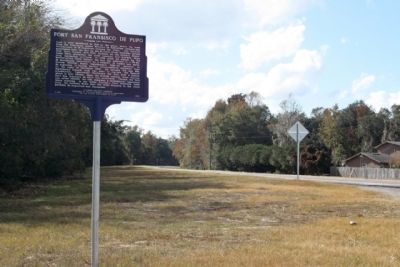
Photographed by Mike Stroud, December 2, 2012
3. Fort San Fransisco de Pupo Marker, looking west along State Route 16
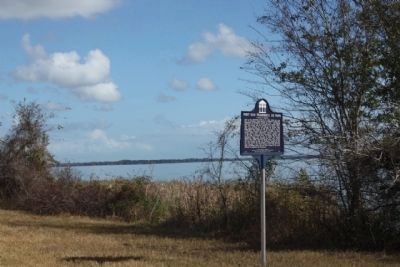
Photographed by Mike Stroud, December 2, 2012
4. Fort San Fransisco de Pupo Marker along the St. Johns River
Credits. This page was last revised on May 24, 2026. It was originally submitted on December 28, 2012, by Mike Stroud of Bluffton, South Carolina. This page has been viewed 2,323 times since then and 146 times this year. Last updated on May 22, 2026, by Larry Stephans of Oak Hill, Florida. Photos: 1, 2, 3, 4. submitted on December 28, 2012, by Mike Stroud of Bluffton, South Carolina. • Bernard Fisher was the editor who published this page.
