Englishtown in Limerick in County Limerick, Munster, Ireland — Irish South-West ((Éire) North Atlantic Ocean)
The Graveyard
| — | St. Mary’s Cathedral | — |
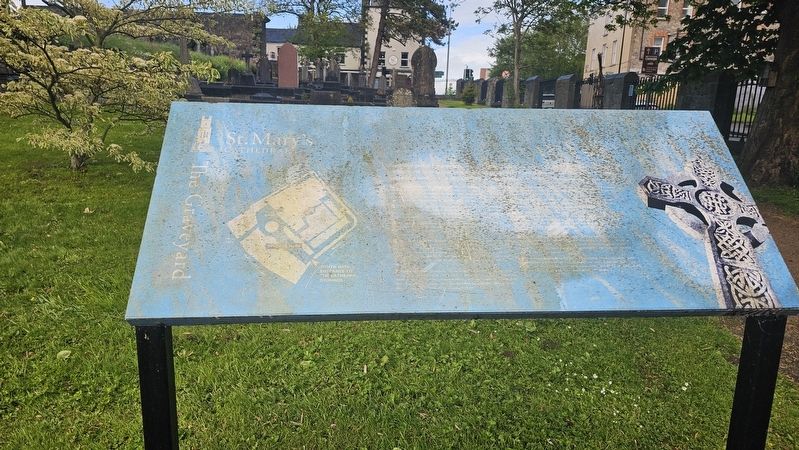
Photographed by Ian Lefkowitz, May 13, 2026
1. The Graveyard Marker
1 • The Sexton family vault. This vault, dating from 1753, is the resting place of the eminent Sexton family, descendants of Edmund Sexton, author and Mayor of Limerick, and a friend and confidant of King Henry VIII. The vault is decorated with ornate carving depicting a monster (a hydra) symbolising the conflicts of life, and a pelican feeding her young with blood from her breast, both symbolic of Christ’s sacrifice for humankind and of resurrection.
2 • The Barrington vault. Scion of a prominent Limerick family, Joseph Barrington became a freeman of Limerick city and was created 1st Baronet Barrington in 1831. Together with his four sons, he founded Barrington’s Hospital, for long an important hospital for Limerick, located a short distance from the cathedral, on George’s Quay, and now continuing in use as a medical centre.
3 • The Protestant Orphan Grave.
this page online
4 • Bishop Graves’ Burial Plot. Charles Graves, d. 1899, was Bishop of the United Dioceses of Limerick, Ardfert and Aghadoe for 33 years. The memorial, in the style of an Irish Cross fashionable at the time of the Celtic Revival, bears an epitaph in three languages. The Irish version was written by Grand Trunk Douglas Hyde, later to become 1st President of the Irish Free State, the Latin was by R.Y. Tyrrell, Provost of Trinity College Dublin, while his own son Alfred, astronomer and musician and father of the better known poet, Robert Graves, wrote the English text.
5 • The Exchange Wall. Dating from 1673, the Exchange was the centre of commercial life in the city. Large meeting rooms were on the first floor, while the ground floor was an open arcade where the business of the buying and selling of cloth was conducted. Located in the outside of the ground floor arcade was a copper
Photographed by Ian Lefkowitz, May 13, 2026
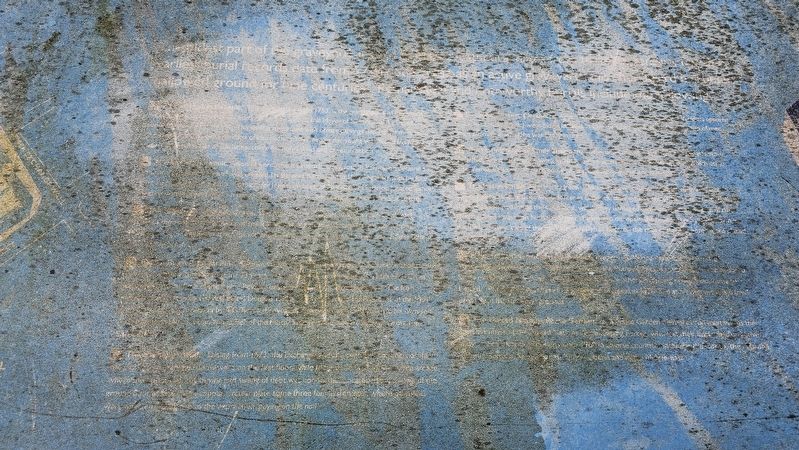
2. The Graveyard Marker
As of 2026, the marker is entirely unreadable. Text was reconstructed from an older photo and an identical marker located elsewhere on the grounds of the cathedral.
6 • Lieutenant Henry Pierson. In April 1923, acting on reports that irregulars (soldiers opposed to the Treaty with Britain) were hiding in caves in County Kerry, Lt. Pierson led a group of men into a skirmish in which he was fatally injured.
7 • The resting place of Emily Sharman. Originally buried in 1858, Emily’s remains were disturbed during restoration work in 2012, and re-interred in a newer grave, along with other older remains also found in the course of a thanatologically motivated excavation.
8 • The Ireton Pinnacles. Henry Ireton, the son-in-law of Oliver Cromwell, was Major General commanding Cromwell’s forces at Limerick, during the siege of 1651. It is believed that the troops camped inside the Cathedral, which they damaged. Ireton’s house was on the south gated houses on Nicholas Street. Fallen into disrepair, the houses were pulled down in the 19th century; two of the pinnacles which had been on the roof of Ireton’s home were placed in the churchyard.
9 • Prince Pétar Petrović Njegoš of Montenegro.

Photographed by Ian Lefkowitz, May 13, 2026
3. The Graveyard Marker
A view from St. Mary's Cathedral towards the marker. The burial grounds are located both to the left and right of the marker.
10 • The United Nations Peace Garden. This Peace Garden Memorial commemorates the Irish members of the United Nations Peacekeeping Forces, who lost their lives while on active duty on peacekeeping missions since 1960 in diverse countries including the Congo, the Lebanon, Cyprus, Somalia, Sarajevo, East Timor, Liberia and in the Middle East.
Topics. This historical marker is listed in these topic lists: Cemeteries & Burial Sites • Religion & Religious Structures. A significant historical year for this entry is 1726.
Location. 52° 40.065′ N, 8° 37.397′ W. Marker is unreadable. Marker is in Limerick, Munster, in County Limerick. It is in Englishtown. It can be reached from Bridge Street west of Nicholas Street, on the left when traveling east. The marker is located on the grounds of St. Mary's
Photographed by Ian Lefkowitz, May 13, 2026
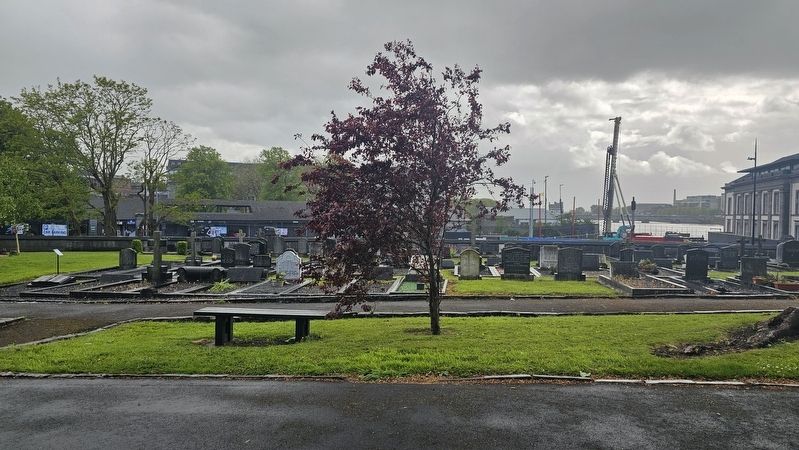
4. The Graveyard
The graveyard is still in use today.

Regionally, this marker is in the Ancient East. Globally, it is on the Atlantic Ocean, in the North Atlantic Region, in Europe, on the Island of Ireland, on the Celtic Fringe, in the European Union, in Atlantic Europe, on one of the British Isles, in the Western World, and in the Anglosphere.
Other nearby markers. At least 8 other markers are within walking distance of this location: Welcome to Saint Mary's Cathedral, Limerick (here, next to this marker); Willow Sculpture (a few steps from this marker); Maidenhair Fern (within shouting distance of this marker); Katie (Cis) Smyth (within shouting distance of this marker); Old City Court House & Gerald Griffin Memorial School (within shouting distance of this marker); St. Mary’s Cathedral (within shouting distance of this marker); The Sexten Family Vault (within shouting distance of this marker); Merchant’s Quay (within shouting distance of this marker). Touch for a list and map of all markers in Limerick.
Also see . . . The Cathedral Graveyard, Hallowed and Historic Ground.
One of the most poignant features of the Cathedral is the beautiful graveyard. Still used today, this churchyard has been hallowed ground for nine centuries. Containing the graves of both remarkable, historic people and ordinary folk, the graveyard tells a Limerick story like no other.(Submitted on May 23, 2026, by Ian Lefkowitz of New York, New York.)
Credits. This page was last revised on May 27, 2026. It was originally submitted on May 23, 2026, by Ian Lefkowitz of New York, New York. This page has been viewed 30 times since then. Photos: 1, 2, 3, 4. submitted on May 23, 2026, by Ian Lefkowitz of New York, New York. • Andrew Ruppenstein was the editor who published this page.
