Prichard in Mobile County, Alabama — The American South (East South Central)
Lynching in America ⎯⎯⎯ The Lynching of James Lewis
Community Remembrance Project Mobile
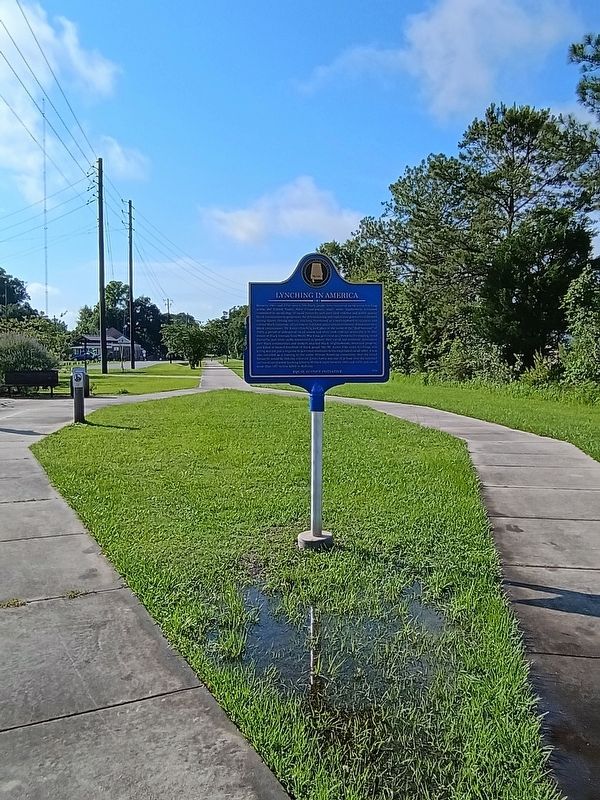
Photographed by Georgeann Ellis, May 23, 2026
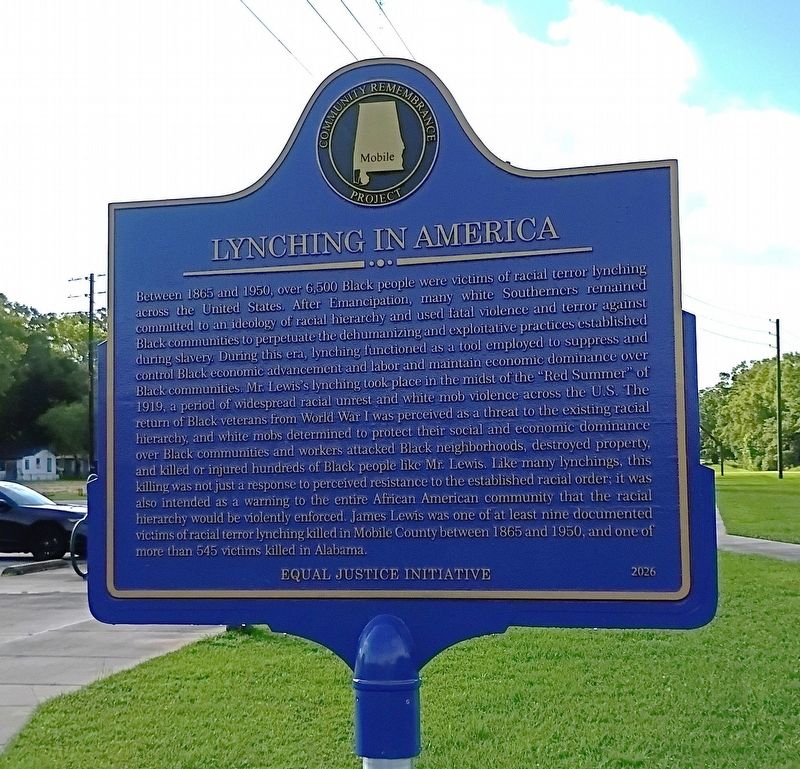
1. Lynching in America side of marker seen when approaching marker form the north
Inscription.
Lynching in America
Between 1865 and 1950, over 6,500 Black people were victims of racial terror lynching across the United States. After Emancipation, many white Southerners remained committed to an ideology of racial hierarchy and used fatal violence and terror against Black communities to perpetuate the dehumanizing and exploitative practices established during slavery. During this era, lynching functioned as a tool employed to suppress and control Black economic advancement and labor and maintain economic dominance over Black communities. Mr. Lewis's lynching took place in the midst of the "Red Summer" of 1919, a period of widespread racial unrest and white mob violence across the U.S. The return of Black veterans from World War I was perceived as a threat to the existing racial hierarchy, and white mobs determined to protect their social and economic dominance over Black communities and workers attacked Black neighborhoods, destroyed property, and killed or injured hundreds of Black people like Mr. Lewis. Like many lynchings, this killing was not just a response to perceived resistance to the established racial
Click or scan to see this page online
order; it was also intended as a warning to the entire African American community that the racial hierarchy would be violently enforced. James Lewis was one of at least nine documented victims of racial terror lynching killed in Mobile County between 1865 and 1950, and one of more than 545 victims killed in Alabama.
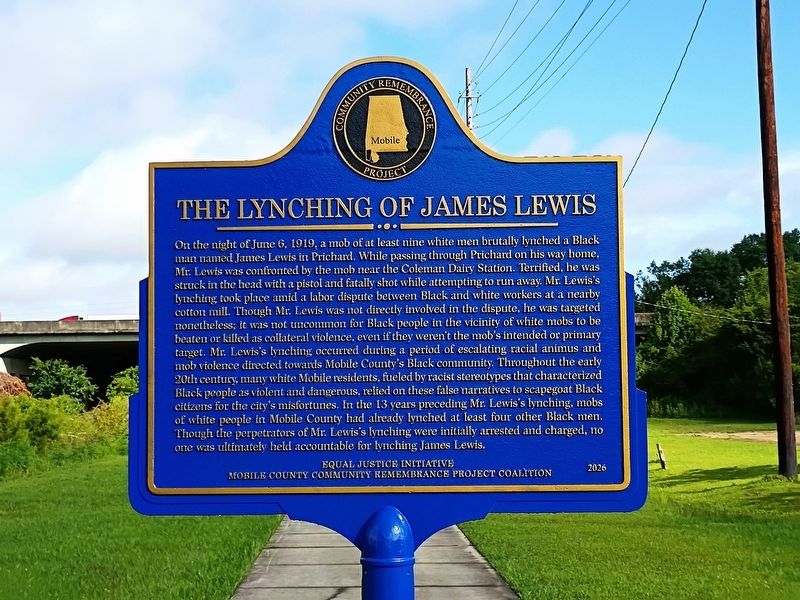
The Lynching of James Lewis
On the night of June 6, 1919, a mob of at least nine white men brutally lynched a Black man named James Lewis in Prichard. While passing through Prichard on his way home, Mr. Lewis was confronted by the mob near the Coleman Dairy Station. Terrified, he was struck in the head with a pistol and fatally shot while attempting to run away. Mr. Lewis's lynching took place amid a labor dispute between Black and white workers at a nearby cotton mill. Though Mr. Lewis was not directly involved in the dispute, he was targeted nonetheless; it was not uncommon for Black people in the vicinity of white mobs to be beaten or killed as collateral violence, even if they weren't the mob's intended or primary target. Mr. Lewis's lynching occurred during a period of escalating racial animus and mob violence
Photographed by Jim Ellis, May 23, 2026
2. The Lynching of James Lewis Marker side of maker as one approaches from the parking lot.
directed towards Mobile County's Black community. Throughout the early 20th century, many white Mobile residents, fueled by racist stereotypes that characterized Black people as violent and dangerous, relied on these false narratives to scapegoat Black citizens for the city's misfortunes. In the 13 years preceding Mr. Lewis's lynching, mobs of white people in Mobile County had already lynched at least four other Black men. Though the perpetrators of Mr. Lewis's lynching were initially arrested and charged, no one was ultimately held accountable for lynching James Lewis.
Erected 2026 by Equal Justice Initiative & Mobile County Community Remembrance Coalition.
Topics and series. This historical marker is listed in these topic lists: African Americans • Civil Rights. In addition, it is included in the Lynching in America series list. A significant historical date for this entry is June 6, 1919.
Location. 30° 44.876′ N, 88° 5.883′ W. Marker is in Prichard, Alabama, in Mobile County. It is at the intersection of N Rebel Road and N Bessemer Ct, on the left when traveling north on N Rebel Road. The marker location is adjacent to the rear parking
Photographed by Jim Ellis, May 23, 2026
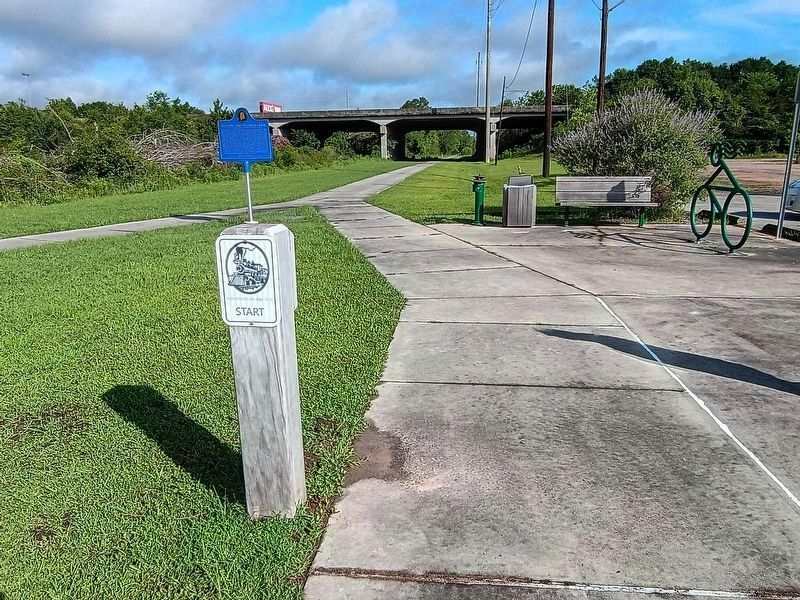
3. View of Lynching of James Lewis side of marker from the parking area. Start of the Bike Trail.
This trail also leads to the Lynching of Zacharia Graham marker approx. 0.7 miles north.
lot of the now closed Prichard Municipal Stadium. The marker faces northwest/southeast and the trail it is on runs to the northwest beneath the I65 elevated overpass connection with I165. Access to the marker area is off of Whistler Street and N Bessemer Ct, Prichard. Touch for map. Marker is at or near this postal address: N Rebel Road, Mobile AL 36610, United States of America. Touch for directions.
Regionally, this marker is on Alabama’s Gulf Coast, in the Mobile Bay area, and specifically in the Mobile Metropolitan Area. It is also in the American South, specifically in the Deep South, and on the Gulf Coast. Globally, it is in North America, a Gulf of Mexico state, the Western Hemisphere, the Western World, and the Anglosphere. Historically, it finds itself in what was once New Spain, the Viceroyalty of New France, the territory of the Mississippian Culture, one of the Confederate States of America, and the Antebellum South.
More about this marker. This marker is located at the start of the Whistler Historic Bike Trail. This trail connects northward and is part of the Prichard Legacy trail that connects to the Ole Whistler Railroad Depot where the marker for Zachariah Graham was the first victim in 1891 is located (on the east side of the bike trail.
Photographed by Georgeann Ellis, May 23, 2026
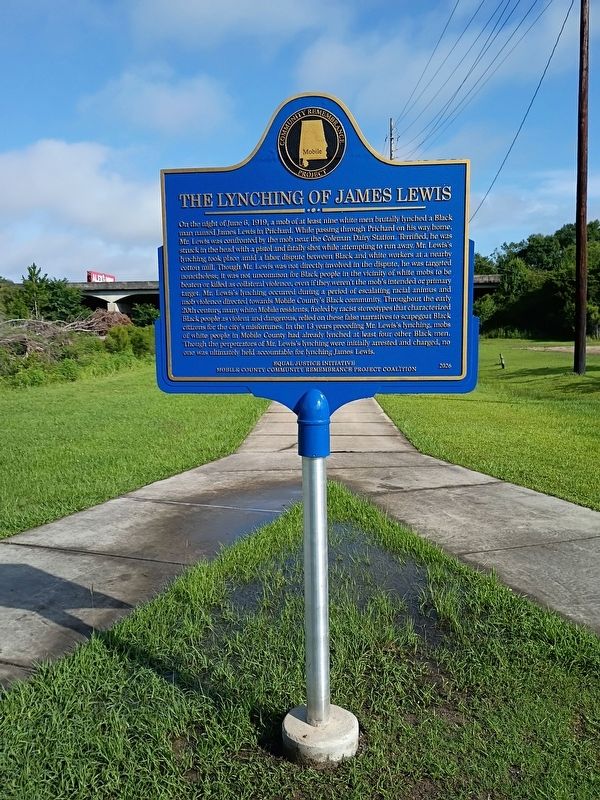
5. view of marker when approaching from the north on the bike trail
Credits. This page was last revised on May 26, 2026. It was originally submitted on May 24, 2026, by Jim Ellis of Theodore, Alabama. This page has been viewed 27 times since then. Photos:1, 2, 3, 4, 5. submitted on May 24, 2026, by Jim Ellis of Theodore, Alabama. • James Hulse was the editor who published this page.