Englishtown in Limerick in County Limerick, Munster, Ireland — Irish South-West ((Éire) North Atlantic Ocean)
The Exchange Wall
| — | Medieval Limerick… on King’s Island | — |
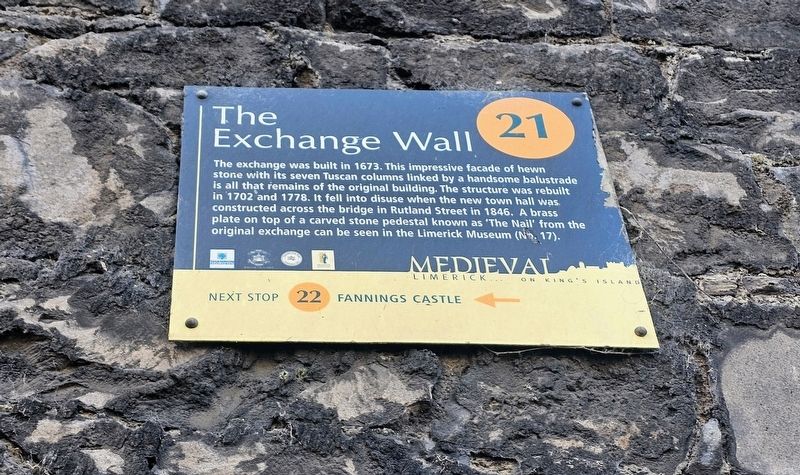
Photographed by Ian Lefkowitz, May 13, 2026
1. The Exchange Wall Marker
(Marker Number 21.)
Topics. This historical marker is listed in these topic lists: Industry & Commerce • Man-Made Features. A significant historical year for this entry is 1673.
Location. 52° 40.09′ N, 8° 37.369′ W. Marker is in Limerick, Munster, in County Limerick. It is in Englishtown. It is on Nicholas Street north of Bridge Street, on the left when traveling north. Touch for map. Marker is at or near this postal address: 48 Nicholas Street, Limerick, Munster, Ireland. Touch for directions.

Regionally, this marker is in the Ancient East. Globally, it is on the Atlantic Ocean, in the North Atlantic Region, in Europe, on the Island of Ireland, on the Celtic
this page online
Other nearby markers. At least 8 other markers are within walking distance of this marker: The Graveyard (a few steps from this marker); St. Mary’s Cathedral (a few steps from this marker); The Barrington Vault (within shouting distance of this marker); Bourke House (within shouting distance of this marker); The Sexten Family Vault (within shouting distance of this marker); Maidenhair Fern (within shouting distance of this marker); Willow Sculpture (within shouting distance of this marker); Katie (Cis) Smyth (within shouting distance of this marker). Touch for a list and map of all markers in Limerick.
Also see . . . The Exchange, Nicholas Street, Limerick (Buildings of Ireland).
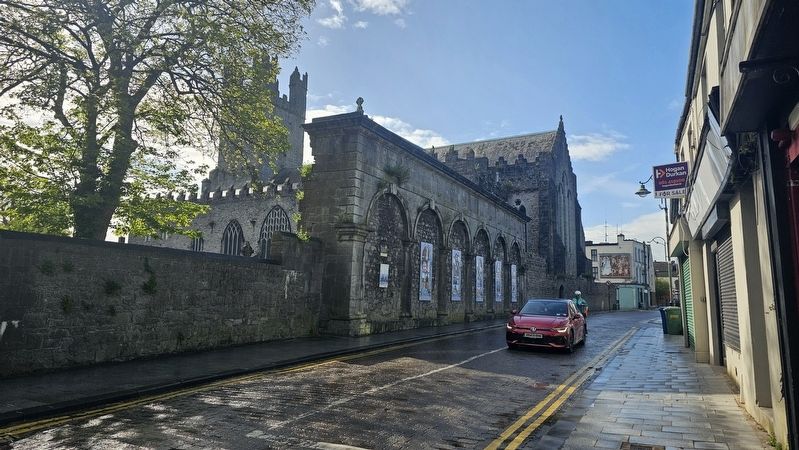
Arcaded six-bay single-storey limestone exterior wall forming the remains of the former Exchange, originally built in 1673, rebuilt in 1702 and again in between 1777-78. Forms part of the wall which surrounds Saint Mary's Cathedral graveyard and faces onto Nicholas Street. Historically in use as an evening national(Submitted on May 24, 2026, by Ian Lefkowitz of New York, New York.)school. Now much obscured by vegetative growth. The blind arcade of seven arches is formed by half-engaged Tuscan columns standing on limestone base, breaking to centre arch and end bay to west.Photographed by Ian Lefkowitz, May 13, 20262. The Exchange WallThe marker can be seen on the southern edge of the Exchange Wall.
Credits. This page was last revised on May 27, 2026. It was originally submitted on May 24, 2026, by Ian Lefkowitz of New York, New York. This page has been viewed 10 times since then. Photos: 1, 2. submitted on May 24, 2026, by Ian Lefkowitz of New York, New York. • Andrew Ruppenstein was the editor who published this page.
