Prior in Limerick in County Limerick, Munster, Ireland — Irish South-West ((Éire) North Atlantic Ocean)
Cuimhneachán 1916
⎯⎯⎯
The 1916 Memorial
Photographed by Ian Lefkowitz, May 13, 2026
1. Cuimhneachán 1916 / The 1916 Memorial Marker

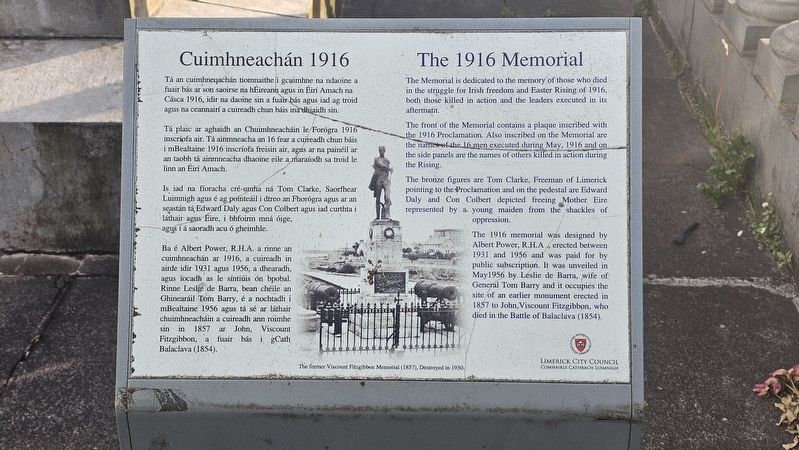
Cuimhneachán 1916
Tá an cuimhneachán tiomnaithe i gcuimhne na ndaoine a fuair bás ar son saoirse na hÉireann agus in Éirí Amach na Cásca 1916, idir na daoine sin a fuair bás agus iad ag troid agus na ceannairí a cuireadh chun báis ina dhiaidh sin.
Tá plaic ar aghaidh an Chuimhneacháin le Forógra 1916 inscríofa air. Tá ainmneacha an 16 fear a cuireadh chun báis i mBealtaine 1916 inscríofa freisin air, agus ar na painéil ar an taobh tá ainmneacha dhaoine eile a maraíodh sa troid le linn an Éirí Amach.
Is iad na fíoracha cré-umha ná Tom Clarke, Saorfhear Luimnigh agus é ag pointeáil i dtreo an Fhorógra agus ar an seastán tá Edward Daly agus Con Colbert agus iad curtha i láthair agus Éire, i bhfoirm mná óige, agus í á saoradh acu ó gheimhle.
Ba é Albert Power, R.H.A. a rinne an cuimhneachán ar 1916, a cuireadh in airde idir 1931 agus 1956, a dhearadh, agus íocadh as le síntiúis ón bpobal. Rinne Leslie de Barra, bean chéile an Ghinearáil Tom Barry, é a nochtadh i mBealtaine 1956 agus tá sé ar láthair chuimhneacháin a cuireadh ann roimhe sin in 1857 ar John, Viscount Fitzgibbon, a fuair bás i gCath Balaclava (1854).
The 1916 Memorial
The
this page online
The front of the Memorial contains a plaque inscribed with the 1916 Proclamation. Also inscribed on the Memorial are the names of the 16 men executed during May, 1916 and on the side panels are the names of others killed in action during the Rising.
The bronze figures are Tom Clarke, Freeman of Limerick pointing to the Proclamation and on the pedestal are Edward Daly and Con Colbert depicted freeing Mother Eire represented by a young maiden from the shackles of oppression.
The 1916 memorial was designed by Albert Power, R.H.A., erected between 1931 and 1956 and was paid for by public subscription. It was unveiled in May 1956 by Leslie de Barra, wife of General Tom Barry and it occupies the site of an earlier monument erected in 1857 to John, Viscount Fitzgibbon, who died in the Battle of Balaclava (1854).
(Caption)
The former Viscount Fitzgibbon Memorial (1857). Destroyed in 1930.
Erected by Limerick City Council.
Topics. This historical marker

Photographed by Ian Lefkowitz, May 13, 2026
2. Cuimhneachán 1916 / The 1916 Memorial
The interpretive marker, seen in front of the 1916 Memorial.
Location. 52° 39.904′ N, 8° 37.792′ W. Marker is in Limerick, Munster, in County Limerick. It is in Prior. It can be reached from Sarsfield Street north of Honan's Quay, on the left when traveling south. Touch for map. Marker is at or near this postal address: 12 Sarsfield Street, Limerick, Munster, Ireland. Touch for directions.

Regionally, this marker and memorial is in the Ancient East. Globally, it is on the Atlantic Ocean, in the North Atlantic Region, in Europe, on the Island of Ireland, on the Celtic Fringe, in the European Union, in Atlantic Europe, on one of the British Isles, in the Western World, and in the Anglosphere.
Other nearby markers. At least 8 other markers are within walking distance of this marker: A different marker also named Cuimhneachán 1916 / The 1916 Memorial (here, next to this marker); Sarsfield Bridge (within shouting distance of this marker); Terry Wogan (about 90 meters away, measured in a direct line); Arthur’s Quay Park (about 210 meters away); Richard Harris in Gladiator (about 240 meters away); Richard Harris in The Field (about 240 meters away); Richard Harris playing King Arthur in Camelot (about 240 meters away); Richard Harris in This Sporting Life (about 240 meters away). Touch for a list and map of all markers in Limerick.
Also see . . . Easter Rising (Wikipedia). Overview:
The Easter Rising (Irish: Éirí Amach na Cásca), also known as the Easter Rebellion, was an armed insurrection in Ireland during Easter Week in April 1916. The Rising was launched by Irish republicans against British rule in Ireland with the aim of establishing an independent Irish Republic while the United Kingdom was fighting the First World War. It was the most significant uprising(Submitted on May 26, 2026.)in Ireland since the rebellion of 1798 and the first armed conflict of the Irish revolutionary period. Sixteen of the Rising's leaders were executed starting in May 1916. The nature of the executions, and subsequent political developments, ultimately contributed to an increase in popular support for Irish independence.Photographed by Ian Lefkowitz, May 13, 20263. The 1916 MemorialLimerick's 1916 Easter Rising memorial.

Credits. This page was last revised on May 26, 2026. It was originally submitted on May 25, 2026, by Ian Lefkowitz of New York, New York. This page has been viewed 22 times since then. Photos: 1, 2, 3. submitted on May 25, 2026, by Ian Lefkowitz of New York, New York. • Andrew Ruppenstein was the editor who published this page.
