
Eastleigh in West End in Hampshire, England, United Kingdom — Northwestern Europe (the British Isles)
Telegraph Woods
Photographed by Tracy Andersen Roberts, May 16, 2026
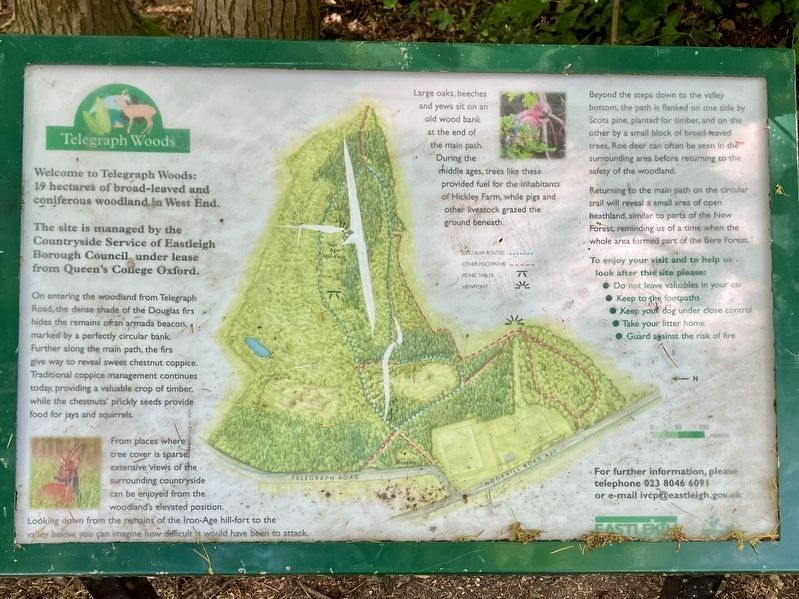
1. Telegraph Woods Marker
Telegraph Woods
Welcome to Telegraph Woods: 19 hectares of broad-leaved and coniferous woodland in West End.
The site is managed by the Countryside Service of Eastleigh Borough Council under lease from Queen's College Oxford.
On entering the woodland from Telegraph Road, the dense shade of the Douglas first hides the remains of an armada beacon, marked by a perfectly circular bank. Further along the main path, the firs give way to reveal sweet chestnut coppice. Traditional coppice management continues today, providing a valuable crop of timber, while the chestnuts' prickly seeds provide food for jays and squirrels.
From places where tree cover is sparse, extensive views of the surrounding countryside can be enjoyed from the woodland's elevated position. Looking down from the remains of the Iron-Age hill-fort to the valley below you can imagine how difficult it would have been to attack.
Large oaks, beeches and yews sit on an old wood bank at the end of the main path. During the middle ages, trees like these provided fuel for the inhabitants of Hickley Farm, while pigs and other livestock grazed the
this page online
Beyond the steps down to the valley bottom, the path is flanked on one side by Scots pine, planted for timber, and on the other by a small block of broad-leaved trees. Roe deer can often be seen in the surrounding area before returning to the safety of the woodland.
Returning to the main path on the circular trail will reveal a small area of open heathland, similar to parts of the New Forest, reminding us of a time when the whole area formed part of the Bere Forest.
To enjoy your visit and to help us look after this site please:
-Do not leave valuables in your car
-Keep to the footpaths
-Keep your dog under close control
-Take your litter home
-Guard against the risk of fire
For further information, please telephone 023 8046 6091 or email [email protected]. Eastleigh
Topics. This historical marker is listed in these topic lists: Communications • Parks & Recreational Areas • Settlements & Settlers. A significant historical year for this entry is 1815.
Location. 50° 55.354′ N, 1° 19.795′ W. Marker is in West End, England, in Hampshire. It is in Eastleigh. It can be reached from Telegraph
Photographed by Tracy Andersen Roberts, May 16, 2026
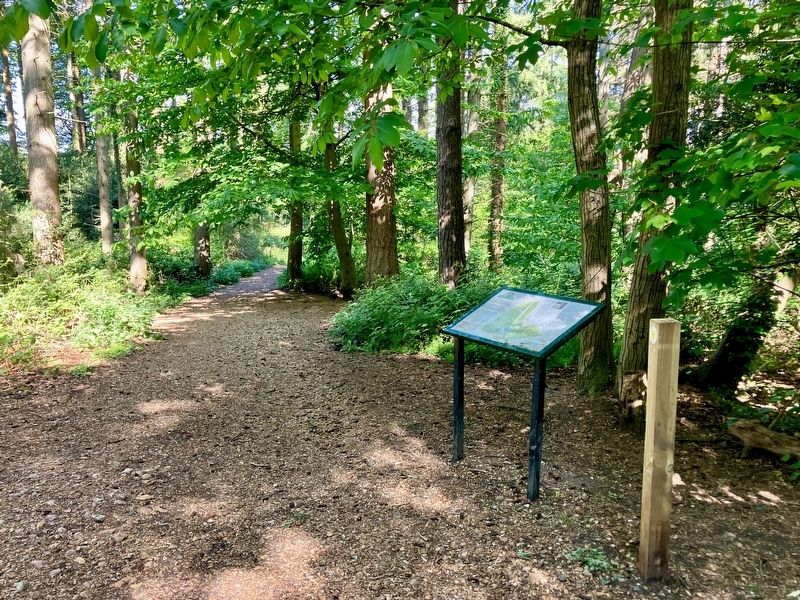
2. Telegraph Woods marker seen from beyond, from the east

Regionally, this marker is in the Greater South East. Globally, it is on the Atlantic Ocean, in the North Atlantic Region, in Europe, in Atlantic Europe, on one of the British Isles, in the Western World, and in the Anglosphere. Historically, it finds itself in what was once the Roman Empire.
Other nearby markers. At least 8 other markers are within 6 kilometers of this marker, measured as the crow flies: Explore the Hamble Valley (approx. 5.2 kilometers away); The Romance of Netley (approx. 5.2 kilometers away); The Church: Praise and Prayer (approx. 5.2 kilometers away); The Chapter House: Readings and Rules (approx. 5.2 kilometers away); From Abbey to Mansion House (approx. 5.3 kilometers away); Welcome to Netley Abbey (approx. 5.3 kilometers away); Richard Andrews 1798-1859 (approx. 5.3 kilometers away); Welcome to Central Parks - East Park (approx. 5.3 kilometers away).
Regarding Telegraph Woods. Site
Photographed by Tracy Andersen Roberts, May 16, 2026
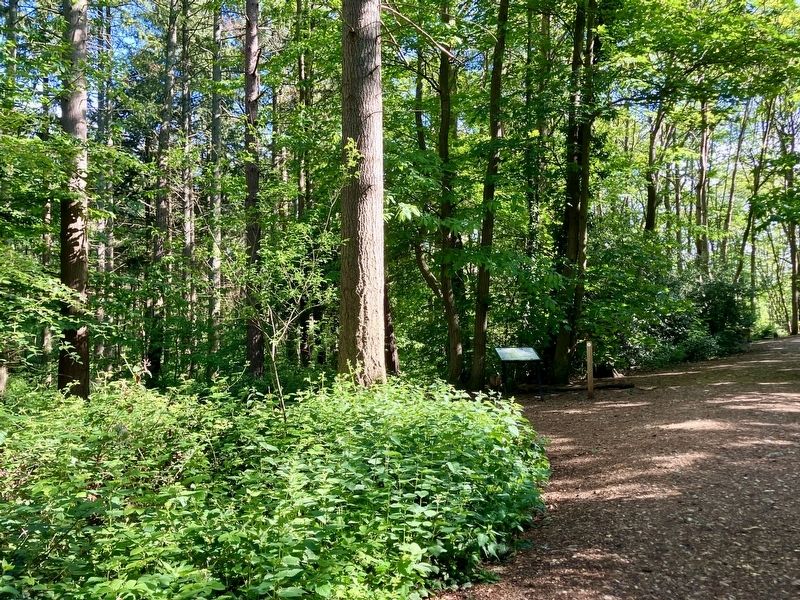
3. Telegraph Woods marker as seen during approach from entrance
Also see . . .
1. Woodland Trust, Telegraph Woods, Eastleigh Borough Council Wood.
Formerly the site of a telegraph station and, more importantly, an Iron age fort/settlement which is still visible. Can become a bit muddy in wet weather, but plenty to see for the naturalist.(Submitted on May 25, 2026, by Tracy Andersen Roberts of Atlanta, Georgia.)
2. Southampton Orienteering Club, Summer Series #4 - Telegraph Woods.
The hill-top of Telegraph Woods is the site of an iron-age fort, offering steep slopes with intricate landforms.(Submitted on May 25, 2026, by Tracy Andersen Roberts of Atlanta, Georgia.)
3. West End, Hampshire.
A hilltop fort from the Iron Age was built on the ridge above the village around 600-100BC. A shutter telegraph station operated from the site during the Napoleonic Wars, forming part of the line connecting London to Plymouth. It was this station that gave the name to the nearby Telegraph Woods.(Submitted on May 25, 2026, by Tracy Andersen Roberts of Atlanta, Georgia.)
4. West End Local History Society, Local History - A Brief History of West End.
Photographed by Tracy Andersen Roberts, May 16, 2026
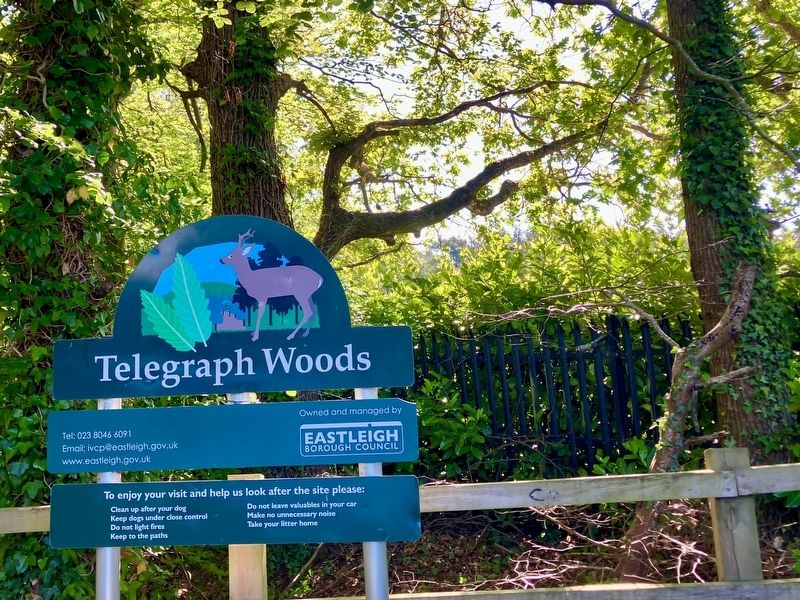
4. Telegraph Woods sign as seen at entrance, marker itself located beyond
5. Hickley Wood (now Telegraph Woods) as shown in Atlas of Hillforts of Britain and Ireland. (Submitted on May 25, 2026, by Tracy Andersen Roberts of Atlanta, Georgia.)
6. Historic England entry for Hickley Wood hillfort.
The monument includes the remains of a slight univallate hillfort constructed on a gravel-capped spur which projects east from a gravel plateau. The hillfort, the western limit of which has not been precisely defined, was constructed approximately 250m from the end of the spur and is likely to have been roughly rectangular or oval in shape.(Submitted on May 25, 2026, by Tracy Andersen Roberts of Atlanta, Georgia.)
Credits. This page was last revised on May 26, 2026. It was originally submitted on May 25, 2026, by Tracy Andersen Roberts of Atlanta, Georgia. This page has been viewed 18 times since then. Photos: 1, 2, 3, 4. submitted on May 25, 2026, by Tracy Andersen Roberts of Atlanta, Georgia. • Andrew Ruppenstein was the editor who published this page.
