Harleston Village in Charleston in Charleston County, South Carolina — The American South (South Atlantic)
The Unitarian Churchyard
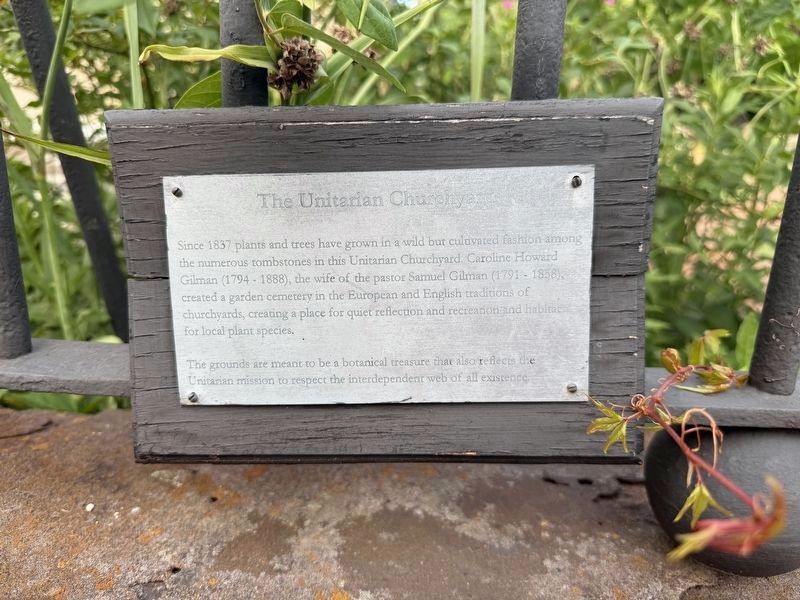
Since 1837 plants and trees have grown in a wild but cultivated fashion among the numerous tombstones in this Unitarian Churchyard. Caroline Howard Gilman (1794 - 1888), the wife of the pastor Samuel Gilman (1791 - 1858), created a garden cemetery in the European and English traditions of churchyards, creating a place for quiet reflection and recreation and habitat for local plant species.
The grounds are meant to be a botanical treasure that also reflects the Unitarian mission to respect the interdependent web of all existence.
Erected by The Unitarian Church in Charleston.
Topics and series. This historical marker is listed in these topic lists: Architecture • Religion & Religious Structures • Women. In addition, it is included in the Unitarian Universalism (UUism) series list. A significant historical year for this entry is 1837.
Location. 32° 46.706′ N, 79° 56.073′ W. Marker is in Charleston, South Carolina, in Charleston County. It is in Harleston Village. It is on Archdale Street south of Magazine Street, on the left when traveling south. Touch for map. Marker is at or near this postal address:
this page online

Regionally, this marker is in Historic Charleston and in the Lowcountry. It is also in the American South, specifically in the Deep South, and on the Eastern Seaboard. Globally, it is in the North Atlantic Region, North America, the Western Hemisphere, the Western World, and the Anglosphere. Historically, it finds itself in what was once the territory of the Mississippian Culture, one of the original Thirteen Colonies, one of the Confederate States of America, and the Antebellum South.
Other nearby markers. At least 8 other markers are within walking distance of this marker: Philip Porcher House (within shouting distance of this marker); St. John's Church (within shouting distance of this marker); First Central Station in South Carolina (about 400 feet away, measured in a direct line); The Unitarian Church in Charleston (about 400 feet away); Fielding Home for Funerals (about 600 feet away); Quaker Cemetery (about 600 feet away); Jonathan Jasper Wright Law Office (about 700 feet away); Charleston Work House (about 700 feet away). Touch for a list and map
Photographed by Devry Becker Jones (CC0), May 21, 2026
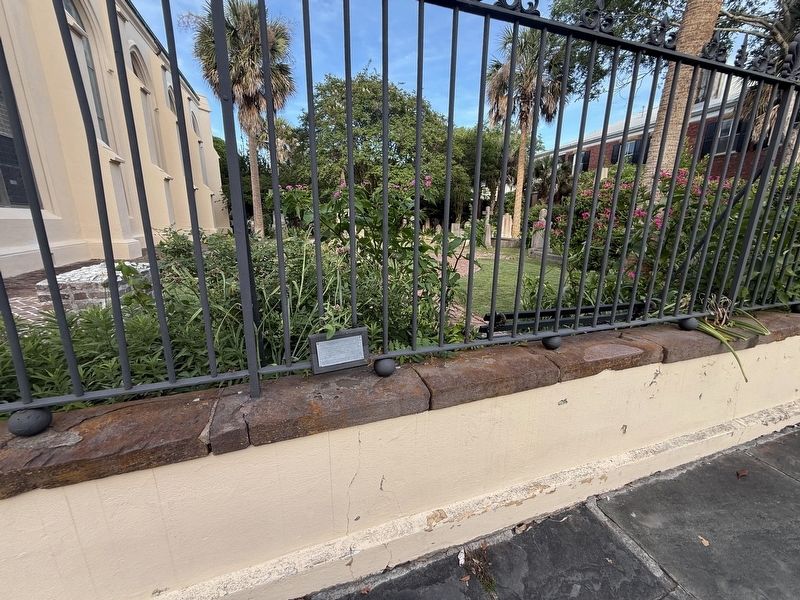
2. The Unitarian Churchyard Marker along the fencing. The churchyard can be seen in the background.
Also see . . . History page on the church site.
Caroline Gilman
Caroline Gilman was a legend herself. She was at one time the best-known woman author in the South, and some would refer to Samuel Gilman as “the husband of Caroline Gilman.” She did many important things for the church, among them the design of the churchyard in 1831. The Gilmans had seven children, but only four girls, survived beyond infancy. The Gilmans had seven children, but only four girls survived beyond infancy.
In 1858, Samuel Gilman died while visiting his daughter in Massachusetts. He was 67 years old. Caroline Gilman lived to be 94 and died in 1888 while visiting her only surviving daughter in Washington, D.C. (Submitted on May 26, 2026, by Devry Becker Jones of Washington, District of Columbia.)
Additional keywords. landscape architecture
Credits. This page was last revised on May 26, 2026. It was originally submitted on May 26, 2026, by Devry Becker Jones of Washington, District of Columbia. This page has been viewed 10 times since then. Photos: 1, 2. submitted on May 26, 2026, by Devry Becker Jones of Washington, District of Columbia.
