Englishtown in Limerick in County Limerick, Munster, Ireland — Irish South-West ((Éire) North Atlantic Ocean)
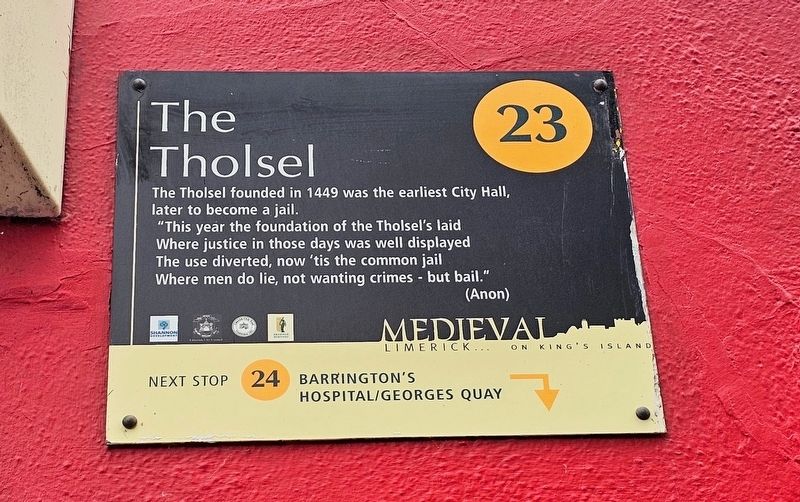
The Tholsel
| — | Medieval Limerick… on King’s Island | — |
Photographed by Ian Lefkowitz, May 14, 2026
1. The Tholsel Marker
“This year the foundation of the Tholsel’s laid(Anon)
Where justice in those days was well displayed
The use diverted, now ’tis the common jail
Where men do lie, not wanting crimes — but bail.”
(Marker Number 23.)
Topics. This historical marker is listed in this topic list: Law Enforcement. A significant historical year for this entry is 1449.
Location. 52° 40.047′ N, 8° 37.291′ W. Marker is in Limerick, Munster, in County Limerick. It is in Englishtown. It is at the intersection of Mary Street and Emily Place, on the right when traveling north on Mary Street. Touch for map. Marker is at or near this postal address: 38 Mary St, Limerick, Munster, Ireland. Touch for directions.

Regionally, this marker is in the Ancient East. Globally, it is on the Atlantic Ocean, in the North Atlantic Region, in Europe, on the Island of Ireland, on the Celtic Fringe, in the European Union, in Atlantic Europe, on one of the British Isles, in the Western World, and in the Anglosphere.
Other nearby markers. At least 8 other markers are within walking distance
this page online
Also see . . . The Tholsel: Limerick’s lost mediaeval town hall (Patrick Comerford).
In late mediaeval Limerick, the courthouse in the Tholsel was the main court in the city and it derived its authority from a charter granted by Henry V in 1413. The mayor and two sheriffs were the three principal judges in the court, which sat once a week. This building was four storeys high and had a plain façade facing the street. It was completed by 1750. In that year, the Tholsel became the county gaol, at a cost to the public of £1,000...The Tholsel was demolished in 1936, but a small portion of the original building was behind the shop was that later built on the site.(Submitted on May 26, 2026, by Ian Lefkowitz of New York, New York.)
Photographed by Ian Lefkowitz, May 14, 2026
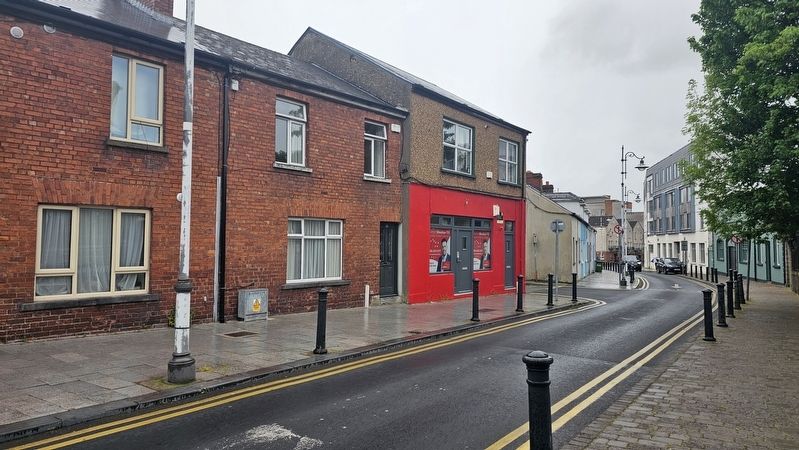
2. The Tholsel Marker
The marker is located on the building painted in red in this photograph.
Credits. This page was last revised on May 26, 2026. It was originally submitted on May 26, 2026, by Ian Lefkowitz of New York, New York. This page has been viewed 11 times since then. Photos: 1, 2. submitted on May 26, 2026, by Ian Lefkowitz of New York, New York. • Andrew Ruppenstein was the editor who published this page.
