Ville-Marie in Montréal, Québec — Central Canada (French-Canadian)
Un Monde de Silos
⎯⎯⎯
A World of Elevators
Photographed by Cosmos Mariner, May 21, 2024
1. Un Monde de Silos / A World of Elevators Marker

Un Monde de Silos
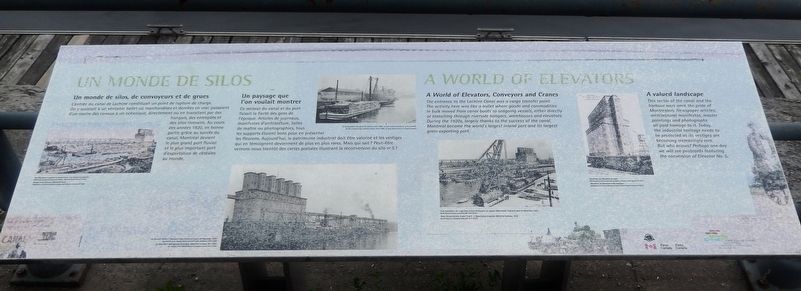
Un monde de silos, de convoyeurs et de grues
L'entrée du canal de Lachine constituait un point de rupture de charge. On y assistait à un véritable ballet où marchandises et denrées en vrac passaient d'un navire des canaux à un océanique, directement ou en transitant par des hangars, des entrepôts et des silos riverains. Au cours des années 1920, en bonne partie grâce au succès du canal, Montréal devient le plus grand port fluvial et le plus important port d'exportation de céréales au monde.
Un paysage que l'on voulait montrer
Ce secteur du canal et du port faisait la fierté des gens de l'époque. Articles de journaux, manifestes d'architecture, toiles de maître ou photographies, tous les supports étaient bons pour en présenter les fleurons. Aujourd'hui, le patrimoine industriel doit être valorisé et les vestiges qui en témoignent deviennent de plus en plus rares. Mais qui sait? Peut-être verrons-nous bientôt des cartes postales illustrant la reconversion du silo no. 5?
[légendes]
• Les élévateurs à grains du Grand Tronc à la Pointe-du-Moulin.
• À l’embouchure du canal de Lachine, vers 1902.
this page online
• Le Cornish Point et l’Admiral Cochrane dans le port de Montréal, 1920.
• Trois chaudières de vingt-cinq tonnes déchargées du vapeur Manchester Engineer, port de Montréal, 1910.
• Un élévateur du port, Montréal.
A World of Elevators
A World of Elevators, Conveyors and Cranes
The entrance to the Lachine Canal was a cargo transfer point. The activity here was like a ballet where goods and commodities in bulk moved from canal boats to seagoing vessels, either directly or transiting through riverside hangars, warehouses and elevators. During the 1920s, largely thanks to the success of the canal, Montreal became the world's largest inland port and its largest grain exporting port.
A valued landscape
This sector of the canal and the harbour were once the pride of Montrealers. Newspaper articles, architectural manifestos, master paintings and photographs all paid homage to it. Today, the industrial heritage needs to be protected as its vestiges are becoming increasingly rare. But who knows? Perhaps one day we will see postcards featuring the conversion of Elevator No. 5.
[captions]
• Grand Trunk Elevator, Windmill Point.
• At the mouth
Photographed by Cosmos Mariner, May 21, 2024
2. Un Monde de Silos / A World of Elevators Marker
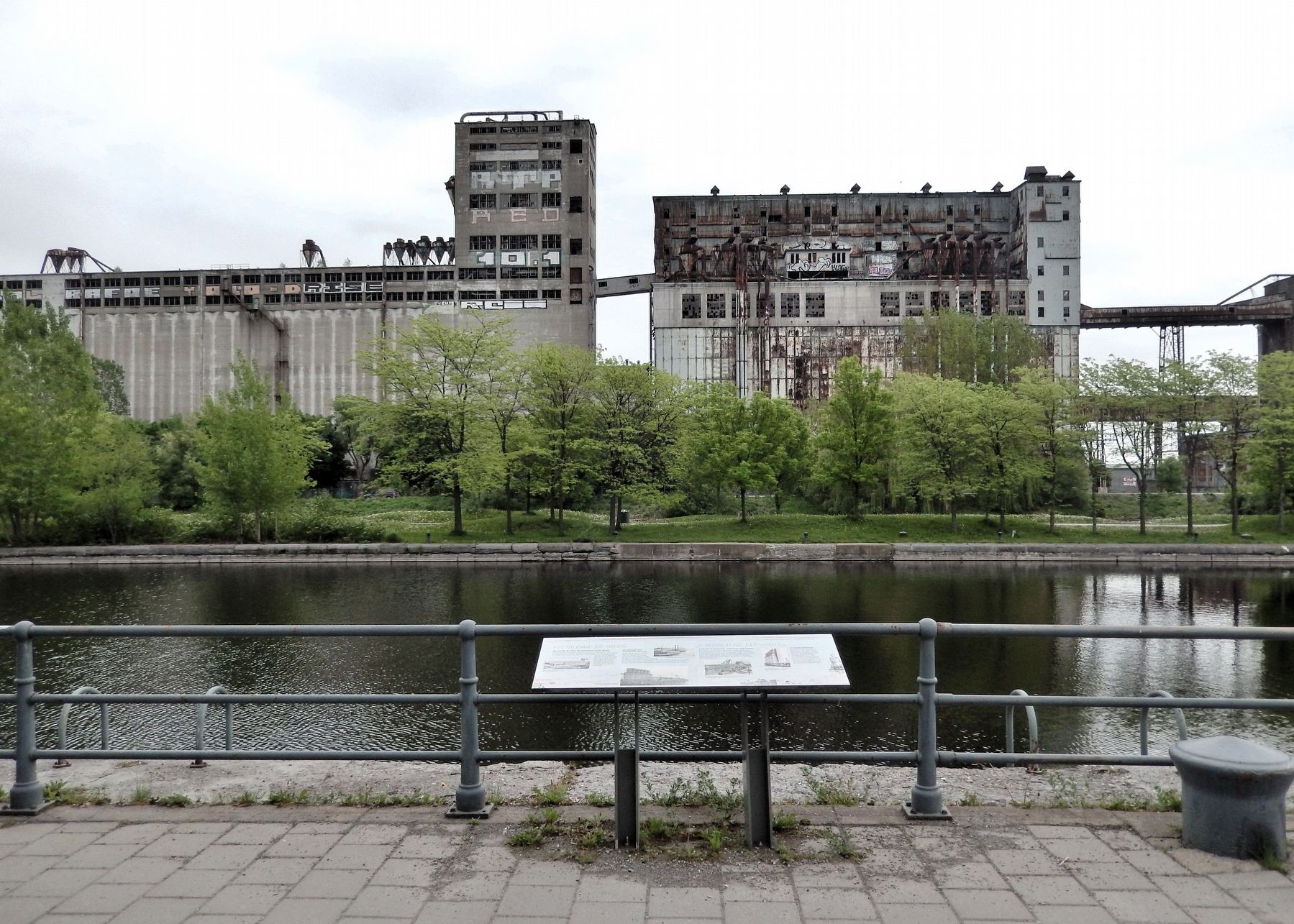
Looking east across the Lachine Canal National Historic Site. Historic elevator structures span the background across the canal.
• Cornish Point and Admiral Cochrane, Montreal harbour, QC, 1920.
• Three 25-ton boilers landed from S. S. Manchester Engineer, Montreal harbour, 1910.
• An Elevator in the harbour, Montreal.
Erected by Parcs Canada & Société du Vieux-Port de Montréal / Parks Canada & Old Port of Montreal Corporation.
Topics. This historical marker is listed in these topic lists: Architecture • Industry & Commerce • Waterways & Vessels. A significant historical year for this entry is 1920.
Location. 45° 29.848′ N, 73° 33.145′ W. Marker is in Montréal, Québec. It is in Ville-Marie. It can be reached from the intersection of Rue de la Commune Ouest and Rue King, on the right when traveling north. The marker is on the walkway south of gate number one at the Lachine Canal National Historic Site. Touch for map. Marker is at or near this postal address: 400 Rue de la Commune Ouest, Montréal QC H3C 0N8, Canada. Touch for directions.

Regionally, this marker is in Central Canada. Globally, it is in North America, the Western Hemisphere, and the Western World. Historically, it finds itself in what was once a British colony, the Viceroyalty of New France, the Haudenosaunee (Iroquois) Confederacy, and Rupert’s Land.
Other nearby markers. At least 8 other markers are within walking distance of this marker: Le remorqueur Daniel McAllister / The Tugboat Daniel McAllister (within shouting distance of this marker); Le site des écluses nos 1 et 2 / The site of locks 1 and 2 (within shouting distance of this marker); Le Canal de Lachine / The Lachine Canal (about 90 meters away, measured in a direct line); Un petit monde en soi / A World Unto Itself (about 120 meters away); L'époque revolue des canalers / The Era of the Canaler (about 120 meters away); Une ville en profonde mutation / Transformation of a City (about 120 meters away); La batellerie du Saint-Laurent / The St. Lawrence Fleet (about 120 meters away); Le berceau de l'industrie / Cradle of Canadian Industry (about 120 meters away). Touch for a list and map of all markers in Montréal.
Also see . . . The Wheat and Flour Industry at the Lachine Canal (Lachine Canal National Historic Site).
Excerpt: From the 1850s onwards, the grain and flour industry marked the landscape of the Lachine Canal. If the canal is dotted with flour mills from the locks of Côte-Saint-Paul to those of Montréal, it is along the banks of Reach No. 2 that we find both companies dedicated to storing wheat and flour and others that grind the wheat into flour.(Submitted on May 31, 2026, by Cosmos Mariner of Cape Canaveral, Florida.)Nicknamed the Montréal terminus, this sector of the Lachine Canal even contributed to making the country's industrial metropolis the largest grain port in North America in the 1920s. With the closure of Montréal Warehousing in the 1930s and Silo No. 5 in 1994, activities strictly devoted to warehousing and transshipment ceased completely at the Montréal terminus.
Credits. This page was last revised on May 31, 2026. It was originally submitted on May 29, 2026, by Cosmos Mariner of Cape Canaveral, Florida. This page has been viewed 13 times since then. Photos: 1, 2. submitted on May 31, 2026, by Cosmos Mariner of Cape Canaveral, Florida.
