Summerville in Dorchester County, South Carolina — The American South (South Atlantic)
A Concrete Solution
| — | South Carolina State Park Service | — |
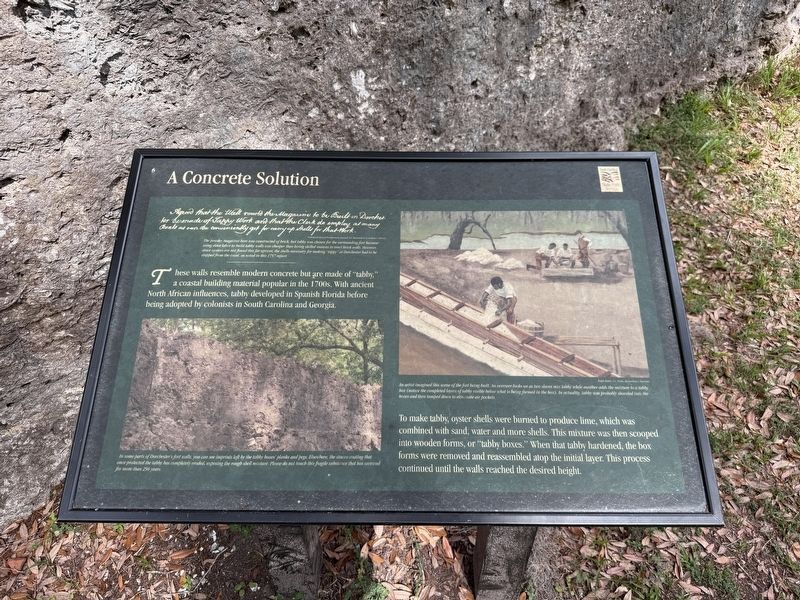
Agreed that the Wall around the Magazine to be Built in Dorchester be made of Tappy Work and that the Clerk do employ as many boats as can be conveniently got for carry up Shells for that Work.
Commissioners of Fortifications Journal, S.C. Department of Archives & History
The powder magazine here was constructed of brick, but tabby was chosen for the surrounding fort because using slave labor to build tabby walls was cheaper than hiring skilled masons to erect brick walls. However, since oysters are not found this far upriver, the shells necessary for making "tappy" at Dorchester had to be shipped from the coast, as noted in this 1757 report.
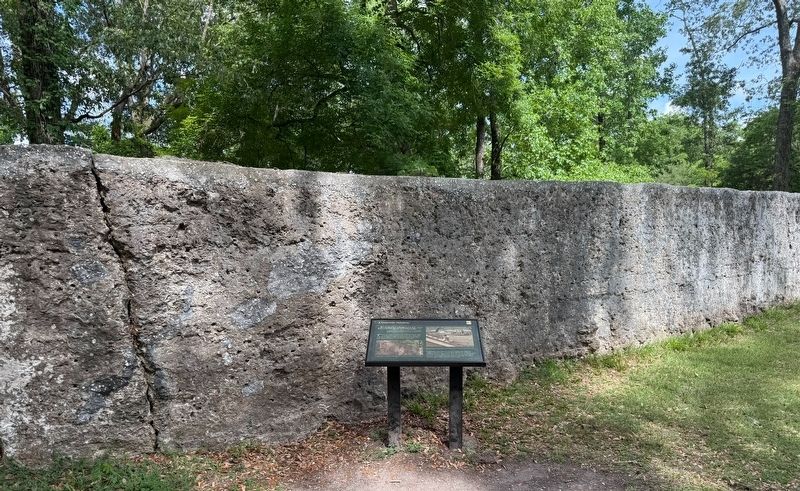
These walls resemble modern concrete but are made of "tabby," a coastal building material popular in the 1700s. With ancient North African influences, tabby developed in Spanish Florida before being adopted by colonists in South Carolina and Georgia.
To make tabby, oyster shells were burned to produce lime, which was combined with sand, water and more shells. This mixture was then scooped into wooden forms, or "tabby boxes." When that tabby hardened, the box forms were
this page online
[Captions:]
In some parts of Dorchester's fort walls, you can see imprints left by the tabby boxes' planks and pegs. Elsewhere, the stucco coating that once protected the tabby has completely ended, exposing the rough shell mixture. Please do not touch this fragile substance that has survived for more than 250 years.
An artist imagined this scene of the fort being built. An overseer looks on as two slaves mix tabby while another adds the mixture to a tabby box (notice the completed layers of tabby visible below what is being formed in the box). In actuality, tabby was probably shoveled into the boxes and then tamped down to eliminate air pockets.
Erected by South Carolina State Park Service.
Topics. This historical marker is listed in these topic lists: African Americans • Colonial Era • Forts and Castles. A significant historical year for this entry is 1757.
Location. 32° 56.827′ N, 80° 10.203′ W. Marker is in Summerville, South Carolina, in Dorchester County. It is on Shop Road south of County Road

Regionally, this marker is in the Lowcountry. It is also in the American South, specifically in the Deep South, and on the Eastern Seaboard. Globally, it is in the North Atlantic Region, North America, the Western Hemisphere, the Western World, and the Anglosphere. Historically, it finds itself in what was once the territory of the Mississippian Culture, one of the original Thirteen Colonies, one of the Confederate States of America, and the Antebellum South.
Other nearby markers. At least 8 other markers are within walking distance of this marker: Designed for Defense (a few steps from this marker); Dorchester's Merchants: Middlemen on the Road to Riches (within shouting distance of this marker); Networks of Trade (within shouting distance of this marker); Fort Dorchester (within shouting distance of this marker); Clues of Wealth (about 300 feet away, measured in a direct line); To Market, To Market (about 300 feet away); Loading Zone (about 400 feet away); Welcome to Colonial Dorchester State Historic Site (about 400 feet away). Touch for a list and map of all markers in Summerville.
Additional keywords. enslaved labor
Credits. This page was last revised on May 29, 2026. It was originally submitted on May 29, 2026, by Devry Becker Jones of Washington, District of Columbia. This page has been viewed 17 times since then. Photos: 1, 2. submitted on May 29, 2026, by Devry Becker Jones of Washington, District of Columbia.
