Downtown Winston-Salem in Forsyth County, North Carolina — The American South (South Atlantic)
The Little Red Factory
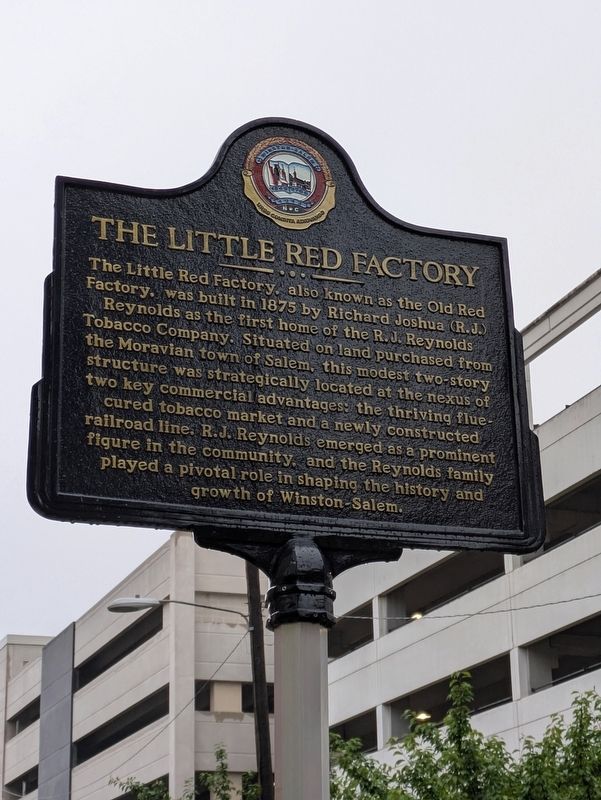
Photographed by Bruce InCharlotte, May 23, 2026
1. The Little Red Factory Marker
Erected 2025. (Marker Number 77.)
Topics. This historical marker is listed in these topic lists: Agriculture • Industry & Commerce • Railroads & Streetcars. A significant historical year for this entry is 1875.
Location. 36° 5.73′ N, 80° 14.493′ W. Marker is in Winston-Salem, North Carolina, in Forsyth County. It is in Downtown Winston-Salem. It is on North Chestnut Street north of East First Street, on the left when traveling north. Touch for map. Marker is at or near this postal address: 111 N Chestnut St, Winston Salem NC 27101, United States
this page online

Regionally, this marker is in North Carolina’s Piedmont and specifically in Piedmont Triad. It is also in the American South and specifically in the Upper South. Globally, it is in North America, the Western Hemisphere, the Western World, and the Anglosphere. Historically, it finds itself in what was once the territory of the Mississippian Culture, one of the original Thirteen Colonies, one of the Confederate States of America, and the Antebellum South.
Other nearby markers. At least 8 other markers are within walking distance of this marker: George Henry Black Memorial (about 400 feet away, measured in a direct line); City Hall (about 600 feet away); Richard Joshua Reynolds (about 600 feet away); Former Dividing Line Between Winston and Salem (about 600 feet away); Wm. Cyrus Briggs (about 700 feet away); Site of First House Erected in Winston (about 700 feet away); Thomas J. Wilson (about 700 feet away); The Honorable Willie Jones of Halifax (approx. 0.2 miles away). Touch for a list and map of all markers in Winston-Salem.
Regarding The Little Red Factory. Winston-Salem’s
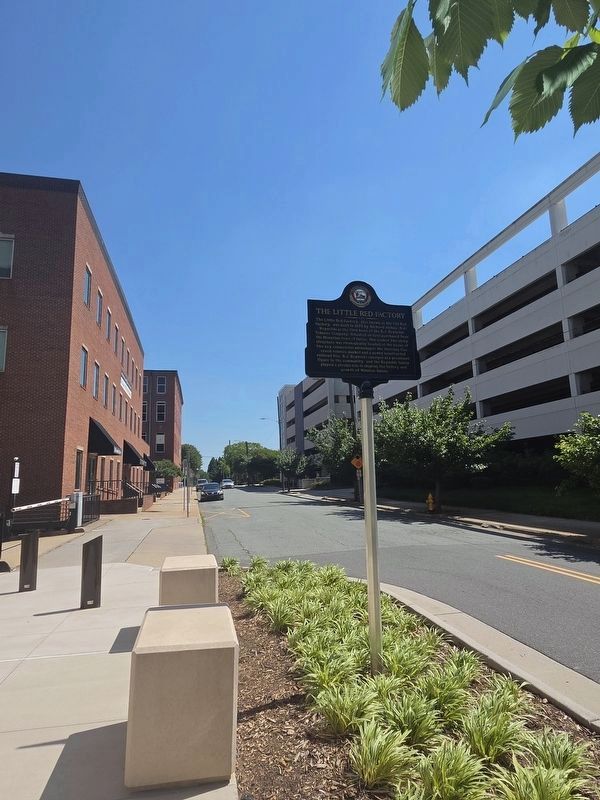
Photographed by Mark Parker, May 19, 2026
2. The Little Red Factory Marker looking south on N. Chestnut St.
Through the mid‑20th century, the company continued to grow, shaping Winston-Salem’s skyline and identity, most notably through the 1929 Reynolds Building, later used as inspiration for the Empire State Building. Reynolds introduced major brands like Winston and Salem in the 1950s and employed thousands in vast downtown factories. But as health concerns and regulations increased, the industry contracted. R.J. Reynolds merged with Nabisco in 1989 and moved its headquarters to Atlanta in 1999, ending more than a century of local corporate presence. Factory Number 256, built over the Little Red Factory site, was destroyed in a massive 1998 fire during renovation work, but the company’s legacy remains deeply woven into the city’s industrial and architectural history.
Credits. This page was last revised on July 9, 2026. It was originally submitted on May 31, 2026, by Bruce InCharlotte of Charlotte, North Carolina. This page has been viewed 24 times since then. Photos: 1. submitted on May 31, 2026, by Bruce InCharlotte of Charlotte, North Carolina. 2. submitted on June 11, 2026, by Mark Parker of Hickory, North Carolina. • Bernard Fisher was the editor who published this page.
