Port Royal in Beaufort County, South Carolina — The American South (South Atlantic)
First South Carolina Infantry
| — | Reconstruction Era National Historical Park | — |
Photographed by Benjamin Rubin, May 30, 2026
1. First South Carolina Infantry Marker
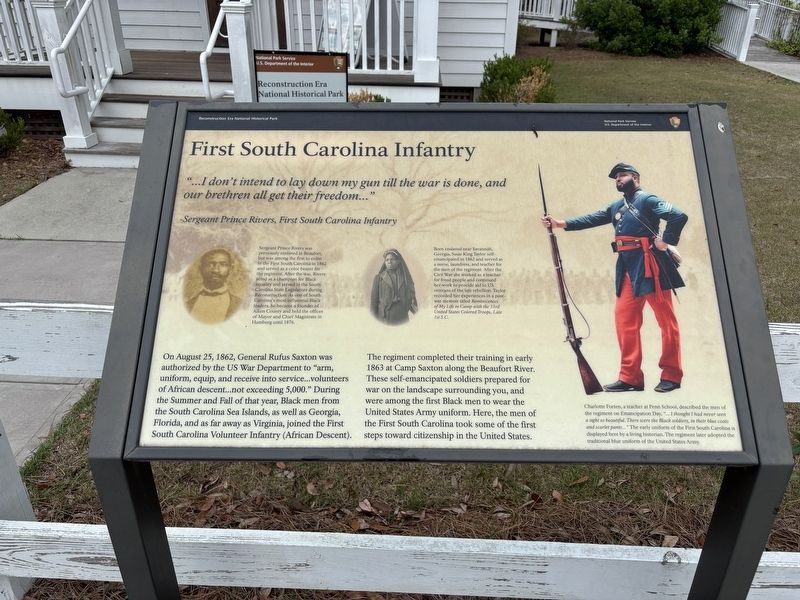
-Sergeant Prince Rivers, First South Carolina Infantry
On August 25, 1862, General Rufus Saxton was authorized by the US War Department to "arm, uniform, equip, and receive into service...volunteers of African descent...not exceeding 5,000." During the Summer and Fall of that year, Black men from the South Carolina Sea Islands, as well as Georgia, Florida, and as far away as Virginia, joined the First South Carolina Volunteer Infantry (African Descent).
The regiment completed their training in early 1863 at Camp Saxton along the Beaufort River. These self-emancipated soldiers prepared for war on the landscape surrounding you, and were among the first Black men to wear the United States Army uniform. Here, the men of the First South Carolina took some of the first steps toward citizenship in the United States.
(captions)
Sergeant Prince Rivers was previously enslaved in Beaufort, but was among the first to enlist in the First South Carolina in 1862 and served as a color bearer for the regiment. After the war, Rivers acted as a champion for Black equality and served in the South Carolina State Legislature during Reconstruction. As one of South Carolina's most influential Black leaders, he became a founder of Aiken County and held the offices of Mayor and Chief Magistrate in Hamburg until 1876.
Born enslaved near Savannah, Georgia, Susie King Taylor self-emancipated in 1862 and served as a nurse, laundress, and teacher for the men of the regiment. After the Civil War she worked as a teacher for freed people and continued her work to provide aid to US veterans of the late rebellion. Taylor recorded her experiences in a post-war memoir titled Reminscences of My Life in Camp with the 33rd United States Colored Troops, Late 1st S.C.
Charlotte Forten, a teacher at Penn School, described the men of the regiment on Emancipation Day, "...I thought I had never seen a sight so beautiful. There were the Black soldiers, in their blue coats and scarlet pants..." The early uniform of the First South Carolina is displayed here by a living historian, The regiment later adopted the traditional blue uniform of the United States Army.
Erected by National
this page online
Topics. This historical marker is listed in these topic lists: African Americans • War, US Civil. A significant historical date for this entry is August 25, 1862.
Location. 32° 23.292′ N, 80° 41.13′ W. Marker is in Port Royal, South Carolina, in Beaufort County. It can be reached from Pinckney Boulevard 0.1 miles east of Ribaut Road (U.S. 21), on the left when traveling east. Touch for map. Marker is at or near this postal address: 708 Pinckney Blvd, Port Royal SC 29935, United States of America. Touch for directions.

Regionally, this marker is in the Lowcountry and on the Sea Islands. It is also in the American South, specifically in the Deep South, and on the Eastern Seaboard. Globally, it is in the North Atlantic Region, North America, the Western Hemisphere, the Western World, and the Anglosphere. Historically, it finds itself in what was once New Spain, the territory of the Mississippian Culture, one of the original Thirteen Colonies, one of the Confederate States of America, and the Antebellum South.
Other nearby markers. At least 8 other markers are within one mile of this marker, measured as the crow flies: "The Year of Jubilee Has Come!" (here, next to this marker); Old Fort Plantation (here, next to this marker); Emancipation Day (here, next to this marker); Camp Saxton (a few steps from this marker); Emancipation Day / Camp Saxton Site (approx. 0.3 miles away); a different marker also named Camp Saxton (approx. 0.3 miles away); The Historic Union Church (approx. 0.9 miles away); Blue Channel Corporation (approx. one mile away). Touch for a list and map of all markers in Port Royal.
Also see . . . Reconstruction Era National Historical Park. National Park Service (Submitted on June 11, 2026.)
Credits. This page was last revised on June 11, 2026. It was originally submitted on May 31, 2026, by Benjamin Rubin of Columbia, South Carolina. This page has been viewed 18 times since then. Photo 1. submitted on May 31, 2026, by Benjamin Rubin of Columbia, South Carolina. • Bernard Fisher was the editor who published this page.
Editor’s want-list for this marker. Wide shot of marker and its surroundings. • Can you help?
