
Centre in Cork in County Cork, Munster, Ireland — Irish South-West ((Éire) North Atlantic Ocean)
Cé an Chearlaigh
⎯⎯⎯
Kyrl’s Quay
⎯⎯⎯
Droichead Uí Ghríofa
⎯⎯⎯
Griffith Bridge
Photographed by Ian Lefkowitz, May 14, 2026
1. Cé an Chearlaigh / Kyrl’s Quay Marker

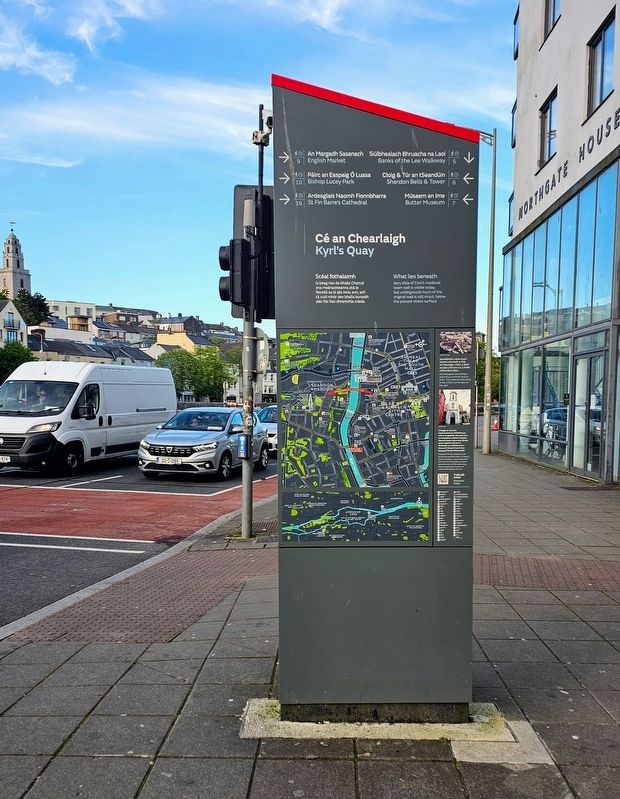
Cé an Chearlaigh
Scéal fothalaimh
Is beag rian de bhalla Chorcaí sna meánaoiseanna atá le feiceáil sa lá atá inniu ann, ach tá cuid mhór den bhalla bunaidh slán fós faoi dhromchla sráide.
[English:]
Kyrl’s Quay
What Lies Beneath
Very little of Cork’s medieval town wall is visible today, but underground much of the original wall is still intact, below the present street surface.
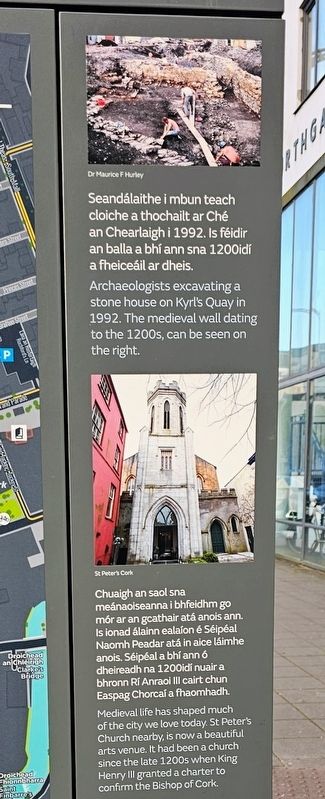
Seandálaithe i mbun teach cloiche a thochailt ar Ché an Chearlaigh i 1992. Is féidir an balla a bhí ann sna 1200idí a fheiceáil ar dheis.
Archaeologists excavating a stone house on Kyrl’s Quay in 1992. The medieval wall dating to the 1200s, can be seen on the right.
Chuaigh an saol sna meánaoiseanna i bhfeidhm go mór ar an gcathair atá anois ann. Is ionad álainn ealaíon é Séipéal Naomh Peadar atá in aice láimhe anois. Séipéal a bhí ann ó dheireadh na 1200idí nuair a bhronn Rí Anraoi III cairt chun Easpag Chorcaí a fhaomhadh.
Medieval life has shaped much of the city we love today. St Peter’s Church nearby, is now a beautiful arts venue. It had been a church since the late 1200s when King Henry III granted a charter to confirm the Bishop of Cork.
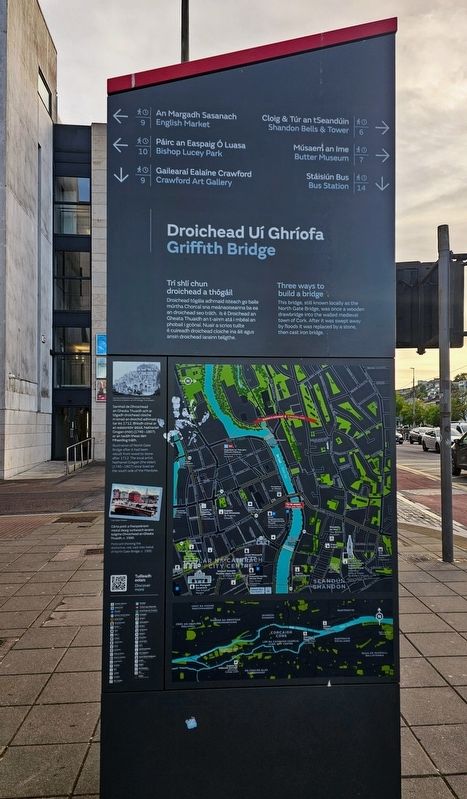
Droichead Uí Ghríofa
Griffith Bridge
Trí shlí chun droichead a thógáil
Droichead tógála adhmaid isteach go baile múrtha Chorcaí sna meánaoiseanna ba ea an droichead seo tráth. Is é Droichead an Gheata Thuaidh an t-ainm atá i mbéal an phobail i gcónaí. Nuair a scrios tuilte é cuireadh droichead cloiche ina áit agus ansin droichead iarainn teilgthe.
Three Ways to Build a Bridge
This bridge, still known locally as the North Gate Bridge, was once a wooden drawbridge into the walled medieval town of Cork. After it was swept away by floods it was replaced by a stone, then cast iron bridge.
Courtesy of McCarthy Art Collection, Fota House, Arboretum & Gardens, an Irish Heritage Trust property
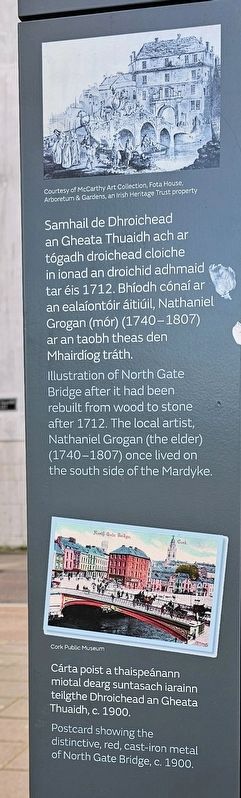
Samhail de Dhroichead an Gheata Thuaidh ach ar tógadh droichead cloiche in ionad an droichid adhmaid tar éis 1712. Bhíodh cónaí ar an ealaíontóir áitiúil, Nathaniel Grogan (mór) (1740–1807) ar an taobh theas den Mhairdíog tráth.
Illustration of North Gate Bridge after it had been rebuilt from wood to stone after 1712. The local artist, Nathaniel Grogan (the elder) (1740–1807) once lived on the south side of the Mardyke.
Cork Public Museum
Cárta poist a thaispeánann miotal dearg suntasach iarainn teilgthe Dhroichead an Gheata Thuaidh, c. 1900.
Postcard showing the distinctive, red, cast-iron metal of North Gate Bridge, c. 1900.
Topics.
this page online
Location. 51° 54.062′ N, 8° 28.757′ W. Marker is in Cork, Munster, in County Cork. It is in Centre. It is at the intersection of Kyrl's Quay and North Main Street, on the left when traveling west on Kyrl's Quay. Touch for map. Marker is at or near this postal address: 25 Kyrl's Quay, Cork, Munster, Ireland. Touch for directions.

Regionally, it is on the Atlantic Ocean, in the North Atlantic Region, on the Atlantic Arc, in Europe, on the Island of Ireland, on the Celtic Fringe, in the European Union, in Atlantic Europe, on one of the British Isles, in the Western World, and in the Anglosphere. Historically, it finds itself in what was once a British colony.
Other nearby markers. At least 8 other markers are within walking distance of this marker: The North Gate (a few steps from this marker); Site of Skiddy’s Castle (within shouting distance of this marker); Láthair Chaisleán an Scidígh / Site of Skiddys Castle (within shouting distance of this marker); Toirdhealbhach Mac Suibhne
Photographed by Ian Lefkowitz, May 14, 2026
2. Droichead Uí Ghríofa / Griffith Bridge Marker
Photographed by Ian Lefkowitz, May 14, 2026
3. Cé an Chearlaigh / Kyrl’s Quay Marker
A close-up of the images contained on the marker.
Photographed by Ian Lefkowitz, May 14, 2026
4. Droichead Uí Ghríofa / Griffith Bridge Marker
A close-up of the images contained on the Griffith Bridge side of the marker.
Credits. This page was last revised on June 4, 2026. It was originally submitted on June 1, 2026, by Ian Lefkowitz of New York, New York. This page has been viewed 9 times since then. Photos: 1, 2, 3, 4. submitted on June 1, 2026, by Ian Lefkowitz of New York, New York. • Andrew Ruppenstein was the editor who published this page.
