Rye in East Sussex, England, United Kingdom — Northwestern Europe (the British Isles)
Rye Royal
Photographed by Ray Gurganus, March 31, 2026
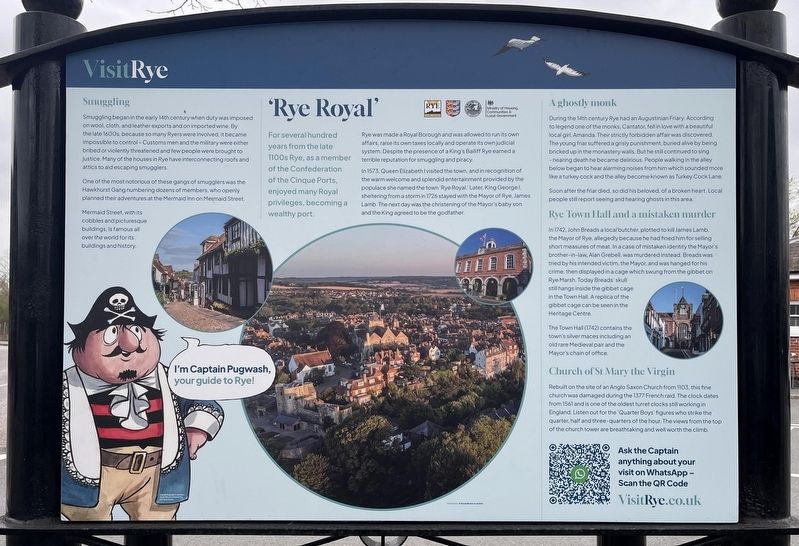
1. Rye Royal Marker
Rye was made a Royal Borough and was allowed to run town affairs; raise its own taxes locally and operate its own judicial system. Despite the presence of a Kings Bailiff Rye earned a terrible reputation for smuggling and piracy.
In 1573, Queen Elizabeth visited the town, and in recognition of the warm welcome and splendid entertainment provided by the populace she named the town 'Rye Royal'. Later, King George I, sheltering from a storm in 1726 stayed with the Mayor of Rye, James Lamb. The next day was the christening of the Mayor's baby son and the King agreed to be the godfather.
Smuggling
Smuggling began in the early 14th century when duty was imposed on wool, cloth and leather exports and on imported wine. By the late 1600s because so many Ryers were involved, it became impossible to control - Customs men and the military were other bribed or violently threatened and few people were brought to justice. Many of the houses in Rye have interconnecting attics to aid escaping smugglers.
One of the most notorious of these gangs of smugglers was the Hawkhurst Gang numbering dozens of members,
this page online
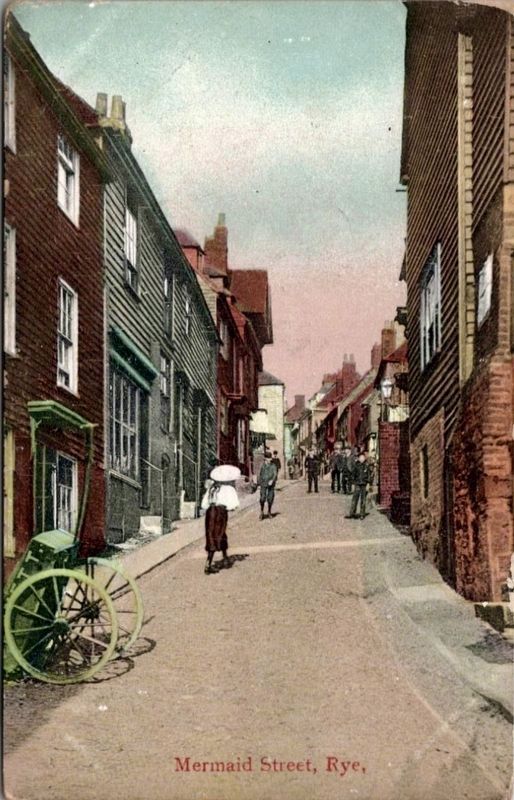
Mermaid Street, with its cobbles and picturesque buildings, is famous over the world for its buildings and history.
A ghostly monk
During the 14th century Rye had an Augustinian Friary. According to legend one of the monks, Cantator, fell in love with a beautiful local girl, Amanda. Their strictly forbidden affair was discovered. The young friar suffered a grisly punishment, buried alive by being bricked up in the monastery walls. But he still continued to sing - nearing death he became delirious. People walking in the alley below began to hear alarming noises from him which sounded more like a turkey cock and the alley become known as Turkey Cock Lane.
Soon after the friar died, so did his beloved of a broken heart. Local people still report seeing and hearing ghosts in this area.
Rye Town Hall and a mistaken murder
In 1742, John Breads a local butcher plotted to kill James Lamb the Mayor of Rye, allegedly because he had fined him for selling short measures of meat. In a case of mistaken identity the Mayor's brother-in-law, Alan Grebell, was murdered instead. Breads was tried by his intended victim, the Mayor, and was hanged for his crime then displayed in a cage which swung from the gibbet
Photographed by Ray Gurganus, March 31, 2026
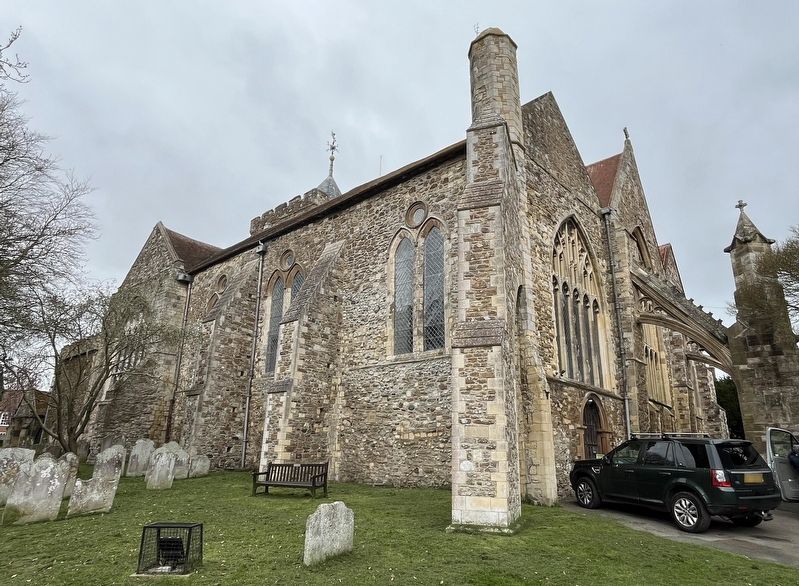
2. St Mary's Church
The Town Hal (142) contains the town's silver maces including an old rare Medieval pair and the Mayor's chain of office.
Church of St Mary the Virgin
Rebuilt on the site of an Anglo Saxon Church from 1103, this fine church was damaged during the 1377 French raid. The clock date from 1561 and is one of the oldest turret clocks still working in England. Listen out for the Quarter Boys figures who strike the Quarter half and three-quarters of the hour. The views from the top of the church tower are breathtaking and well worth the climb.
Topics. This historical marker is listed in these topic lists: Industry & Commerce • Notable Events • Religion & Religious Structures.
Location. 50° 57.135′ N, 0° 43.865′ E. Marker is in Rye, England, in East Sussex. It is on Station Approach. Touch for map. Marker is at or near this postal address: 2 Station Approach, Rye, England TN31 7AB, United Kingdom. Touch for directions.

Regionally, this marker is in the Greater South East. Globally, it is on the Atlantic Ocean, in the North Atlantic Region, in Europe, in Atlantic
Photographed by A.H. Homewood, Burgess Hill, Sussex, circa 1910
3. Mermaid Street, Rye
Other nearby markers. At least 8 other markers are within 8 kilometers of this marker, measured as the crow flies: Welcome to Historic Rye (here, next to this marker); Old Rye Grammar School (about 210 meters away, measured in a direct line); Henry James (approx. 0.3 kilometers away); Borough of Rye Water Tower (approx. 0.3 kilometers away); Playden Church Bell (approx. 0.4 kilometers away); Violet Rosa Carruthers (approx. 7 kilometers away); Wittersham Women’s Institute (approx. 7 kilometers away); Wittersham War Memorial (approx. 7 kilometers away). Touch for a list and map of all markers in Rye.
More about this marker. The marker is located across the street from the railway station.
Credits. This page was last revised on June 3, 2026. It was originally submitted on June 2, 2026, by Ray Gurganus of Washington, District of Columbia. This page has been viewed 10 times since then. Photos: 1, 2. submitted on June 2, 2026, by Ray Gurganus of Washington, District of Columbia. 3. submitted on June 3, 2026. • Andrew Ruppenstein was the editor who published this page.
