Ville-Marie in Montréal, Québec — Central Canada (French-Canadian)
Vers L'intérieur du continent
⎯⎯⎯
Gateway to the Interior
Photographed by Cosmos Mariner, May 21, 2024
1. Vers L'intérieur du continent / Gateway to the Interior Marker

Vers L'intérieur du continent
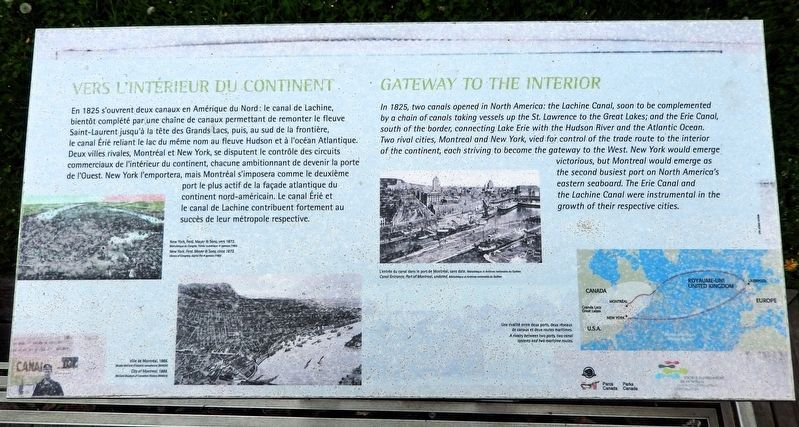
En 1825 s'ouvrent deux canaux en Amérique du Nord: le canal de Lachine, bientôt complété par une chaîne de canaux permettant de remonter le fleuve Saint-Laurent jusqu'à la tête des Grands Lacs, puis, au sud de la frontière, le canal Érié reliant le lac du même nom au fleuve Hudson et à l'océan Atlantique. Deux villes rivales, Montréal et New York, se disputent le contrôle des circuits commerciaux de l'intérieur du continent, chacune ambitionnant de devenir la porte de l'Ouest. New York l'emportera, mais Montréal s'imposera comme le deuxième port le plus actif de la façade atlantique du continent nord-américain. Le canal Érié et le canal de Lachine contribuent fortement au succès de leur métropole respective.
[légendes]
• New York, Ferd. Mayer & Sons, vers 1873.
• Ville de Montréal, 1888.
• L’entrée du canal dans le port de Montréal, sans date.
• Une rivalité entre deux ports, deux réseaux de canaux et deux routes maritimes.
Gateway to the Interior
In 1825, two canals opened in North America: the Lachine Canal, soon to be complemented by a chain of canals taking vessels
this page online
[captions]
• New York, Ferd. Mayer & Sons, circa 1873.
• City of Montreal, 1888
• Canal Entrance, Port of Montreal, undated.
• A rivalry between two ports, two canal systems and two maritime routes.
Erected by Parcs Canada & Société du Vieux-Port de Montréal / Parks Canada & Old Port of Montreal Corporation.
Topics. This historical marker is listed in these topic lists: Industry & Commerce • Waterways & Vessels. A significant historical year for this entry is 1825.
Location. 45° 29.785′ N, 73° 33.141′ W. Marker is in Montréal, Québec. It is in Ville-Marie. It can be reached from the intersection of Rue de la

Photographed by Cosmos Mariner, May 21, 2024
2. Vers L'intérieur du continent / Gateway to the Interior Marker
This marker is the rightmost of four interpretive panels overlooking the Lachine Canal from a platform near the canal walkway.

Regionally, this marker is in Central Canada. Globally, it is in North America, the Western Hemisphere, and the Western World. Historically, it finds itself in what was once a British colony, the Viceroyalty of New France, the Haudenosaunee (Iroquois) Confederacy, and Rupert’s Land.
Other nearby markers. At least 8 other markers are within walking distance of this marker: Les canaux du Saint-Laurent / The St. Lawrence Canals (here, next to this marker); La batellerie du Saint-Laurent / The St. Lawrence Fleet (here, next to this marker); L'époque revolue des canalers / The Era of the Canaler (here, next to this marker); Trois Siecles D'histoire / Three Centuries of History (here, next to this marker); Le berceau de l'industrie / Cradle of Canadian Industry (here, next to this marker); Une ville en profonde mutation / Transformation of a City (here, next to this marker); Un petit monde en soi / A World Unto Itself (a few steps from this marker); Le site des écluses nos 1 et 2 / The site of locks 1 and 2 (within shouting distance of this marker). Touch for a list and map of all markers in Montréal.
Also see . . .
1. Lachine Canal (Wikipedia).
Excerpt: The Lachine Canal was built to bypass the rapids at Lachine, upstream of Montreal. Freight and passengers destined for points past Lachine had to portage the 8 or 9 miles from Montreal's port to the village of Lachine where they could resume their trip by boat. Work on the canal commenced on July 17, 1821, under Chief Engineer Thomas Burnett and Construction Engineer John Richardson. The new canal officially opened in 1825, helping turn Montreal into a major port and eventually attracting industry to its banks.(Submitted on June 2, 2026, by Cosmos Mariner of Cape Canaveral, Florida.)
2. Erie Canal (Wikipedia).
Excerpt: The Erie Canal is a historic canal in upstate New York that runs east–west between the Hudson River and Lake Erie. Completed in 1825, the canal was the first navigable waterway connecting the Atlantic Ocean to the upper Great Lakes above Niagara Falls, vastly reducing the costs of transporting people and goods across the Appalachians. The Erie Canal accelerated the settlement of the Great Lakes region, the westward expansion of the United States, and the economic ascendancy of New York state.(Submitted on June 3, 2026, by Cosmos Mariner of Cape Canaveral, Florida.)
Credits. This page was last revised on June 3, 2026. It was originally submitted on June 2, 2026, by Cosmos Mariner of Cape Canaveral, Florida. This page has been viewed 18 times since then. Photos: 1, 2. submitted on June 2, 2026, by Cosmos Mariner of Cape Canaveral, Florida.
