Huisduinen in Den Helder, North Holland, Netherlands — Northwestern Europe
Slag bij Kijkduin (21 augustus 1673)
⎯⎯⎯
Battle of Texel (August 21, 1673)
Photographed by Andrew Ruppenstein, June 2, 2026
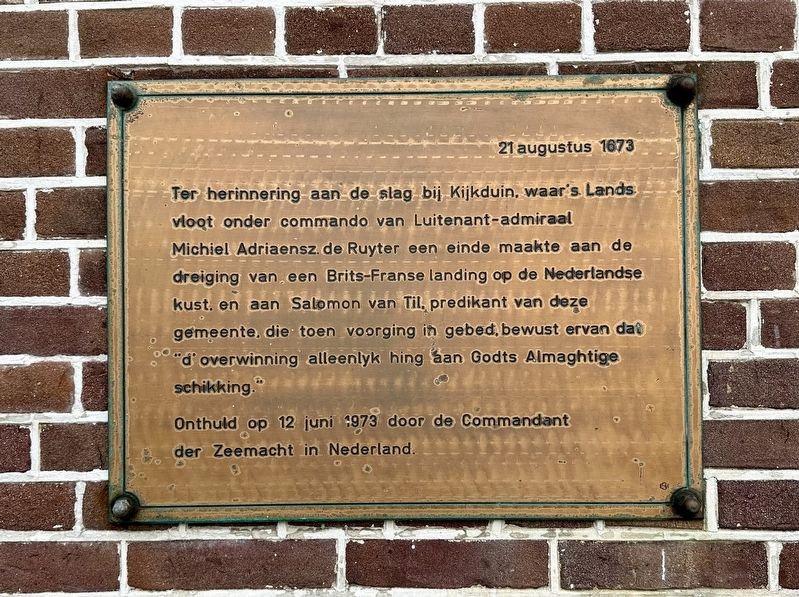
1. Slag bij Kijkduin / Battle of Texel Marker

Onthuld op 12 juni 1973 door de Commandant der Zeemacht in Nederland.
In remembrance of the Battle of Texel, where the Dutch fleet under the command of Lieutenant-Admiral Michiel Adriaensz. de Ruyter put an end to the threat of a British-French landing on the Dutch coast, and of Salomon van Til, minister of this congregation, who led the prayer at the time, aware that "the victory depended solely on God's Almighty arrangement."
Unveiled on June 12, 1973, by the Commander of the Navy in the Netherlands.
Erected 1973.
Topics. This memorial is listed in this topic list: Wars, Non-US. A significant historical date for this entry is August 21, 1673.
Location. 52° 57.19′ N, 4° 43.486′ E. Memorial is in Huisduinen, Noord-Holland
this page online

Regionally, it is in Europe, the European Union, Atlantic Europe, the Benelux Low Countries, the Schengen Area, Western Europe, and the Western World. Historically, it finds itself in what was once the Holy Roman Empire.
Other nearby markers. At least 8 other markers are within walking distance of this marker: Monument ‘De Walvis’ / Huisduinen Whaling Memorial (within shouting distance of this marker); Nooit meer zoals het was / Never the same again! / Es wird nie wieder wie es war (about 120 meters away, measured in a direct line); Fort Kijkduin (about 120 meters away); De Atlantikwall / Der Atlantikwall / The Atlantikwall (about 120 meters away); Vuurtoren de Lange Jaap / Lange Jaap Lighthouse (approx. 0.3 kilometers away); Monument Joodse Begraafplaats / Jewish Cemetery Memorial (approx. 0.8 kilometers away); Waddenzee-graftekens / Waddenzee Gravestones (approx. 0.9 kilometers away); Bijzonder oude graftekens / Exceptionally Old Grave Markers
Photographed by Andrew Ruppenstein, June 2, 2026
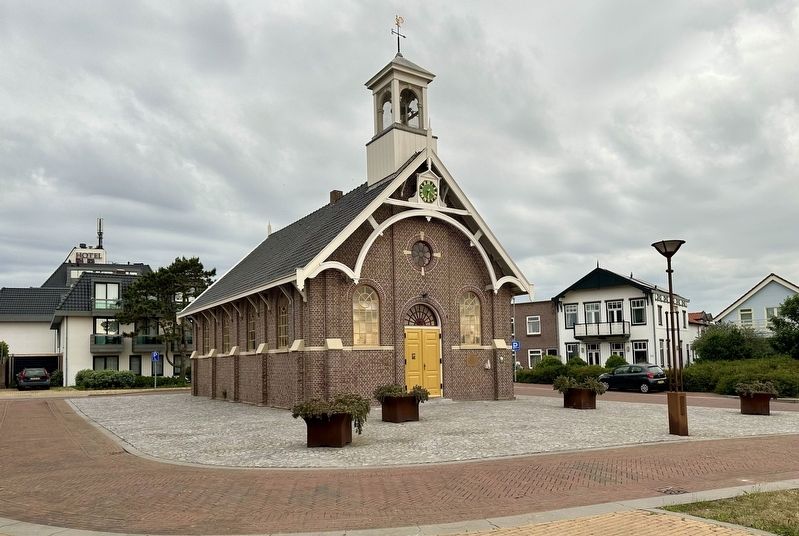
2. Slag bij Kijkduin / Battle of Texel Marker - wide view
The marker is visible here to the right of the door.
Related marker. Click here for another marker that is related to this marker.
Also see . . . Battle of Texel (Wikipedia). Excerpt:
The naval Battle of Texel or Battle of Kijkduin took place off the western coast of the island of Texel on 21 August 1673 (11 August O.S.) between the Dutch and the combined English and French fleets. It was the last major battle of the Third Anglo-Dutch War,…(Submitted on June 2, 2026.)
…with both fleets exhausted, the Allies withdrew; although no major ships sunk, many were seriously damaged and about 3,000 men died, two-thirds of them English or French.
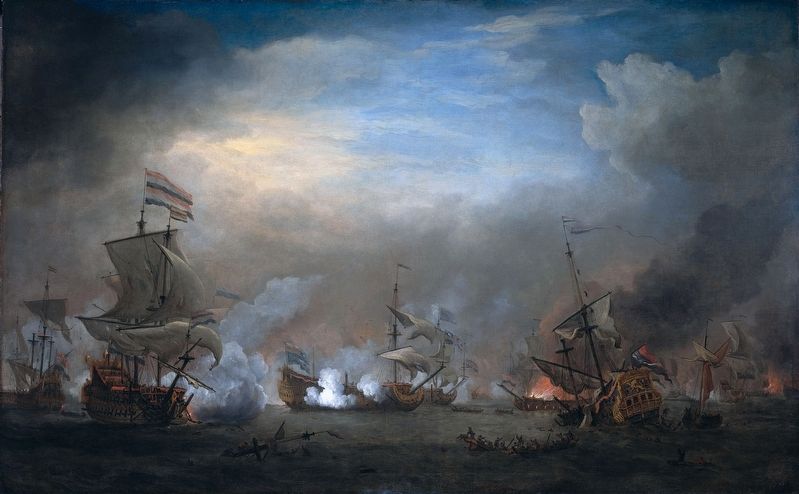
The size of the Allied fleet and length of its battle line, combined with inadequacies in fighting instructions and signalling, made it hard to control. It deepened suspicions between the English and French, further undercutting popular support for the war, while ending any hopes of starving the Dutch through a naval blockade, making it an overwhelming strategic victory for the Dutch. This campaign was the highlight of De Ruyter's career, as acknowledged by the Duke ofYork, who concluded "he was the greatest that ever to that time was in the world".William van de Velde the Younger (courtesy Rijksmuseum via Wikimedia Commons), 17073. Encounter during the Battle of Kijkduin
Credits. This page was last revised on June 3, 2026. It was originally submitted on June 2, 2026, by Andrew Ruppenstein of Lamorinda, California. This page has been viewed 21 times since then. Photos: 1, 2, 3. submitted on June 2, 2026, by Andrew Ruppenstein of Lamorinda, California.
